When the Visitor Is an Agent, Not a Crawler
Agent traffic is real, it is visible in exactly one place, and almost everything published about optimizing for it is unfalsifiable. This draws the line.

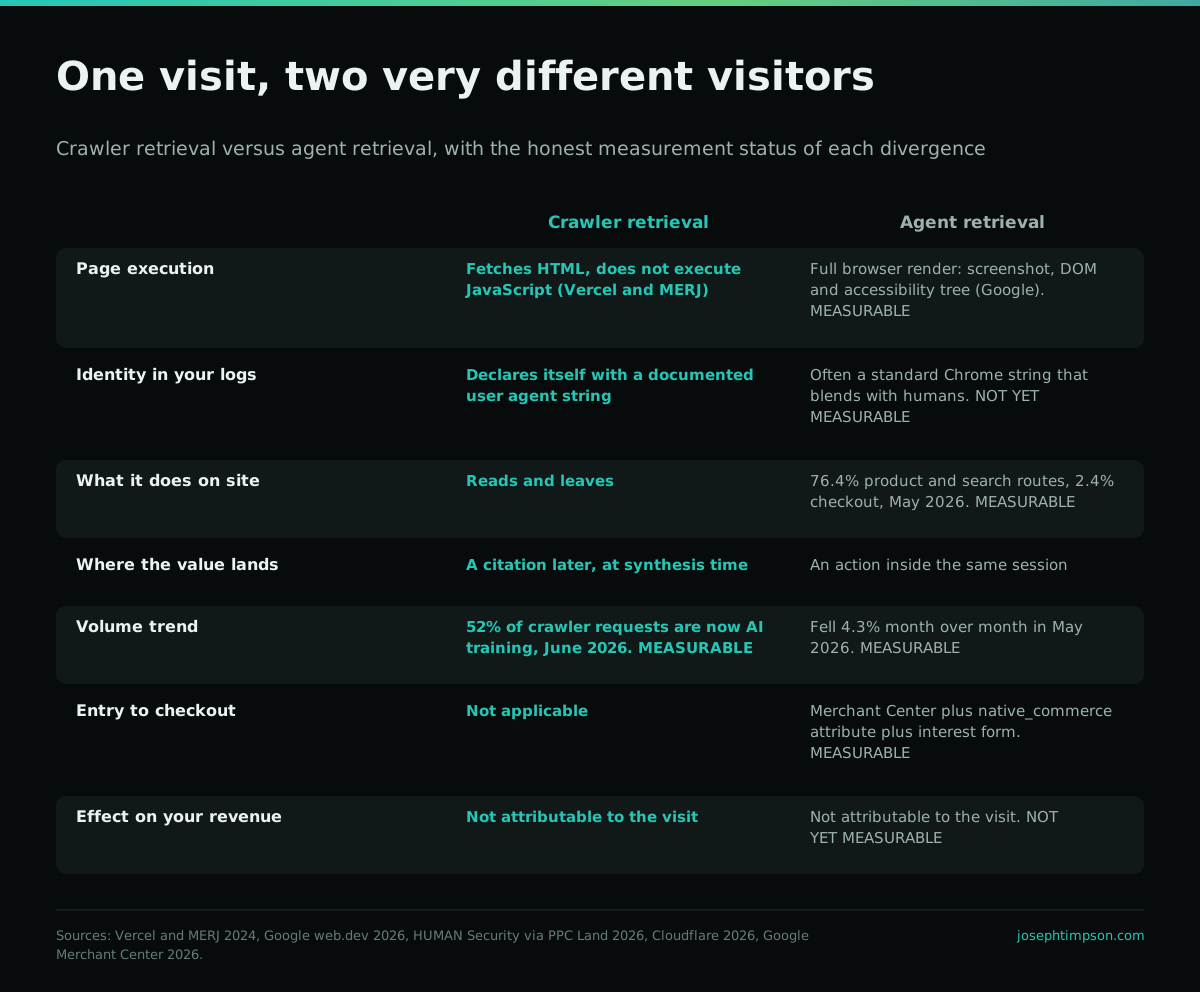
- In May 2026, 76.4% of AI agent activity on tracked sites landed on product and search routes. Checkout and payment routes took 2.4%. Agents are researchers, not buyers, at current volumes.
- Agents run a real browser. The famous finding that AI crawlers never execute JavaScript describes crawlers, and applying it to agents is the most common technical error in this category.
- Agent visits are only detectable server side. ChatGPT Atlas sent a standard Chrome user agent string, so client side analytics counted those sessions as people.
- The agentic checkout surfaces are contracts, not optimizations. Google's Buy button needs Merchant Center, an interest form, and a specific product attribute before anything you write matters.
- Nobody can attribute revenue to agent visibility. No engine publishes agent level selection data, and no published experiment has tested whether agent friendly markup changes what an agent picks.
The number that should have ended the speculation
An AI agent on your site today is a researcher, not a buyer. HUMAN Security's May 2026 benchmark put 76.4% of agent activity on product and search routes and only 2.4% on checkout and payment. Build for the research surface, treat agentic checkout as a distribution contract you either sign or skip, and refuse to pay for anything in between.
Every agentic SEO deck I have been sent this year opens with the same picture: your customer stops browsing, an agent shops for them, and your funnel dies. The measured behaviour looks nothing like that. HUMAN Security's monthly agentic traffic benchmark, reported in detail by PPC Land, broke May 2026 agent activity down by route: 76.4% product and search, 6.4% user account, 5.6% authentication, 4.7% content engagement, and 2.4% checkout or payment.
That is a research tool. It is not a buying tool yet.
Two more facts from the same benchmark break the growth story that gets sold with it. Total agent traffic fell 4.3% month over month in May 2026, and the share of agent requests being blocked rose from 8.2% in April to nearly 9%. Agent traffic is not a smooth exponential. It is a product metric, and it moves when vendors ship and when operators block.
The vendor point is the sharper one. Perplexity's Comet held about 47% of measured agent traffic in May 2026, ChatGPT Atlas 20.3%, and Anthropic's Claude Chrome extension 18.6%. The number two agent on that list no longer exists as a product: OpenAI folded Atlas back into ChatGPT roughly nine months after its October 2025 launch. Any strategy that names a specific agent product was obsolete before the retainer renewed. Strategy that names a behaviour, product research, survives the churn.
An agent is not a crawler, and the rendering rule flips
The single most repeated technical claim in AI search is that AI crawlers do not execute JavaScript. It is true, and it is well sourced: Vercel and MERJ's log study found GPTBot fetching JavaScript files in 11.50% of requests and ClaudeBot in 23.84%, with neither executing them. That study is from December 2024 and it describes crawlers.
Agents invert it. Google's own agent friendly website guidance says browser agents perceive a page through three modalities at once: a screenshot passed to a vision model, the DOM, and the accessibility tree. A browser agent is a browser. Rendering is not the failure mode.
Agents don't look at your website on a monitor. They operate on a machine-readable representation of your site.
So the lever moves. For the crawler class, server side rendering and access are the levers, and I have argued that case at length in the crawler access audit. For the agent class, the failure mode is interaction. Google's guidance is unusually concrete about it: prefer real <button> and <a> elements over styled <div> and <span>, give non semantic elements an explicit role and tabindex, use the for attribute on labels, keep layout stable because screenshot based agents get confused by shifting pages, keep interactive targets larger than eight square pixels, and avoid transparent overlays that hide real controls.
Read that list again. It is an accessibility audit wearing a new hat.
That is not a criticism, it is the cheapest good news in this whole category. The work is already specified, already in most backlogs, and pays off for humans using screen readers whether or not a single agent ever arrives. Compare that to the rest of the agentic SEO menu, where the recommended work has no independent payoff and no evidence behind it.
The standards bodies agree the current approach is bad. The WebMCP proposal at the W3C Web Machine Learning Community Group, which would let a site register callable tools through document.modelContext, justifies itself by saying that when agents observe pages through screenshots and DOM snapshots and then simulate human input, "Simple operations often require multiple steps and can be slow or unreliable." That is the people building the future telling you the present is duct tape. It is a draft, first published in August 2025, and nothing on your site depends on it yet.
The verifiable column: five things you can check this week
Everything below can be confirmed by an operator, on their own property, without buying a tool.
- Agent hits in raw server logs, not in your analytics platform
- Whether your pages are indexed and snippet eligible, which is the documented prerequisite for Google generative surfaces
- Whether your key conversion paths survive an interaction audit against Google's agent guidance
- Your edge blocking rate, and whether you are rejecting agents you would rather serve
- Whether you are technically eligible for any agentic checkout surface at all
The first one is the one nobody does. Seer Interactive's analytics team is blunt about why: "Invisible crawlers are only detectable server-side; client-side analytics will never surface them," as Jessica Propst and John Lovett write in their agent detection guide. If your agent number came out of a JavaScript tag, it is not a number. Start with server log analysis or start with nothing.
And even the log number is a floor, not a total. The same Seer guidance notes that ChatGPT Atlas sent standard Chrome user agent strings that blend into human traffic, and that agents which reach you through a search step arrive looking like ordinary Bing organic sessions. You can count the agents that announce themselves. You cannot count the ones that do not.
The eligibility check is the least glamorous and the most likely to be broken. Google's documentation states plainly that to appear in generative AI features, a page must be indexed and eligible to be shown with a snippet. A stray nosnippet zeroes you out of the answer layer before any agent question arises.
The unverifiable column, which is where most of the advice lives
Here is what nobody can measure, including me.
There is no first party share of voice inside any agent. No engine publishes which candidates an agent considered and rejected, so every agent visibility number on the market is a sample of prompts, with all the noise that implies. I have written about why sample size decides whether those numbers mean anything, and about the distance between a citation and a recommendation.
There is no agent attribution. An agent session that ends in a purchase three days later through a branded search looks exactly like a branded search, which is the same structural blind spot that already breaks AI search attribution.
Identity is not solved either, and Cloudflare says so in its own words. Its agent registry proposal, published in October 2025 by Thibault Meunier and Maxime Guerreiro, describes IP addresses and user agent strings as "brittle identification" and concedes that even "Cryptographic keys are a pseudonymous form of identity." The fix, Web Bot Auth and signed agents, is real and standardising through the IETF, but it is opt in on both sides. Until adoption is universal, agent counts are estimates.
Most importantly: no published experiment tests whether agent friendly markup changes what an agent selects. Not one. Compare that with schema, which did get tested and lost. Ahrefs tracked 1,885 pages adding JSON-LD against 4,000 controls and found AI Overview citations falling 4.6% and the other platforms statistically indistinguishable from zero, which is the evidence I walk through in detail on whether schema helps AI citations. Google's own guidance says the same: structured data is not required for generative AI search.
So when a vendor tells you agents "care about schema markup," ask which study. There isn't one. The two agentic tactics that have been tested at all, schema and llms.txt, both failed. The rest have not even been measured.
That is my position, stated plainly: most published agentic SEO advice sits entirely in the unverifiable column, and the small share that sits in the verifiable column is accessibility work you should have done anyway.
If someone has quoted you for agentic optimization, bring the scope document. Thirty minutes is enough to sort it into the two columns above and tell you which half is real.
Book a working session→Agentic checkout is a contract, not an optimization
The transaction surface is where the futurism gets most excited and where an operator has the least room to manoeuvre, because entry is gated by paperwork rather than by content.
There are three live standards. Stripe and OpenAI's Agentic Commerce Protocol, published September 2025, defines programmatic commerce flows between buyers, agents and businesses, and is careful to reassure merchants that "you maintain your customer relationships as the merchant of record." Google's Agent Payments Protocol handles the authorization problem through signed mandates, framing the merchant side risk as a direct question: "How can a merchant be sure an agent's request accurately reflects the user's true intent, without errors or AI 'hallucinations'?" And Google's Universal Commerce Protocol, announced in January 2026 by Amit Handa, Director of Engineering, Google Commerce, and Ashish Gupta, VP and GM of Merchant Shopping, collapses the integration burden into a single manifest published at /.well-known/ucp so agents can discover a merchant's capabilities without hard coded integrations.
That manifest path is genuinely useful to you as a diagnostic. It is a URL. You can check whether a competitor has one in about four seconds.
What you cannot do is optimize your way in. Google's Merchant Center documentation on UCP checkout states the gate directly: merchants must meet published requirements, submit an interest form, and complete a technical implementation, and "Only product listings using the native_commerce(checkout_eligibility) product attribute will display the 'Buy' button." Eligibility is limited to the United States, Canada and Australia.
Three protocols, three sponsors, one shared property: entry is an application, an attribute and a payments integration. Price it as a development project with a distribution upside. Do not let anyone bill it as an SEO deliverable, and be suspicious of any proposal for agentic commerce optimization that arrives before the integration exists.
Search itself is moving the same direction. Google has begun rolling out connected apps inside AI Mode, and the framing from the product team is explicit about the shift from answering to doing.
You can already connect some of your favorite services to the Gemini app, and now, to help you get even more done, we're enabling you to directly connect your apps in Search.
What actually earns agent selection is the boring thing
Strip out the speculation and the mechanism is unremarkable. Agents that search still search. Comet, the largest single agent by measured volume, sits on Perplexity's retrieval stack, and Semrush found Perplexity carrying the highest overlap with Google's top 10 of any AI surface tested, which is the whole argument in how Perplexity actually retrieves. An agent asked to compare three products issues subqueries, and subquery level retrieval is exactly what query fan out describes.
Which means the levers are the ones already on the table: be indexed and snippet eligible, be retrievable at the subquery level rather than the head keyword, be an unambiguous entity, and be present on the third party properties where the comparison actually happens. None of that is new, and none of it is agent specific. That is the finding, not a hedge.
Visibility earns inclusion. Legibility determines what the market makes of you.
The scale caveat has to stay attached. Cloudflare's June 2026 bot report states that "more than 50% of traffic on the Internet is now non-human," and that some heavily crawled categories have seen human traffic fall as much as 40% in under a year. The same report also says Google still accounts for approximately 88% of referral traffic. Both things are true. The audience composition is changing fast and the revenue composition is not, yet.
The web is not disappearing. Humans are simply becoming the minority of those who read it.
As automation accelerates and begins to outpace human activity, we're witnessing a fundamental shift in how the internet operates.
The ninety day version
Instrument the logs
Pull raw server logs for ninety days and count agent hits by route. Report it as a floor, never as a total, because Atlas class agents blend into Chrome traffic.
Audit one conversion path
Take your single highest value form or booking flow and run it against Google's agent guidance. Real buttons, labelled inputs, no ghost overlays, stable layout.
Check the blocking rate
Find out what your edge is currently rejecting. Blocking agents is a defensible choice. Blocking them by accident is not.
Decide the checkout question once
Either you are pursuing an agentic checkout integration this year or you are not. If not, stop paying for anything positioned as preparation for it.
Set the honest KPI
Agent hits by route is a real number. Agent share of voice is not. Say which is which when you report it.
If you are presenting this to a client, the framing matters more than the data, and I have written the version that survives a finance review in GEO client reporting. The measurement tooling question is separate and I have graded the market in AI visibility tracking tools.
The rest of this argument, including the measurement stack and the access layer it depends on, is laid out across the insights archive and formalised in the Cited Method.
Frequently asked questions
Is AI agent traffic actually reaching normal websites yet?
Yes, and it is measurable. HUMAN Security's benchmark recorded agent traffic across ecommerce, media and travel sites through 2026, with year over year growth of 7,851%. Volumes remain small against human traffic, and total agent traffic fell 4.3% month over month in May 2026.
Can I see AI agents in Google Analytics?
No. Agent visits are only reliably detectable server side, because client side JavaScript tags never fire for most automated sessions. Seer Interactive's analytics team states this directly. Pull raw server logs instead, and treat the resulting count as a floor rather than a total.
Do AI agents execute JavaScript?
Browser agents do. They run inside a real browser and combine a screenshot, the DOM and the accessibility tree. That is the opposite of AI training and search crawlers, which Vercel and MERJ found fetch JavaScript files without executing them. Do not apply crawler rules to agents.
Does schema markup help me get selected by AI agents?
There is no evidence it does. Ahrefs tested 1,885 pages adding JSON-LD against 4,000 controls and found no citation uplift on any platform. Google's own documentation says structured data is not required for generative AI search. Nobody has tested schema against agent selection specifically.
What is the fastest agent related fix on a normal website?
Semantic HTML on your conversion path. Real button and anchor elements, labels linked to inputs with the for attribute, stable layout, no transparent overlays hiding controls. Google publishes this list. It also improves screen reader accessibility, so it pays off regardless.
How do I get into ChatGPT or Google agentic checkout?
By integration, not optimization. Google's UCP Buy button requires Merchant Center, an interest form, a technical implementation and the native_commerce checkout eligibility product attribute, limited to the US, Canada and Australia. Stripe and OpenAI's protocol requires a payments integration. Content changes do not qualify you.
Should I block AI agents from my site?
It is a defensible choice, and roughly 9% of agent requests were already being blocked in May 2026. The mistake is blocking by accident. Find out what your edge currently rejects before deciding, and keep the access decision separate from the content decision.
Can I measure my brand's share of agent recommendations?
Not with first party data. No engine publishes which candidates an agent considered. Every share of voice figure sold today is a sampled prompt set, which means it carries sampling error that most vendors never state. Report it with the sample size attached or not at all.
Is agentic commerce big enough to plan around in 2026?
Not on current volumes. Checkout and payment routes accounted for 2.4% of agent activity in May 2026, and Cloudflare reports Google still delivers roughly 88% of referral traffic. Track the surface, build the integration only if your commerce stack makes it cheap.
What is WebMCP and do I need it?
It is a W3C draft letting sites register callable tools for agents through document.modelContext, so agents stop simulating clicks. It is a proposal, not a shipped requirement. Nothing on your site depends on it today, and no published data ties it to selection.
Sources
- PPC Land, reporting HUMAN Security data. AI agent traffic dips in May but blocking rates keep climbing (2026-06)
- HUMAN Security. HUMAN Security's 2026 State of AI Traffic and Cyberthreat Benchmark Report (2026-04)
- PPC Land. OpenAI kills Atlas browser, folds it into new ChatGPT Work agent (2026-07)
- Google (web.dev). Build agent friendly website experiences (2026-04)
- Vercel with MERJ. The rise of the AI crawler (2024-12)
- Seer Interactive. How will you know when OpenAI's Operator agent hits your website (2026-07)
- Google Search Central. AI features and your website (2025-12)
- Cloudflare. Beyond IP lists: a registry format for bots and agents (2025-10)
- Cloudflare. The age of agents: cryptographically recognizing agent traffic (2025-08)
- Cloudflare. Content Independence Day, one year on: building the business model for the agentic Internet (2026-07)
- Ahrefs. Does schema markup increase AI citations? (2026-05)
- Stripe. Developing an open standard for agentic commerce (2025-09)
- Google. Agent Payments Protocol (AP2) documentation (2025-09)
- Google Developers Blog. Under the hood: Universal Commerce Protocol (UCP) (2026-01)
- Google Merchant Center Help. About the Universal Commerce Protocol and UCP powered checkout on Google (2026)
- W3C Web Machine Learning Community Group. WebMCP explainer (2025-08)
- Google. Connected apps in AI Mode (2026-07)
- iPullRank (Michael King). Machine media (2026-05)
- Jono Alderson. SEO vs GEO is the wrong question (2026-07)
- Google Search Central. Optimizing your website for generative AI features on Google Search (2026-07)
Joseph Timpson has worked in search since 2010 and runs Timpson Marketing out of St. George, Utah. He built The Cited Method, a five stage framework for earning and proving real citations in AI answers, and publishes what does not work alongside what does.
Want me to run this on your site and show you the before and after?
One call, no pitch deck. We look at what is actually blocking you and tell you the truth about whether we can help.
Book a free consultation →