Proving AI search produced revenue, honestly
Five stages, four joints, three of them broken by default. Here is the chain with the breaks marked, and the exact claim each surviving subset entitles you to make.

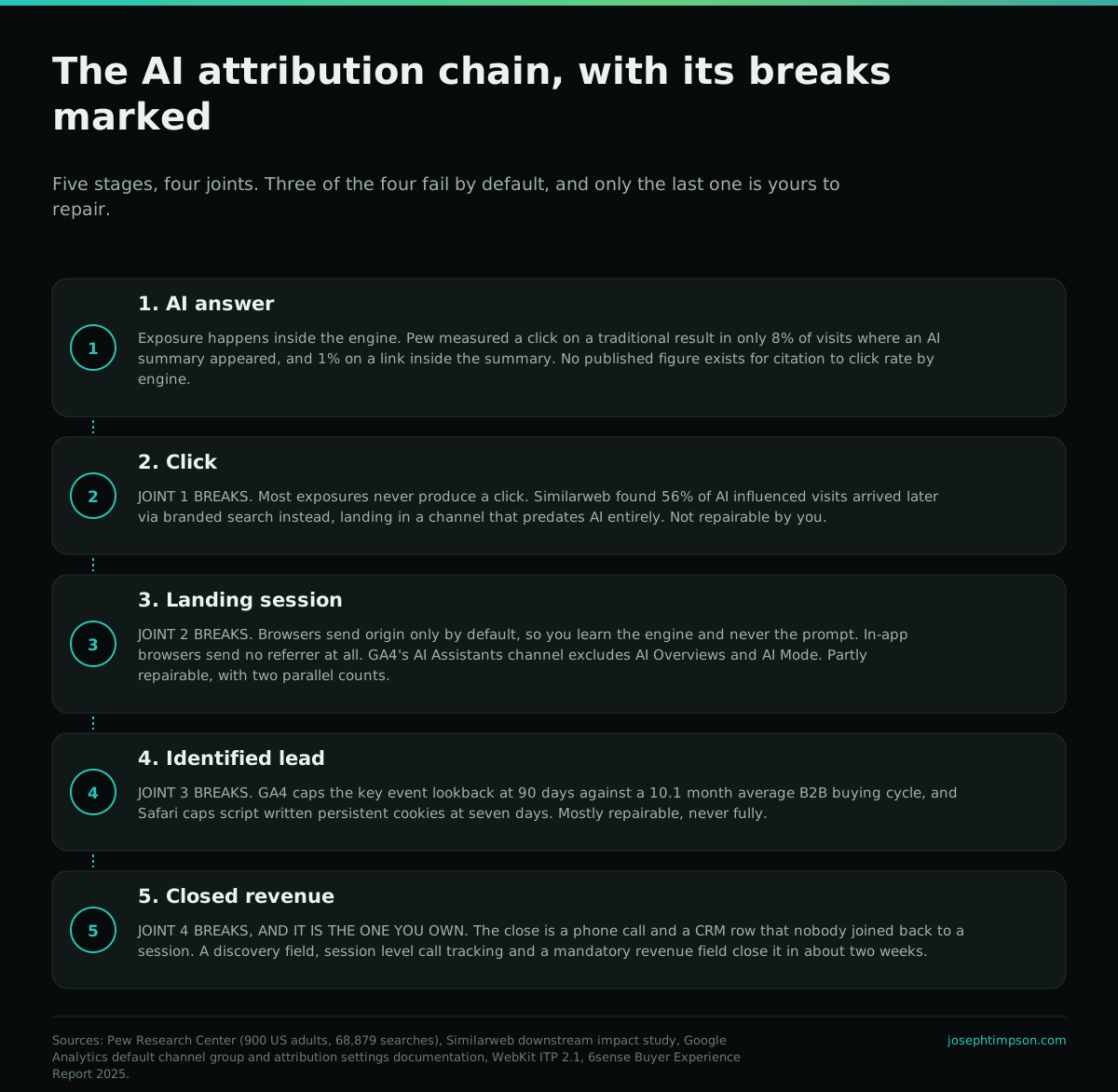
- AI search attribution is a five stage chain: AI answer, click, landing session, identified lead, closed revenue. Three of the four joints between those stages break by default, and no GA4 regex repairs any of them.
- GA4's AI Assistants channel excludes Google's own AI Overviews and AI Mode by definition, and Google does not publish the referrer list behind it. Perplexity and Claude are not named in the documented examples.
- The dominant path from an AI answer to your site is not a referral. Similarweb found 56% of AI influenced visits arrived through branded search, against 40% for standard visits, so the largest effect lands in a channel you already had.
- The window loses before it starts. GA4 caps the key event lookback at 90 days while the average B2B buying cycle runs 10.1 months, and Safari has capped a large class of first party cookies at seven days since 2019.
- The only joint you fully control is the last one. A self reported discovery field, session level call tracking and a closed revenue field in the CRM close it in about two weeks, and almost nobody does it.
- Downgrade the claim to match the surviving joints. Tier 2 must always carry the word floor. Tier 5 is a real, sellable answer, and the exact paragraph is in the post.
Google's AI channel excludes Google's AI
Open Google Analytics and read the definition of the channel you have been using to report AI performance. Google's default channel group documentation says it plainly: "AI Assistants is the channel by which users arrive at your site from sources like ChatGPT, Gemini, Deepseek, Copilot, or Grok. It excludes Google's AI Overviews and AI Mode."
The largest AI answer surface on earth is definitionally outside your AI channel. Perplexity and Claude are not named in that list either. The rule underneath is one line: medium exactly matches ai-assistant, set when the referrer matches a list Google does not publish.
AI search attribution is a five stage chain: AI answer, click, landing session, identified lead, closed revenue. Four joints connect those stages and three of the four break by default. You cannot fix that with a GA4 regex. What you can do is instrument the joints you control, then downgrade your claim to match the joints that survive. A defensible AI attribution claim is not a bigger number. It is a smaller sentence with the broken links named out loud.
I have shipped reports with an AI referral line in them. So has everyone reading this. What almost nobody prints next to that line is which links in the chain were actually measured and which were assumed. This post prints them.
The chain, and the four joints that carry it
Five stages. Four joints. Draw it this way and the argument stops being philosophical.
| Joint | Connects | Default state | Repairable by you |
|---|---|---|---|
| J1 | AI answer to click | Broken for most exposures | No |
| J2 | Click to landing session | Partial, engine dependent | Partly |
| J3 | Landing session to identified lead | Broken past 7 to 90 days | Mostly |
| J4 | Identified lead to closed revenue | Broken unless joined manually | Yes |
That fourth column is the useful one, and it inverts the usual advice. The joint everyone obsesses over, J2, the referrer and the channel grouping and the regex, is the joint you have the least control over. The joint almost nobody instruments, J4, is the one you can fix completely with a hidden form field and a CRM column.
Every section below is one joint. Then the ladder that tells you what to say when some of them hold.
J1: the click that mostly never happens
Start with the joint you cannot repair, because it sets the ceiling on everything downstream.
Pew Research Center tracked the actual browsing of 900 US adults across 68,879 Google searches in March 2025, 12,593 of which produced an AI summary. Users who saw an AI summary clicked a traditional result in 8% of visits, against 15% when no summary appeared. Clicks on a link inside the summary itself: 1%.
So the modal outcome of a successful AI citation is no click. There is no session to attribute. J1 is not broken by a technical defect, it is broken by design.
But no click is not no effect. Similarweb followed real user journeys across Finance, Travel and Beauty, keeping only users with no prior contact with the brand, and found that people who received an AI recommendation were 2.5 times more likely to visit that brand's site within seven days. Of those visits, 56% arrived through branded search, against 40% for standard visits.
Read that last number carefully, because it is the entire problem. The dominant path from an AI answer to your site is not a referral at all. It is a person remembering your name and typing it into Google days later. That session lands in Organic Search or Direct with a branded query attached, indistinguishable from a customer who saw your van.
When a user asks ChatGPT for a product recommendation, reads the answer, and then searches for that brand three days later, your analytics has no idea those two things are connected.
Now put a denominator under it. Semrush's channel mix study of more than 50,000 websites across 17 industries put AI systems at 0.14% of total website traffic in 2025, against 64.69% direct and 16.04% organic search. AI referral volume grew 66% that year. It is still a rounding error as a channel.
Here is the synthesis those two findings force, and it is the opposite of how most agencies use them. The 0.14% number is used to dismiss AI search. The 2.5x number is used to sell it. Both readings are wrong, because they are measuring different things. The correct reading is that AI's traffic effect is small and its demand effect is larger and unmeasured, which means the number in your AI channel is simultaneously too small to matter and too small to be the whole story. Any honest report has to say both sentences in the same paragraph.
J2: four ways the referrer dies before it reaches you
This is the joint the tooling market sells against, and it is genuinely leaky, but not for the reason most posts give.
One. The referrer is truncated by default, everywhere. Since Chrome 85 changed the default, and per the MDN reference, the browser default is strict-origin-when-cross-origin: "For cross-origin requests send the origin (only)." You learn the engine. You never learn the prompt, the answer, the position, or the citation context. Every AI referral you have ever received arrived stripped of the only information that would make it strategically useful.
Two. The referrer is absent entirely from apps. In-app browsers and native clients frequently send no Referer header at all, so the session is classified Direct, which Seer Interactive has argued for years is better read as dark traffic than as a real channel. Search Engine Journal's coverage of the GA4 channel launch states the limitation directly: AI assistant traffic arriving without a referrer header still lands in Direct. Given the mobile skew of AI usage, this is not an edge case.
Three. The tagging that does work is the engine's gift, not your instrument. ChatGPT started appending utm_source=chatgpt.com to citation links, then extended it to the More section in June 2025 after Glenn Gabe spotted it. Before that change, an entire class of ChatGPT clicks was reported as Direct.
Heads-up, this should jump the traffic levels in GA4 and other analytics tools for ChatGPT. That's because ChatGPT finally added utm parameters for 'More' sources versus just the citations.
Sit with what that means for your trend line. A step change in your ChatGPT referral numbers in June 2025 was a product decision at OpenAI, not a marketing result. The parameter can be removed as easily as it was added. You are trending an instrument that a third party controls and can recalibrate without telling you.
Four. The classification itself is incomplete and Google says so. The AI Assistants channel excludes AI Overviews and AI Mode by definition, and Google's own Search Central documentation confirms why: sites appearing in AI features are included in the overall search traffic in Search Console. AI Overview clicks are google organic. They always were.
Which is why the first party data does not rescue you either. Google is rolling out a generative AI performance report in Search Console to a subset of site owners, and it is a real step forward, but it reports impressions only. No clicks. No CTR. No queries. You can now see that you appeared. You still cannot see whether appearing did anything. Ahrefs made the same complaint about the missing AI Overview clickthrough data more than a year earlier, and the fix Google shipped since then did not touch it.
It seems that Google doesn't want us to see the clickthrough rate for AI Overviews.
The practical conclusion is the one Seer Interactive's analytics team states outright in their guide to tracking AI traffic, and it should be printed under every AI channel chart you ship.
We'd encourage you to treat any AI traffic number as a directional floor rather than a precise count.
Floor, not count. That single word change is most of what separates a defensible report from a fabricated one, and it costs nothing.
J3: your attribution window is shorter than the decision
This joint fails on arithmetic, not on plumbing, and the arithmetic is not close.
GA4's attribution settings give you a maximum 90 day lookback for key events and a 30 day default for acquisition events. Data retention on a standard property maxes at 14 months, and that limit governs explorations and funnel reports, which is exactly where you would go to reconstruct a path.
Now the buyer. 6sense surveyed nearly 4,000 B2B buyers and found the average buying cycle running 10.1 months, with 94% of buying groups ranking their shortlist before ever contacting a seller and 3.6 of roughly 5.1 shortlist spots filled on day one.
Put those side by side. The AI answer that put you on the shortlist happened on day one of a ten month process. Your longest available attribution window closes on day 90. The touch that decided the deal is outside the window by month four, structurally, on every analytics platform in the category. No vendor fixes this, because it is not a bug.
Then the cookie. Google's advertising and measurement cookie reference lists _ga with a two year lifespan. Apple's Intelligent Tracking Prevention has capped a large class of first party cookies at seven days since 2019.
With ITP 2.1, all persistent client-side cookies, i.e. persistent cookies created through document.cookie, are capped to a seven day expiry.
WebKit later extended the same seven day logic to Indexed DB, LocalStorage, SessionStorage, Service Worker registrations and cache. So on Safari, the two year number in Google's table is aspirational unless your identifier is written server side. Test it on your own property before you assume which case you are in, because the answer changes whether a return visit on day eight is the same user or a brand new one.
The honest statement, then, is this. For any purchase with a consideration window longer than a week, on any Safari heavy audience, the AI touch and the conversion are two unrelated users in your analytics. Not badly attributed. Not attributed at all.
J4: the joint you can actually fix, which nobody fixes
Everything above is other people's infrastructure. This one is yours.
The conversion in most local and professional service businesses is a phone call, and the close happens days later in a CRM or on a job sheet. Rio SEO's panel of more than 228,000 enterprise brand locations recorded Google Business Profile calls down 12.9% year over year in Q4 2025 while direction requests rose 6.4%, which tells you both that calls are the currency and that the currency is moving.
And AI is not closing those calls on its own. BrightLocal's panel of 1,227 US local searchers found only 18% felt ready to contact the business an AI tool recommended, with 43% of AI starters going on to check Google.
AI may rapidly be becoming part of the journey, but it's not yet in a place where consumers feel they can trust it.
So the last mile is human, offline, and delayed. No analytics product observes it. The only way to close J4 is to manufacture a join key and carry it by hand.
- Add a required "How did you first hear about us?" field to every form and every intake script, with ChatGPT, Google AI, Perplexity and Claude as named options rather than an open text box.
- Write the landing page URL, the full query string and the GA4 client ID into hidden form fields, and push all three into the CRM record on create.
- Give call tracking a session level number so an inbound call carries the same session identifier as a form fill.
- Add one CRM field for closed revenue and one for close date, and make them mandatory to move a deal to won.
- Reconcile monthly. Join CRM closed deals back to sessions on the client ID, and report the join rate as a headline number, because the join rate is the confidence interval.
- Report self reported discovery and instrumented attribution as two separate columns. They will disagree. The disagreement is the finding.
That last item is the one I argue for hardest and it is the one clients resist. Self reported attribution is biased, recall is poor, and buyers under credit the touch they cannot remember. It is also the only signal in the entire chain that survives a stripped referrer, an expired cookie and a ten month sales cycle. Biased data that spans the whole journey beats clean data that covers 90 days of it.
The downgrade ladder
Here is the part I have not seen written down anywhere. You do not need the whole chain to say something true. You need to know which sentence each surviving subset of the chain entitles you to.
| Joints that hold | The claim you may make | |
|---|---|---|
| Tier 1 | J1, J2, J3, J4 all instrumented | AI search produced a stated dollar figure in closed revenue. Realistic only for a same session self serve online purchase from an engine that tags its links. |
| Tier 2 | J2, J3, J4, with J1 unmeasurable | Sessions we can identify as AI referred produced a stated dollar figure. This is a floor, not a total, and the true figure is higher by an unknown factor. |
| Tier 3 | J3 and J4, referrer unreliable | Self reported AI discovery appears on a stated number of closed deals worth a stated amount. Attribution is buyer reported, not instrumented. |
| Tier 4 | J4 only, plus a timing correlation | AI visibility moved from A to B while branded search and direct sessions moved from C to D over the same window. We are describing co movement, not causation. |
| Tier 5 | Nothing joined | We cannot attribute revenue to AI search on this account, and here is exactly what is missing. |
Three rules govern the ladder.
Never claim a tier above your weakest joint. The chain does not average. One broken link caps the whole claim, and the most common failure in this industry is running Tier 4 evidence and writing a Tier 1 sentence.
Tier 2 must always carry the word floor. Without it, Tier 2 reads as a total, and a floor read as a total is a lie by omission even when every number in it is real.
Tier 4 is not a failure state. Co movement across a long enough window, with a stated null hypothesis, is how brand measurement has always worked. It only becomes dishonest when you drop the second sentence.
Whether we're talking about a brand's visibility on the side of a highway in 1926 or its presence in an AI tool's response in 2026, it's clear that influence is happening. What marketers must do now is change the way they run measurement and attribution.
The ladder is also a pricing instrument. If a prospect wants a Tier 1 claim and their business closes on the phone eleven days later, you now have a concrete conversation about what instrumentation would cost instead of a vague promise. That conversation belongs in your retainer scope before it belongs in a report.
PROVE is the last stage of the Cited Method, and this ladder is the whole of it. Nothing gets claimed above the tier the instrumentation supports, and the broken joints get named in the report rather than papered over.
See how PROVE works→A worked example, using the only proof I actually have
Rules are cheap. Here is the ladder applied to my own numbers, which is the least flattering way to demonstrate it and therefore the only honest one.
On one client engagement I can point to 2,718 organic visits in a month and 472 Google Business Profile calls in a month. On another, a PageSpeed Insights result of 100 across all four categories, an Ahrefs traffic value increase of $16.7K, and a lift from 113 to 659 in estimated monthly organic traffic.
Now the part that matters.
Every one of those is a classic search outcome. Organic sessions, profile calls, page speed scores, third party traffic value estimates. Not one of them establishes anything about AI citation, AI referral or AI influenced revenue. The engagements were not instrumented at J1 or J2 for AI surfaces, so under my own ladder the strongest AI claim those numbers support is nothing at all. Not Tier 4. Nothing.
They are also single engagements. They are not typical, they are not a promise, and anyone including me who shows you a client number without a denominator is showing you a selected result.
I am putting them in this post specifically to demonstrate the downgrade. A practitioner with real, verifiable, good results still lands at Tier 5 on the AI question if the AI joints were never wired. That is the discipline. If I will not stretch my own numbers, you have a reason to believe the rest of the method, and if I would stretch them, you should not believe any of it. The same standard runs through how I size a measurement claim and what goes in a client report.
The protocol
Run in this order. The order matters, because instrumenting J4 first makes every later joint worth measuring, and instrumenting J2 first produces a number you cannot use.
Confirm the engines can reach you
Attribution of zero traffic is a solved problem. If AI crawlers are blocked or challenged, none of the rest exists. Run the crawler access audit first and confirm it with log analysis, not with a robots.txt read.
Close J4 before anything else
Self reported discovery field, hidden URL and client ID fields, call tracking joined to session, closed revenue and close date mandatory in the CRM. This is a two week job and it is the only joint you own outright.
Instrument J2 twice
Keep GA4's native AI Assistants channel and add a custom channel group on your own referrer and UTM list, because the native list is undisclosed, excludes AI Overviews and AI Mode by definition, and does not name Perplexity or Claude. Report both. Where they diverge, the divergence is your error bar. Choosing between tracking tools matters less than running two independent counts.
Fix the J3 window you can fix
Set the key event lookback to 90 days, extend data retention to the maximum your property allows, and test whether your identifier survives eight days in Safari. Then accept that a ten month cycle still outruns it and stop pretending otherwise.
Measure visibility separately and honestly
Track appearance in AI answers as its own metric with its own sample size, and keep it in a separate column from revenue. The rules for that live in citations versus recommendations and how to read the sources cited.
Declare the tier in every report
State which joints held this period, name the tier, and write the claim the tier permits. Not the claim the client wants.
And when the chain does not hold at all, which it will not on most accounts for the first two quarters, this is the paragraph. Copy it.
That paragraph has never lost me a client. Claiming credit I could not trace nearly did, once, when the client's own CRM disagreed with my report and I had no answer.
The rest of this cluster covers the stages either side of PROVE: the myths to stop paying for, why brand mentions out predict the levers most vendors sell, what a full audit looks like when it is written out, and how the whole method fits together. More of it is filed under insights.
If you want the ladder applied to your account rather than a generic one, book a call and bring your CRM export, not your GA4 screenshot.
Frequently asked questions
Why does ChatGPT traffic show up as direct in GA4?
Because no referrer arrived. In-app browsers and native clients often send no Referer header, and copied links carry none either. GA4 falls back to Direct when there is no UTM, no click identifier, no referrer and no stored session. The traffic is real, the label is not.
Does GA4's AI Assistants channel capture all AI traffic?
No. Google's documentation says the channel covers sources like ChatGPT, Gemini, Deepseek, Copilot and Grok, and explicitly excludes AI Overviews and AI Mode. The underlying referrer list is not published. Run a custom channel group alongside it and treat the gap between the two counts as your error bar.
Can Search Console show me AI search clicks?
Not yet. The generative AI performance report, still rolling out to a subset of site owners, reports impressions only, broken down by page, country, device and date. There is no click data, no clickthrough rate and no query breakdown. AI Overview and AI Mode clicks remain folded into overall Web search totals.
What is the best way to track AI referral traffic?
Run two independent counts. Keep GA4's native AI Assistants channel and build a custom channel group from your own referrer and UTM list covering Perplexity, Claude and anything the native list misses. Report both numbers and describe the higher one as a floor, never as a total.
How do I prove AI search generated revenue?
Only by joining a closed deal back to a session. That needs a self reported discovery field on every form, hidden fields carrying the landing URL and client ID into the CRM, call tracking joined at the session level, and mandatory closed revenue and close date fields on won deals.
Is self reported attribution reliable?
It is biased and buyers under credit touches they cannot remember. It is also the only signal that survives a stripped referrer, an expired cookie and a ten month sales cycle. Biased data covering the whole journey beats clean data covering ninety days of it. Report both columns separately.
Why does my attribution window not cover the buying cycle?
Arithmetic. GA4 allows a maximum ninety day lookback for key events, while 6sense measured the average B2B buying cycle at 10.1 months with most shortlist spots filled on day one. The touch that decided the deal falls outside the window by month four on every platform.
Does Safari break AI attribution?
It breaks the session to lead joint. WebKit has capped persistent cookies created through document.cookie at seven days since ITP 2.1 in 2019, and later applied the same logic to LocalStorage and IndexedDB. Test whether your own identifier survives eight days before assuming a two year lifespan.
What should I tell a client when nothing is instrumented?
State the tier. Report the visibility change and the downstream signal as two separate numbers, say plainly that the link between them is not instrumented on this account, list what closing the gap requires, and refuse to draw the line until it is. Clients respect that more than a fabricated arrow.
Sources
- Google Analytics Help. [GA4] Default channel group (2026-05)
- Google Analytics Help. [GA4] Select attribution settings (2026-07)
- Google Analytics Help. [GA4] Data retention (2026-07)
- Google Search Console Help. Generative AI performance report (Search) (2026-06)
- Google Search Central. AI Features and Your Website (2026-06)
- Search Engine Journal (Matt G. Southern). Google Analytics Adds AI Assistant As Default Channel Group (2026-05)
- Pew Research Center. Google users are less likely to click on links when an AI summary appears in the results (2025-07)
- Similarweb (Adelle Kehoe). The downstream impact of AI visibility (2026-06)
- Semrush (Margarita Loktionova). Traffic Channel Mix Study (2026-04)
- Seer Interactive (Jonathan Wehausen). Your AI Traffic Is Hiding: A Practical Guide to Tracking ChatGPT, Claude, and More (2026-07)
- Seer Interactive. What is Dark Traffic in Google Analytics? (2017-10)
- MDN Web Docs. Referrer-Policy HTTP header reference (2026-07)
- Chrome for Developers. A new default Referrer-Policy for Chrome: strict-origin-when-cross-origin (2020-07)
- WebKit (John Wilander). Intelligent Tracking Prevention 2.1 (2019-02)
- WebKit (John Wilander). Full Third-Party Cookie Blocking and More (2020-03)
- Google Safety Center. Advertising and measurement cookie reference (2026-07)
- 6sense. 2025 B2B Buyer Experience Report (2025-11)
- BrightLocal (Rosie Murphy). Consumer Search Behavior: Channels (2026-07)
- Rio SEO. Local consumer search behavior trends in Q4 (2026-02)
- PPC Land. ChatGPT adds UTM parameters to more links for better analytics tracking (2025-06)
- Ahrefs (Ryan Law). AI Overviews Reduce Clicks by 34.5% (2025-04)
Joseph Timpson has worked in search since 2010 and runs Timpson Marketing out of St. George, Utah. He built The Cited Method, a five stage framework for earning and proving real citations in AI answers, and publishes what does not work alongside what does.
Want me to run this on your site and show you the before and after?
One call, no pitch deck. We look at what is actually blocking you and tell you the truth about whether we can help.
Book a free consultation →