Cited in One Engine, Invisible in Another
Two engines, one query, opposite outcomes. The divergence is not noise. Read correctly it is the fastest instrument you have for finding what is actually broken.

- Perplexity runs a live search on essentially every query. ChatGPT's own developer documentation says the model can choose to search or not, which is why the same page gets cited in one and ignored in the other.
- Being named in an answer without a link is usually not a failure. Semrush and Kevin Indig found 61.7% of AI citations never mention the brand, and the reverse case, a mention with no citation, means the model already holds you in memory.
- The single most common cause of a one-engine gap is that the missing engine's crawler never reached the page. OAI-SearchBot, not GPTBot, is the ChatGPT gate.
- A gap that appears on one date across you and your competitors at once is an engine-side change, not something you did. Ahrefs' own AI Overview top-10 figure fell from roughly 76% to 38% in eight months.
- None of this is readable from one prompt run. SparkToro measured under a 1 in 100 chance that two runs of the same prompt return the same brand list.
The divergence is the data, not the noise
Perplexity cites your page. ChatGPT, asked the same question ninety seconds later, names three competitors and never mentions you. Nothing on your site changed between those two answers. Something inside the two machines did, and that difference is the sharpest diagnostic instrument in this whole discipline.
Most of the field treats cross engine divergence as randomness, then writes a separate checklist per engine. That is backwards. A single engine audit tells you what one system happened to do. The pattern of which engines see you and which do not eliminates entire classes of cause at once, which is exactly how a differential diagnosis works.
When one engine cites you and another does not, the gap itself narrows the cause. Perplexity retrieves on nearly every query. ChatGPT retrieves only when the model decides retrieval would help. Google fans one question into many. So being cited by a retrieval heavy engine while invisible in a retrieval optional one almost always means you were never fetched, not that your content was judged weak.
One caution before any of this becomes useful. SparkToro and Gumshoe.ai ran 2,961 prompt runs across ChatGPT, Claude and Google AI and found less than a 1 in 100 chance that any two runs of the same prompt return the same brand list. A screenshot of divergence is not evidence of divergence. The pattern only means something after repeated sampling against a fixed prompt set, which is why sample size is the first thing to fix before you diagnose anything.
AIs do not give consistent lists of brand or product recommendations. If you don't like an answer, or your brand doesn't show up where you want it to, just ask a few more times.
Two machines wearing one label
The phrase "AI search" hides a hard architectural split, and almost nobody selling GEO explains it. Some engines answer from documents they fetched at query time. Some answer from what the weights already encode. Most sit somewhere between, and where a given engine sits on that spectrum determines every failure mode you will ever see from it.
Perplexity sits at the retrieval end. Its crawler documentation describes PerplexityBot as the bot that surfaces and links websites in Perplexity search results, explicitly not a training crawler, and its developer platform sells the product as web grounded answers with built in citations. Retrieval is the product, not an optional tool call.
ChatGPT sits at the other end, and OpenAI says so plainly. The web search guide states that the model can choose to search the web or not based on the content of the input prompt. When it chooses not to, your page had no opportunity to be cited at any price. That is the mechanism behind the most common complaint in this category, and it is not a content quality problem.
Google is a third case. Its own optimization documentation says generative features are rooted in core Search ranking and quality systems and names only two mechanisms, grounding and query fan out. Elizabeth Reid, who runs Search, described fan out as breaking a question into subtopics and issuing a multitude of queries simultaneously. Retrieval happens, but against subqueries you never see, which is a separate topic worth understanding on its own.
Then there is the second gate, which even fewer people talk about. Retrieved is not cited. OpenAI's own API documentation distinguishes citations from sources and notes that the number of sources the model consulted is often greater than the number of citations it shows. Ahrefs put a number on that filter across 1.4 million ChatGPT prompts: cited URLs matched the prompt at cosine 0.602 while retrieved but uncited URLs matched at only 0.484, and both were beaten by the match to ChatGPT's internally generated fan out queries at 0.656.
So there are two distinct ways to lose, and they need opposite fixes. Never fetched is an access problem. Fetched and dropped is a semantic match problem at the subquery level. Every diagnosis below is really an attempt to tell those two apart.
By the time a user sees an answer, the model has already decided which sources matter.
The differential diagnosis table
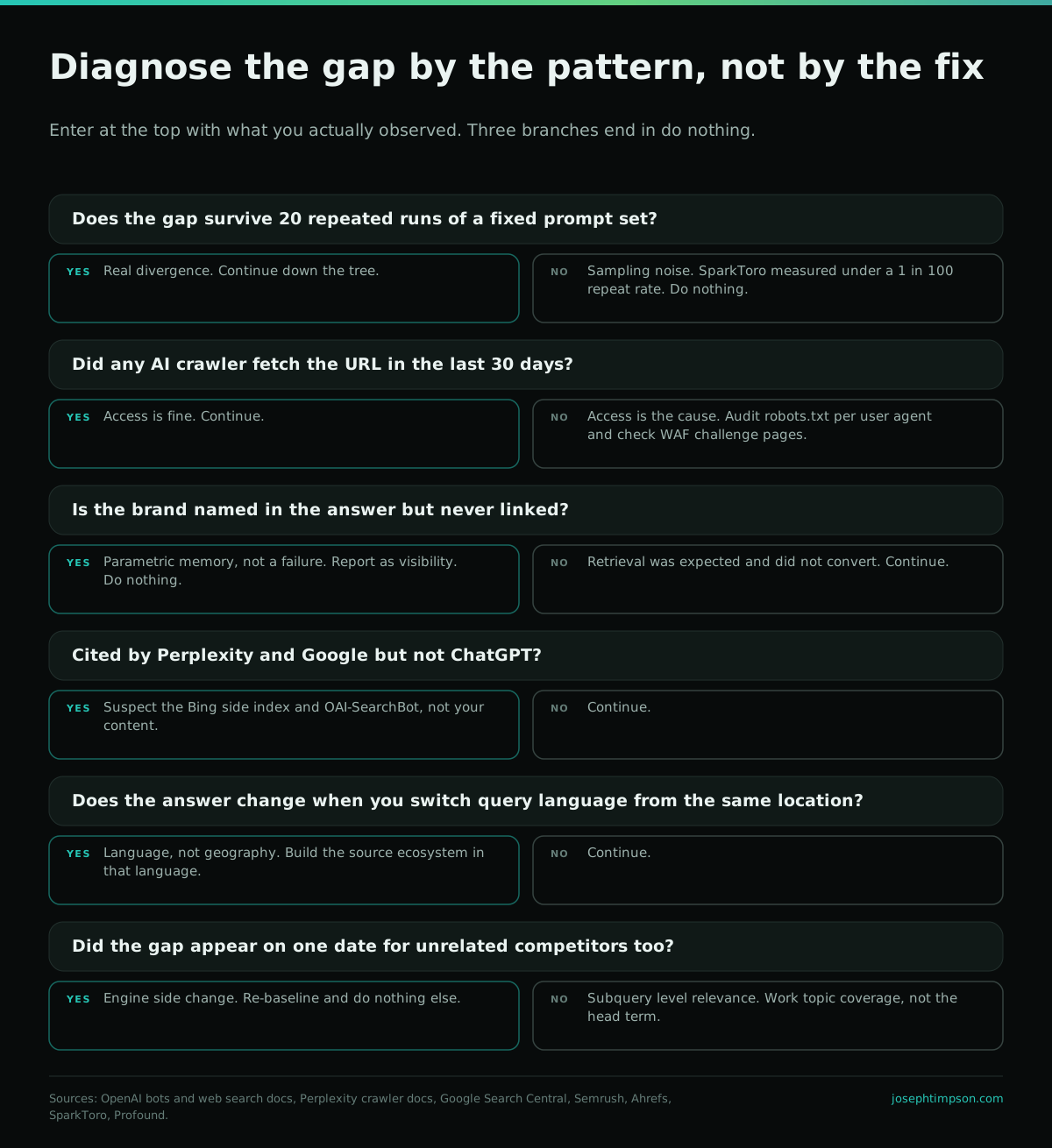
Enter this table by the pattern you observed, not by the fix you were hoping to sell. Each row gives the most probable cause and the single check that confirms or eliminates it. Two of the seven terminate in do nothing, and those matter as much as the actionable ones.
| Observed divergence | Most probable cause | The one check that settles it |
|---|---|---|
| Cited by Perplexity, absent from ChatGPT | ChatGPT never retrieved. Search is mandatory in one, optional in the other | Server logs for OAI-SearchBot hits on that URL in the last 30 days |
| Cited by ChatGPT, absent from AI Overviews | Strength on the Bing side, weakness on the Google side | Bing Webmaster Tools AI Performance versus Search Console generative reports |
| Brand named in the answer, never linked | Parametric memory. The model knows you without fetching you | Re-run the prompt asking explicitly for sources. If a URL appears, retrieval was available and unused |
| Visible in AI Overviews, thin in AI Mode | Different retrieval substrate. AI Mode cites wider and shallower | Whether you rank for the subtopics, not the head term |
| Visible in one country only | Query language, not user location | Same prompt, same location, other language |
| Present last month, gone this month, competitors too | Engine side change | Whether the drop lands on one date across multiple unrelated brands |
| No engine cites you anywhere | Crawler access or index eligibility | Anonymous fetch of the clean URL, then robots.txt and snippet directives |
The ordering is deliberate. Access failures are cheap to check and expensive to leave in place, so they go last in the table only because they are the residual case. In practice, run that check first.
Pattern one: Perplexity yes, ChatGPT no
This is the most reported divergence and the most misdiagnosed. Practitioners see it and conclude ChatGPT dislikes their content. The likelier story is duller.
Start with the base rates. Semrush tested 5,000 keywords and over 150,000 citations and found Perplexity had the highest overlap with Google's top 10 of any AI surface measured, above 91% at the domain level, while ChatGPT had the weakest overlap of the set. If classic rankings are what you have, Perplexity is the engine that will convert them first. Its silence would be the surprising result, not ChatGPT's.
Second, the gate is a specific user agent. OpenAI documents four bots, and its guidance is unambiguous that sites opted out of OAI-SearchBot will not be shown in ChatGPT search answers while GPTBot governs training. The same doc notes an opted out site can still appear as a navigational link, so the loss is the cited answer, not the brand name. Plenty of sites blocked "AI bots" in 2025, kept GPTBot in the deny list for good reasons, and took OAI-SearchBot down with it by accident. That is a self inflicted citation blackout in one engine, and it is the first thing an access audit should surface.
Third, the index behind the engine. Glenn Gabe documented a site cited in over 90,000 ChatGPT prompts while carrying almost no Google visibility, and traced it to its rankings in Bing rather than Google. Run that logic backwards and the inverse case has an obvious test: if Perplexity and Google both cite you and ChatGPT does not, look at your Bing index status before you touch a word of content.
So like I've said many times, if you drop in Google, you can drop in AI Overviews, AI Mode, and downstream at AI search platforms like ChatGPT.
Gabe's line is the correlation. The divergence cases are the exceptions that prove where the correlation breaks, and the exceptions are where the diagnosis lives.
Pattern two: named everywhere, linked nowhere
This one gets escalated as a crisis and it is usually the opposite. Semrush, working with Kevin Indig, logged 3,981 domain appearances across 115 prompts in 14 countries and found 61.7% of citations never mentioned the brand in the answer text. The mirror image of that finding, a brand named with no link attached, means the model reached for you without needing to fetch you.
That is parametric memory doing its job. It is the closest thing to a durable moat in this channel, because a link can be re-ranked away next week and a name encoded in weights cannot. The correct action in most cases is nothing, and any tool that reports it as a red cell in a dashboard is measuring the wrong object. This is the distinction between citations and recommendations, and it changes what you should report to a client.
The AI knows the information about the brand came from somewhere, but doesn't feel the need to explicitly say so to users. The brand name carries on its own.
There is a real reason this pattern favours some brands over others. Across 75,000 brands, Ahrefs found branded web mentions correlated with AI Overview visibility at Spearman 0.664 while backlinks managed only 0.218, and the authors say plainly that correlation is not causation. The mechanism is intuitive anyway: a name repeated across the open web is a name a model can hold without retrieval. That is why earning mentions outperforms earning links for this specific outcome.
Pattern three: one country, or actually one language
Geographic divergence is real and almost always mislabelled. Profound analysed 3.25 billion citations across seven engines and 14 countries in March 2026 and found that query language rewires the citation graph, not just the local domains that appear. Spanish prompts surfaced social material at roughly 1.4 times the English rate inside Google AI Overviews and roughly half the English rate inside ChatGPT, regardless of where the query originated. Author Davis McCain notes that Portuguese pushed YouTube to 65% of AI Overview social citations against 38% in English.
Regardless of where the query originated is the load bearing clause. If your visibility differs between two markets, test language before you test geography, because you can change the language of your source ecosystem far more cheaply than you can change a country.
Granularity is the second trap. Yext analysed 6.8 million citations from roughly 1.6 million AI responses across Gemini, OpenAI and Perplexity and found the source mix splits hard by engine: Gemini drew 52.15% of its citations from first party websites while OpenAI leaned on third party listings at 48.73%. One blended citation rate for a multi location brand averages two different problems into one number. Yext also lists a quantitative geographic breakdown as future work, so if a vendor shows you a measured rural versus urban split, ask which dataset produced it.
If you have a divergence you cannot explain, the fastest path is someone reading your logs alongside your prompt set rather than another engine specific checklist.
Book a diagnosis call→Pattern four: it was there before the update
When visibility moves on a single date, check whether it moved for everyone. Engine side changes are common, large, and entirely outside your control, and mistaking one for a self inflicted wound is how retainers get spent on nothing.
The evidence for how violently these surfaces move is published by the vendors themselves. Ahrefs measured 863,000 SERPs and 4 million AI Overview URLs and reported that only 38% of AI Overview citations now rank in the top 10, down from roughly 76% in its own July 2025 measurement. That is the same company halving its own headline number in eight months. seoClarity separately found each AI Overview citing about three URLs from the top 20, down from five earlier in 2025, so the slot count itself is shrinking.
Interface changes count too. Similarweb measured ChatGPT referrals rising 157.7% week on week after an interface change on 7 May 2026, with homepage referrals up 354.7%. Nobody's content improved that week. If your reporting cannot separate that class of movement from your own work, your attribution model will take credit and blame for things it did not cause.
The confirming check is simple and nobody runs it: pick five competitors you do not compete with on content velocity, and see whether their curve bent on the same date. If it did, the correct response is to re-baseline and do nothing else.
Pattern five: nobody cites you, anywhere
When every engine is silent, stop diagnosing and start checking access. This is the highest certainty mechanical lever in the whole category and the one most sellers skip, because it is unglamorous and it is finished in an afternoon.
Google's requirement is a single sentence: to appear in generative AI features a page must be indexed and eligible to be shown with a snippet. A stray nosnippet or max-snippet directive zeroes out AI feature eligibility without touching your rankings, which makes it invisible to every rank tracker you own. Rendering is the other silent killer. Vercel and MERJ's log study found GPTBot fetched JavaScript files in 11.50% of requests and ClaudeBot in 23.84% while neither executed them, so client side rendered content is simply absent. That study is from December 2024 and no comparable replication has been published since, so treat it as directionally true and dated rather than settled.
What will not be the cause: llms.txt and schema. Ahrefs found 97% of llms.txt files received zero requests in May 2026, and Google's documentation says outright that you do not need AI text files to appear in Search. On schema, Ahrefs tracked 1,885 pages that added JSON-LD against 4,000 controls and measured minus 4.6% on AI Overviews. Both are worth understanding in full before you buy either, which is what the llms.txt evidence audit and the schema experiment breakdown exist for.
Adding schema produced no major uplift in citations on any platform.
- Anonymous fetch of the clean URL from outside your network, checking for challenge pages and JavaScript dependency
- robots.txt read line by line for OAI-SearchBot, PerplexityBot and Claude-SearchBot, separately from the training crawlers
- Server logs for 30 days, counting hits per AI user agent per URL rather than in aggregate
- Snippet directives, index status and Bing index status checked as three separate questions
That sequence is the ACCESS stage of the Cited Method, and it exists because every downstream measurement is meaningless if the page was never fetched. Log reading in particular deserves more attention than it gets, which is the subject of its own breakdown.
What the divergence cannot tell you
This framework has hard limits, and the honest version is more useful than the confident one.
No engine publishes its selection criteria. Everything above is inference from vendor documentation, log behaviour and third party measurement, and every one of those sources has an incentive or a blind spot. There is no first party share of voice inside any engine, so all cross engine comparison is sampled, noisy and prompt set dependent. Two agencies tracking "the same" query are not tracking the same thing: SparkToro measured an average semantic similarity of 0.081 across 142 human written prompts asking for the same recommendation.
Access is necessary but not reliably sufficient, and it is not reliably enforced either. Perplexity's own documentation states that Perplexity-User generally ignores robots.txt rules because a user requested the fetch, and OpenAI says the same of ChatGPT-User. Columbia's Tow Center tested 1,600 queries across eight engines in February 2025 and found Perplexity Pro surfacing excerpts from articles it should not have had access to, alongside error rates above 60% across the field. Blocking a bot does not guarantee absence, and allowing one does not guarantee presence.
Finally, the academic record is thinner than the discourse suggests. The best peer adjacent work available is Kai-Cheng Yang's analysis of over 366,000 citations from 65,000 AI Search Arena responses, which found models from different providers cite distinct news sources while sharing concentration patterns. That is a real finding about divergence, and it is also almost the entire independent literature. Anyone claiming a settled ranking factor model for a specific engine is ahead of the evidence.
Use the pattern to narrow. Use the check to confirm. Then accept that a meaningful share of what you observe is an engine changing its mind, and build a reporting layer that can say so out loud.
Frequently asked questions
What is Perplexity SEO, and is it different from normal SEO?
It is the same retrieval stack with one difference that matters. Perplexity runs a live web search on essentially every query, so classic ranking converts to citations faster there than anywhere else. Semrush measured over 91% domain overlap between Perplexity citations and Google's top 10.
Why does Perplexity cite my site but ChatGPT never does?
Usually because ChatGPT never fetched the page. OpenAI's documentation says the model chooses whether to search based on the prompt, and that sites opted out of OAI-SearchBot will not appear in ChatGPT search answers. Check that user agent in your logs first.
Is blocking GPTBot the reason I am invisible in ChatGPT?
Not by itself. GPTBot governs training data. OAI-SearchBot is the crawler that surfaces sites in ChatGPT search answers. Many sites blocked both in one robots.txt edit and only intended to block the first, which produces a single engine blackout that no rank tracker will ever show you.
AI answers mention my brand but never link to me. Is that a problem?
Usually not. That pattern means the model holds your brand in its weights and did not need to retrieve you. It is more durable than a citation, because a link can be re-ranked away and an encoded name cannot. Report it as a win, not a gap.
How many prompt runs do I need before a divergence is real?
More than most people run. SparkToro and Gumshoe.ai found under a 1 in 100 chance that two runs of the same prompt return the same brand list across 2,961 runs. Fix a prompt set, sample it repeatedly, and only then compare engines.
Does llms.txt or schema fix a one-engine visibility gap?
No published evidence says so, and two controlled tests say the opposite. Ahrefs found 97% of llms.txt files got zero requests in May 2026, and its schema test on 1,885 pages against 4,000 controls measured minus 4.6% on AI Overviews. Google's own documentation states neither is required.
Why is my visibility different in another country?
Test language before geography. Profound analysed 3.25 billion citations across seven engines and 14 countries and found that query language reshapes which domains get cited, regardless of where the query originated. Location matters too, but language is the larger and the cheaper lever to pull.
My visibility dropped in every engine on the same day. What happened?
Almost certainly an engine side change rather than anything you did. Check whether unrelated competitors moved on the same date. Ahrefs' own AI Overview top-10 citation figure fell from roughly 76% to 38% inside eight months, so these surfaces move hard.
Sources
- Perplexity AI. Perplexity Crawlers (2026-07)
- Perplexity AI. Perplexity API Platform Overview (2026-07)
- OpenAI. Web search (API guide) (2026-07)
- OpenAI. OpenAI bots and crawlers (2026-07)
- Google Search Central. Optimizing your website for generative AI features on Google Search (2026-07-10)
- Google Search Central. AI features and your website (2025-12-10)
- Google. AI Mode in Search gets new capabilities (2025-05-20)
- Semrush. AI Mode vs AI Overviews vs ChatGPT vs Perplexity study (2025-07-21)
- Semrush with Growth Memo. The Ghost Citations Study (2026-06-09)
- Semrush. Expanded 2026 AI Visibility Index (2026-06-26)
- Ahrefs. Why ChatGPT cites the pages it cites (2026-04-15)
- Ahrefs. Only 38% of AI Overview citations rank in the top 10 (2026-03-02)
- Ahrefs. Branded web mentions correlate with AI Overview visibility (2025-05-26)
- Ahrefs. Does schema markup increase AI citations? (2026-05-11)
- Ahrefs. The llms.txt study (2026-06-15)
- SparkToro with Gumshoe.ai. AIs are highly inconsistent when recommending brands (2026-01-28)
- Profound. How query language reshapes AI citations (2026-04-21)
- Yext Research. AI citations, user locations and query context (2025-10-09)
- seoClarity. AI Overview and organic ranking overlap research (2025-10-12)
- G-Squared Interactive. Surging in ChatGPT, dead in Google (2026-06-22)
- Vercel with MERJ. The rise of the AI crawler (2024-12-17)
- Similarweb. ChatGPT referral traffic triples after interface change (2026-05-25)
- Kai-Cheng Yang, arXiv 2507.05301. News Source Citing Patterns in AI Search Systems (2025-07-07)
- Tow Center for Digital Journalism, Columbia Journalism Review. AI Search Has a Citation Problem (2025-03)
- Clearscope. Search engine wars are back with AI (2026-03-24)
Joseph Timpson has worked in search since 2010 and runs Timpson Marketing out of St. George, Utah. He built The Cited Method, a five stage framework for earning and proving real citations in AI answers, and publishes what does not work alongside what does.
Want me to run this on your site and show you the before and after?
One call, no pitch deck. We look at what is actually blocking you and tell you the truth about whether we can help.
Book a free consultation →