What Google's Docs Say vs What GEO Invoices Say
Google's public documentation has a section called "Mythbusting generative AI search: what you don't need to do." It names five things. I fetched five live GEO service pages and found all five being sold.

- Google's generative AI documentation contains a section headed "Mythbusting generative AI search: what you don't need to do" that names five specific tactics, including chunking, rewriting content for AI, and seeking inauthentic mentions.
- The single deliverable with the strongest primary source support, AI crawler access, did not appear on any of the five vendor deliverable lists I fetched.
- Google and Microsoft contradict each other in public on content structuring, and the GEO industry quotes only the Microsoft half.
- No engine publishes a share of voice figure. Google Search Console's generative AI report gives impressions only, so every AI share of voice number in a client deck is external sampling.
- The mechanism behind mention seeding is real (branded mentions correlate with AI visibility at roughly three times the strength of backlinks) but the delivery method Google names by description is paid placement.
Google published the myth list itself
Google's documentation for generative AI features on Search contains a section under this exact heading: "Mythbusting generative AI search: what you don't need to do." It names five things. The page stamp reads last updated 2026-07-10. I fetched it on 2026-07-28.
Here are the five, verbatim, in Google's order:
- LLMS.txt files and other "special" markup
- "Chunking" content
- Rewriting content just for AI systems
- Seeking inauthentic "mentions"
- Overfocusing on structured data
The same page carries this sentence: "While terms like Answer Engine Optimization (AEO) or Generative Engine Optimization (GEO) are common online, many suggested 'hacks' aren't effective or supported by how Google Search actually works."
That is not a leaked memo or a conference aside. It is product documentation on developers.google.com, the same domain that documents robots.txt and canonicals.
So I did the obvious thing that nobody in this argument has bothered to do. I fetched live GEO service and pricing pages, pulled their deliverable wording verbatim, and put each line next to the sentence in the engine's own documentation that speaks to it. All five of Google's named myths turned up across those pages. Two of them appear by name on a single vendor's ten item deliverable list.
Most generative engine optimization myths are not myths because a blogger says so. They are myths because Google, OpenAI, Perplexity and Anthropic have each published a sentence that addresses them, and the sentence says the opposite of the sales page. The three deliverables that survive a primary source check are crawler access, non-commodity content, and earned third party presence. Everything else on a typical GEO invoice is either unaddressed by any engine or contradicted by the engine's own words.
How I built this, and what I am not claiming
Every vendor quote below was read on a live page. Where a Wayback snapshot exists I have given the date, because sales copy is edited quietly and a claim with no archive is a claim that can disappear.
The pages, with their archive status as of 2026-07-28:
- GreenBanana SEO, GEO agency service page. Archived 2026-07-24.
- Percepture, GEO services page. Archived 2026-02-11.
- REDCmts, Reddit GEO service page. Archived 2026-05-09.
- Similarweb, LLM seeding guide by Shai Belinsky, Senior SEO Specialist, dated 2026-01-22. Archived 2026-01-26.
- DoodleWeb, GEO services scope and pricing, dated 2026-06-17. No Wayback snapshot exists. The most specific deliverable list and the most specific price band I found are the ones with no independent record.
Three things I am not claiming, and I would rather say them at the top than get quoted out of context.
First, I am not alleging that any named vendor has defrauded anyone. Quoting a service page is not an accusation. Several of these pages are more careful than the category average, and I will point that out where it is true.
Second, Google's documentation is not the whole truth. It speaks for Google. It does not speak for ChatGPT, Perplexity or Copilot, and on one row below the engines openly disagree with each other. A vendor can be at odds with Google's docs and still be right about ChatGPT.
Third, I normalized dash characters when quoting, because this site does not publish them. No words were changed, added or reordered inside any quotation.
The five rows
| Deliverable, as worded on a live service page | The primary source sentence that addresses it | Status |
|---|---|---|
| Not itemized on any of the five deliverable lists I fetched | "Sites that are opted out of OAI-SearchBot will not be shown in ChatGPT search answers, though can still appear as navigational links." (OpenAI) | Supported, and missing from the invoice |
| "Tables & Lists: LLMs love structure." (Similarweb, 2026-01-22) | "There's no requirement to break your content into tiny pieces for AI to better understand it." (Google) vs "Clear headings, tables, and FAQ sections help surface key information." (Microsoft) | Engines disagree in public |
| "AEO gets you recognized. GEO gets you written in." (GreenBanana) | "You don't need to write in a specific way just for generative AI search." (Google) | Contradicted as framed |
| "Reddit and LinkedIn answer seeding" (DoodleWeb, 2026-06-17) | "Seeking inauthentic 'mentions' across the web isn't as helpful as it might seem." (Google) | Contradicted in method, supported in mechanism |
| "Weekly multi-engine tracking" (DoodleWeb, 2026-06-17) | "Impressions are how many times links to your site were shown to a user in a generative AI feature on Google Search." (Search Console Help) | Unaddressed by any engine |
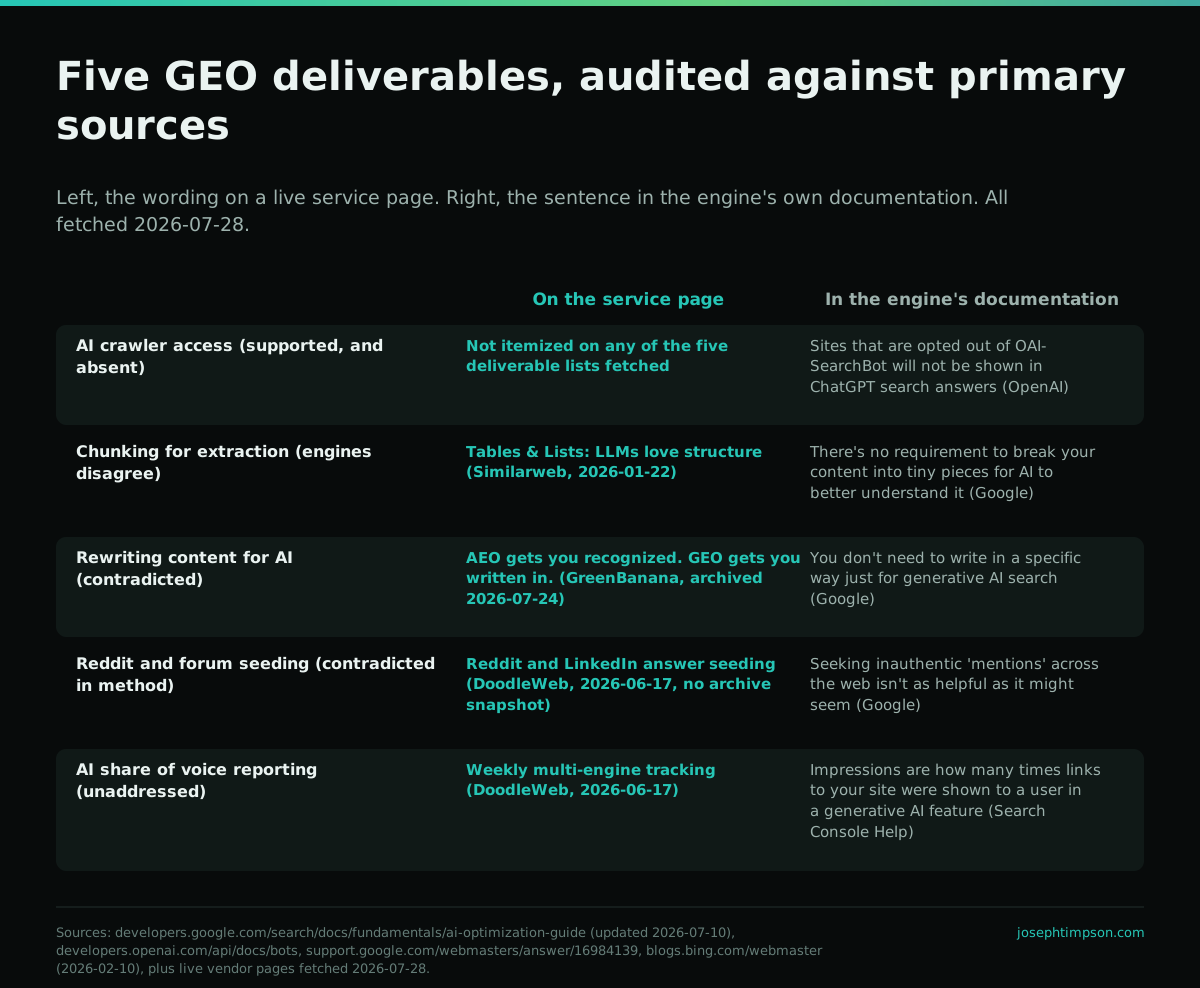
Row one: the deliverable that works is the one nobody itemizes
Every engine has now published, on the record, what you lose by blocking its search crawler. This is the most under-sold fact in the category.
OpenAI's bots and crawlers documentation documents four bots and separates them by function. GPTBot trains models. OAI-SearchBot is the one that matters for visibility: "OAI-SearchBot is used to surface websites in search results in ChatGPT's search features." And then the consequence sentence, which is the entire ball game: "Sites that are opted out of OAI-SearchBot will not be shown in ChatGPT search answers, though can still appear as navigational links."
Anthropic's crawler documentation runs the same three way split and states the cost plainly: "Disabling Claude-SearchBot on your site prevents our system from indexing your content for search optimization, which may reduce your site's visibility and accuracy in user search results." Last updated 2026-04-07.
Perplexity's crawler documentation draws the same line: "PerplexityBot is designed to surface and link websites in search results on Perplexity. It is not used to crawl content for AI foundation models."
And Google's AI features documentation states the technical floor: "To be eligible to be shown as a supporting link in AI Overviews or AI Mode, a page must be indexed and eligible to be shown in Google Search with a snippet, fulfilling the Search technical requirements."
Here is the synthesis that no myth post I read has made. Four vendors have independently published a mechanical, binary, verifiable gate on AI visibility, and not one of the five deliverable lists I fetched contains a line item for checking it. GreenBanana's phased deliverables cover roadmap, page builds and reporting. DoodleWeb's ten items cover queries, entity pages, schema, listicles, directories, seeding, llms.txt, tracking and benchmarking. Crawler access is on none of them.
That is not an oversight in the abstract. A WAF rule, a bot manager default or a stray robots.txt line can zero out ChatGPT eligibility while every other deliverable on the invoice continues to be produced on schedule. It is also the one row where the fix is cheap, the verification is objective, and the result does not require repeated sampling to observe. If you want the procedure, I wrote it up as an AI crawler access audit, and the log side of it lives in AI crawler log analysis.
The uncomfortable read: the highest certainty lever in generative engine optimization is boring, one time, and hard to bill monthly. That may be exactly why it is missing.
Row two: "structure it for extraction" is where the engines openly disagree
Google's mythbusting item two is "Chunking" content, and the sentence under it reads: "There's no requirement to break your content into tiny pieces for AI to better understand it."
Microsoft, in the Bing Webmaster Tools AI Performance announcement of 2026-02-10 by Krishna Madhavan, Meenaz Merchant, Fabrice Canel and Saral Nigam, says this: "Clear headings, tables, and FAQ sections help surface key information and make content easier for AI systems to reference accurately."
The vendor side, from Similarweb's guide to LLM seeding: "Tables & Lists: LLMs love structure. Using HTML tables for comparisons makes it easy for models to scrape and replicate that data."
This is the only row of the five where two engines contradict each other in their own documentation, and it is the row the industry handles worst. GEO sales decks quote the Microsoft sentence and omit the Google one. Debunk posts quote the Google sentence and omit the Microsoft one. Both are real, both are current, and both are load bearing.
My reading, and it goes further than either source: they are describing different things and the word "chunking" is doing the damage. Google is refusing a requirement. Microsoft is describing a preference. Neither claims a mechanical uplift, and the difference between "required" and "helps" is the whole argument.
The mechanism data settles it better than either doc. DejanSEO's analysis of 7,060 queries and 883,262 snippets found Google allocates roughly a 2,000 word grounding budget per query with per source grounding plateauing near 540 words, and coverage falling from 61 percent for pages under 1,000 words to 13 percent for pages over 3,000. Dan Petrovic's own summary: "The implication for content strategy is clear: density beats length."
So structure is not a citation trick. It is a way of making sure the 540 words the engine actually grounds on are the 540 words that answer the question. That is a real argument for headings and tables and a terrible argument for shredding a page into forty micro sections. I unpacked the retrieval side of this in how LLMs chunk web content.
Worth noting how thin the controlled evidence is on the formatting family generally. When Profound ran an actual A/B test on serving Markdown to AI crawlers, 381 pages across six sites, 189 control and 192 treatment, 19 January to 8 February 2026, the result was about one extra median bot visit over three weeks.
The data doesn't support it, at least not at a scale that would justify treating it as a priority.
Row three: "written for AI" is the exact phrasing Google wrote against
Google's mythbusting item three is Rewriting content just for AI systems. The sentence: "You don't need to write in a specific way just for generative AI search."
GreenBanana's service page headline, archived 2026-07-24, reads: "AEO gets you recognized. GEO gets you written in." The page also promises full page builds covering "writing + schema + FAQs + structure (done-for-you)" and content produced "so AI systems use your pages as source material, not just a link."
Read them together and the contradiction is exact, not approximate. One is selling a rewrite whose stated purpose is machine consumption. The other says a rewrite whose purpose is machine consumption is not needed.
But this row is where the honest version gets more interesting than the debunk, because the academic evidence cuts partly the other way. The paper that coined the term, Aggarwal and colleagues, accepted to KDD 2024, tested nine content interventions on a 10,000 query benchmark. Quotation Addition scored 27.2 on Position Adjusted Word Count against a 19.3 unoptimized baseline. Statistics Addition scored 25.2. Cite Sources scored 24.6. Those are real, measured, positive results for adding named quotes, hard numbers and citations to a page.
And the same table contains the finding that ought to be on the wall of every agency that pivoted a keyword density process into a GEO process. Keyword Stuffing scored 17.7, below the 19.3 baseline. It measured worse than doing nothing.
While this technique has been widely used for Search Engine Optimization, we find such methods have little to no performance improvement on Generative Engine's responses.
So the resolution is not "never change your content." It is that the evidenced changes (quote a named expert, add a real statistic, cite a source) are all changes that make a page better for a human reader too. The unevidenced changes are the ones that only make sense if a machine is the audience. Google's positive guidance on the same page points the same direction: "Don't just recycle what others on the internet have already said, or could easily be produced by a generative AI model." And, flatly, "There's no ideal page length, and in the end, make pages for your audience, not just for generative AI search."
A clean test for any content deliverable on a GEO scope: would you still ship this change if AI search did not exist? If no, the primary sources do not support it. I went through the origin paper line by line in the GEO research, read properly, and the definitional ground is in what generative engine optimization actually is.
Every row above is either documented, evidenced, or cut. That is the whole design principle behind the Cited Method: five stages, nothing on the scope that cannot survive being placed next to a primary source.
See the method that survived the audit→Row four: the mechanism is real and the delivery method is the problem
This is the sharpest row, and it is the one where both sides are partly right.
Google's mythbusting item four is Seeking inauthentic "mentions." The full passage: "Just like the rest of Google Search, our generative AI features can show what's being said about products and services across the web, including in blogs, videos, and forum discussions. However, seeking inauthentic 'mentions' across the web isn't as helpful as it might seem. Our core ranking systems focus on high-quality content while other systems block spam; our generative AI features depend on both."
DoodleWeb's ten item retainer includes "Reddit and LinkedIn seeding (ongoing)." REDCmts sells a Reddit GEO service that will "publish concise, source-ready comments that explain the brand, answer the thread, and stay grounded in truthful campaign context." Credit where it is due: that page is more candid than most, it says explicitly that generic AI copy alone "is not a good Reddit GEO strategy," and it commits to truthful context. It is still paid placement of brand favourable comments in threads chosen because engines cite them.
And here is the definitional claim that props up the whole category, from Similarweb:
LLM seeding is the strategic practice of placing your brand's content within the specific datasets and high-authority domains that Large Language Models (LLMs) trust and cite.
The second half of that sentence is defensible. The first half is not, and it is worth being precise about why, because it is the single most common technical error in GEO sales copy.
You cannot place content into the datasets. OpenAI's own documentation splits its bots by function precisely so this confusion is impossible: GPTBot "is used to crawl content that may be used in training our generative AI foundation models," while OAI-SearchBot handles retrieval, and "ChatGPT-User is not used to determine whether content may appear in Search." A model's training set is frozen at a point in time and you have no write access to it. What a Reddit comment can do is sit in a retrievable index that gets fetched at answer time. That is a live retrieval mechanism, not a dataset placement, and the difference decides what you should measure and how fast you should expect anything to move.
Now the part that cuts against Google. The underlying mechanism is genuinely well evidenced. Ahrefs, across 75,000 brands, measured branded web mentions correlating with AI Overview visibility at Spearman 0.664 against 0.218 for backlinks, roughly three times stronger. The authors state the causation caveat themselves and most blogs repeating the number strip it out. Peec AI's study of nearly 200,000 AI responses across eight engines found that ranking first in a third party listicle that engines already cite was associated with a 16.5 percentage point visibility lift in B2B SaaS, and moved brands 1.17 positions earlier in the answer.
So mentions matter, a lot, and more than links. Which means the split is not between "mentions work" and "mentions do not work." It is between earning the mention and buying it. Google's spam policies define link spam as "the practice of creating links to or from a site primarily for the purpose of manipulating search rankings," and the mythbusting sentence extends the same logic to mentions inside AI features. A seeded comment is cheap, fast, and rests entirely on the engine's spam systems not catching up. An earned listicle placement is slow, expensive, and does not have that failure mode.
I would rather be in the second business, and the evidence on how citation sources actually get selected is in how to analyze AI citation sources and what the brand mention data really shows.
Row five: no engine sells you a share of voice number
DoodleWeb's retainer includes "Weekly multi-engine tracking (week 5 onward)" and a "Quarterly competitive benchmark." GreenBanana promises a "GEO reporting dashboard & monthly experiment log" and says "we track prompts + citations across platforms and iterate monthly." Percepture offers reporting that will "track mentions, sentiment, and referral traffic from AI platforms."
Here is what the engines actually give you.
Google Search Console's generative AI performance report, launched June 2026, is impressions only. Search Console's Help documentation defines the unit precisely: "Impressions are how many times links to your site were shown to a user in a generative AI feature on Google Search." No clicks. No queries. No competitor set.
Microsoft's Bing Webmaster Tools AI Performance report is more generous and shows "the key phrases the AI used when retrieving content that was referenced in AI-generated answers," which is Microsoft publishing the fan out subqueries under its own name. OpenAI, Anthropic and Perplexity publish nothing comparable for site owners at all.
Add it up. Not one engine exposes a share of voice figure, a competitor comparison, or a prompt level ranking. Which means every AI share of voice percentage that has ever appeared in a client deck was produced by an external tool re-asking prompts and counting what came back. That is a legitimate method. It is a sampling method, and sampling methods have error bars that almost nobody prints.
SparkToro's research on AI recommendation consistency measured how wide those error bars are: 600 volunteers, 12 prompts, 2,961 runs across ChatGPT, Claude and Google AI.
AIs do not give consistent lists of brand or product recommendations. If you don't like an answer, or your brand doesn't show up where you want it to, just ask a few more times.
The same study found an average semantic similarity of 0.081 across 142 human written prompts asking for the same recommendation, which means two agencies tracking "the same" query are not tracking the same thing at all.
My position, stated plainly so it can be argued with: a weekly AI visibility percentage reported to one decimal place, with no sample size and no run count, is not a measurement. It is a screenshot with a font applied. The fix is not to stop measuring, it is to publish n, publish the prompt set, publish the run count, and report a range. I set out the arithmetic in AI visibility sample size, reviewed what the trackers can and cannot see in AI visibility tracking tools, and put the reporting format itself in GEO client reporting.
The two rows I deliberately left out
Google's list has five items. I audited three of them here and skipped two on purpose.
LLMS.txt is myth one on Google's list, and the evidence against it is now overwhelming from three independent directions: Google's own "You don't need to create new machine readable files, AI text files, markup, or Markdown to appear in Google Search," Ahrefs finding 97 percent of published files received zero requests in May 2026, and SE Ranking finding no citation relationship across nearly 300,000 domains. It gets its own teardown in does llms.txt work.
Structured data is myth five, and it deserves more care than a bullet, because Google's wording is genuinely two sided: "Structured data isn't required for generative AI search, and there's no special schema.org markup you need to add. However, it's a good idea to continue using it as part of your overall SEO strategy, as it helps with being eligible for rich results on Google Search." Pair that with Ahrefs' controlled test of 1,885 pages against 4,000 matched controls and you get a defensible position rather than a slogan. That is does schema help AI citations.
Splitting them out is deliberate. A myth post that lands eleven claims at once persuades nobody, because the reader cannot check any of them. One claim per page, with the source next to it, is checkable.
What survives the audit
Strip out everything that no engine documents and everything an engine contradicts, and a short list is left standing.
| Commonly sold | Documented or evidenced | |
|---|---|---|
| Entry gate | AI file formats and markup packages | Indexed, snippet eligible, and search crawlers unblocked |
| Content | Rewrites formatted for machine consumption | Non-commodity content with real quotes, real statistics, real citations |
| Off site | Seeded forum and community mentions | Earned placement in third party sources engines already cite |
| Measurement | A weekly share of voice percentage | A fixed prompt set, repeated runs, a reported range |
| Cadence | Monthly optimization retainer | Access checks once, content and off site continuously |
Google's own positive guidance on that same documentation page comes down to three headings: "Create valuable, non-commodity content for your audience," "Build and maintain a clear technical structure," and "Optimize your local business and ecommerce details." That is not a discipline. It is a shorter version of the job.
Which raises the obvious question about whether the category needs a separate name at all. Ahrefs' March 2026 update found only 38 percent of AI Overview citations now come from pages ranking in the top 10, down from about 76 percent in July 2025, so the surfaces have genuinely decoupled and "just rank number one" is no longer sufficient either. I worked through that data in do AI Overviews cite top ranking pages.
Visibility earns inclusion. Legibility determines what the market makes of you.
What to ask before the next invoice
If you are the one defending the line item, you do not need to win the philosophical argument. You need four answers on paper.
- For each deliverable, which published sentence from Google, OpenAI, Microsoft, Anthropic or Perplexity supports it? Not a blog post. The vendor's own documentation.
- If no such sentence exists, which controlled study supports it, with sample size, control group and date?
- Does the scope include verifying that OAI-SearchBot, Claude-SearchBot, PerplexityBot and Googlebot can actually fetch the pages? If not, ask why the cheapest verifiable lever is absent.
- For every number in the report, what is the prompt set, how many runs, and what is the range? A single figure with no n is a screenshot.
Any competent vendor can answer all four. A vendor who cannot answer the first two is selling a process, not an outcome. If you want the version of this written as a scope document rather than an audit, it is in the GEO retainer scope of work, and the attribution question sits in AI search attribution.
One last thing, because it is the honest end of a post like this. Google's documentation is a primary source, not a neutral one. Google has commercial reasons to tell you no special optimization is needed, exactly as vendors have commercial reasons to tell you it is. What makes the comparison useful is not that one side is trustworthy. It is that both sides are now on the record, dated, and archivable, and you can hold the two sentences up against each other yourself. That is the entire point of the exercise, and it is the reason every claim on this site ships with the URL attached. The rest of the evidence audits live in insights.
Frequently asked questions
Is generative engine optimization a scam?
No, but a large share of what is sold under the label is unsupported. Google's own documentation names five commonly sold tactics under a heading about what you do not need to do. The underlying discipline is real. The question is whether a specific deliverable traces to a primary source or a study.
What does Google actually say about optimizing for AI Overviews?
Google states there are no additional requirements to appear in AI Overviews or AI Mode, and no other special optimizations necessary. The only stated technical gate is that a page must be indexed and eligible to show in Search with a snippet, fulfilling Search technical requirements.
Which GEO tactic has the strongest primary source support?
AI crawler access. OpenAI, Anthropic and Perplexity each publish a sentence stating what visibility you lose by blocking their search crawler. It is binary, verifiable, and cheap to fix. It also did not appear on any of the five vendor deliverable lists I fetched.
Does Reddit seeding get your brand into AI answers?
Branded mentions correlate with AI visibility about three times more strongly than backlinks, so the mechanism is real. Google's documentation specifically addresses seeking inauthentic mentions and notes its spam systems apply to generative features. The evidence favours earning placement over buying it.
Can you place content into an AI model's training data?
Not deliberately, and the framing confuses two systems. OpenAI separates GPTBot, which crawls for model training, from OAI-SearchBot, which handles retrieval for ChatGPT search. Live citations come from retrieval at answer time, not from a training set you can write into after the fact.
Why do Google and Microsoft disagree about content structure?
They are answering different questions. Google says there is no requirement to break content into tiny pieces. Microsoft says clear headings, tables and FAQ sections help AI systems reference content accurately. One refuses a requirement, the other describes a preference. Both statements are current.
How accurate are AI share of voice reports?
No engine publishes a share of voice figure, so every one is external sampling. SparkToro found AI assistants return highly inconsistent brand lists across repeated runs of the same prompt. Treat any single percentage without a stated prompt set, run count and range as indicative only.
What does Google Search Console show for AI features?
The generative AI performance report launched in June 2026 shows impressions from generative AI features, defined as how many times links to your site were shown to a user. It does not provide clicks, query level data, or any competitor comparison.
Should I stop paying for GEO services entirely?
No. Ask which published sentence or controlled study supports each deliverable, whether crawler access verification is in scope, and what sample size sits behind every reported number. A vendor who can answer those is selling something real. A vendor who cannot is selling a process.
Sources
- Google Search Central. Optimizing your website for generative AI features on Google Search (2026-07)
- Google Search Central. AI Features and Your Website (2025-12)
- Google Search Central. Google Search spam policies (2026-05)
- Google Search Console Help. Generative AI performance report (Search) (2026-06)
- OpenAI. OpenAI bots and crawlers documentation (2026-07)
- Perplexity AI. Perplexity crawlers documentation (2026-07)
- Anthropic. Does Anthropic crawl data from the web, and how can site owners block the crawler? (2026-04)
- Microsoft Bing Webmaster Blog. Introducing AI Performance in Bing Webmaster Tools (Public Preview) (2026-02)
- Aggarwal, Murahari, Rajpurohit, Kalyan, Narasimhan, Deshpande. GEO: Generative Engine Optimization (KDD 2024) (2024-06)
- Ahrefs. Only 38% of AI Overview citations come from top 10 pages (2026-03)
- Ahrefs. Branded web mentions correlate with AI Overview visibility (2025-05)
- Ahrefs. Does schema markup increase AI citations? (2026-05)
- Ahrefs. 97% of llms.txt files receive no AI crawler requests (2026-06)
- SE Ranking. LLMs.txt study across 300,000 domains (2025-11)
- Profound. Does Markdown increase AI bot traffic? (2026-02)
- SparkToro with Gumshoe.ai. AIs are highly inconsistent when recommending brands or products (2026-01)
- DejanSEO. How big are Google's grounding chunks? (2025-12)
- Peec AI. The listicle rank effect across nearly 200,000 AI responses (2026-07)
- Similarweb. LLM seeding explained (2026-01)
- DoodleWeb. Generative Engine Optimization Services: 2026 Scope and Pricing (2026-06)
- GreenBanana SEO. Generative Engine Optimization Agency service page (2026-07)
- REDCmts. Reddit GEO service page (2026-05)
- Percepture. GEO services page (2026-02)
- Jono Alderson. SEO vs GEO is the wrong question (2026-07)
Joseph Timpson has worked in search since 2010 and runs Timpson Marketing out of St. George, Utah. He built The Cited Method, a five stage framework for earning and proving real citations in AI answers, and publishes what does not work alongside what does.
Want me to run this on your site and show you the before and after?
One call, no pitch deck. We look at what is actually blocking you and tell you the truth about whether we can help.
Book a free consultation →