Do Brand Mentions Beat Backlinks for AI Citation?
The correlation is real and it is being used to justify budget moves it cannot support. This is the evidence laid out honestly, the three confounds that could produce all of it, and the experiment nobody has run.

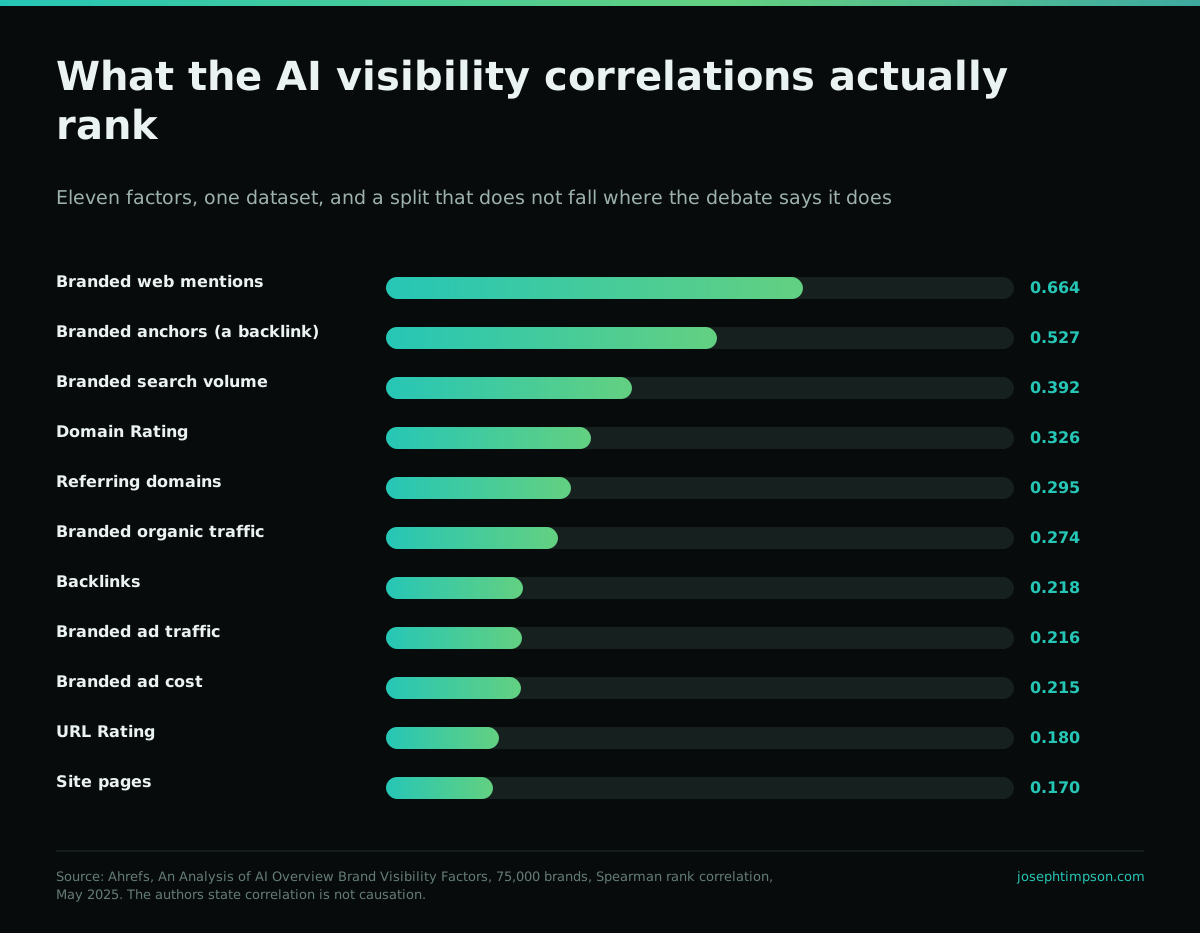
- Branded web mentions correlate with AI Overview visibility at 0.664 against 0.218 for backlinks, across 75,000 brands, Spearman rank correlation.
- Branded anchor text scored 0.527, and branded anchor text is a backlink, so the gradient runs along whether a metric carries the brand name, not along whether there is a hyperlink.
- Semrush found nofollow links correlate with AI mentions slightly better than follow links, which rules out link ranking credit as the mechanism.
- Three confounds (brand size, reverse causation, and shared measurement corpus) could produce the entire observed gap with no mention mechanism at all.
- The matched-control difference-in-differences study that would separate them has been run on schema markup and never on brand mentions.
The two numbers the whole argument rests on
Brand mentions do out-correlate backlinks for AI visibility, by roughly three to one in the largest published dataset. That gap cannot carry a budget decision yet. No published analysis separates mention volume from brand size, brand search demand and editorial output, and those three move together well enough to produce the entire observed gap on their own.
One agency published guidance this year telling marketing leaders to move mid-market off-page budget from a 70/30 backlinks-to-mentions split to roughly 30/70, cutting generic link building in half. The stated basis is two numbers.
Those numbers come from Ahrefs. In May 2025 the company published a Spearman correlation study across 75,000 brands measuring which metrics track brand visibility in Google AI Overviews. Branded web mentions scored 0.664. Backlinks scored 0.218.
The full table is rarely reprinted, and the full table is where the argument starts to move.
| Factor | Spearman correlation with AI Overview visibility |
|---|---|
| Branded web mentions | 0.664 |
| Branded anchors | 0.527 |
| Branded search volume | 0.392 |
| Domain Rating | 0.326 |
| Referring domains | 0.295 |
| Branded organic traffic | 0.274 |
| Backlinks | 0.218 |
| Branded ad traffic | 0.216 |
| Branded ad cost | 0.215 |
| URL Rating | 0.180 |
| Site pages | 0.170 |
A December 2025 follow-up on the same 75,000 brands extended the measurement to ChatGPT and Google AI Mode. YouTube mentions came out as the single strongest correlate at roughly 0.737. Branded web mentions landed at 0.664 for ChatGPT, 0.709 for AI Mode and 0.656 for AI Overviews. Site count stayed near the bottom at about 0.194.
Every one of the eleven factors is positive. Not one is negative, and not one is near zero. When eleven different variables all point the same direction across the same 75,000 rows, the parsimonious reading is not eleven separate mechanisms. It is one underlying thing that all eleven partly measure. That is the observation the reallocation advice skips, and it is the observation that makes this post necessary rather than another entry in the pile of GEO claims that survive on a single coefficient.
The datapoint that breaks the mentions-versus-backlinks frame
Branded anchors scored 0.527.
A branded anchor is a backlink. It is a hyperlink pointing at your domain whose anchor text contains your brand name. It is not a mention. It is the thing the mentions camp says has been superseded.
It beat raw backlinks by 2.4 times. It beat referring domains, the link metric practitioners actually trust, by 0.232. And it sits within 0.137 of branded web mentions, the number the entire argument is built on.
So the gradient in this dataset does not run along whether there is an anchor tag. It runs along whether the metric carries the brand name.
Semrush tested that separation directly. In a study of 1,000 randomly selected domains run with Kevin Indig across five AI platforms, nofollow links correlated with AI mentions at Pearson 0.340 and Spearman 0.509. Follow links correlated at 0.334 and 0.504. Nofollow edged out follow.
That result deserves more attention than it has had. The only functional difference between a follow and a nofollow link is whether Google is asked to pass ranking credit. If flipping that attribute does nothing to the correlation, then whatever produces the correlation is not the link mechanism. It is the fact that a credible page said your name near a topic, which is what an entity-first reading of the same data would predict.
Google's own position points the same way, from the opposite direction. Asked whether unlinked mentions behave like links, John Mueller said that without an actual hyperlink "there is no signal passing like there would be with any normal link there". That was 2022, and it concerns classic ranking rather than AI citation. Take it at face value and the conclusion is not that mentions are worthless. It is that whatever mentions do, they are not doing it through the link graph, which is exactly what the nofollow result shows from the other side.
One honest exception, because the pattern is not universal. Branded organic traffic (0.274) and branded ad traffic (0.216) also carry the brand name and score low. The regularity holds for metrics counted on third-party web content, not for every metric with the word branded in its label. I have not seen anyone else draw that line, and drawing it narrows my own claim rather than widening it.
Confound one: size loads onto everything
Rank a Fortune 500 brand and a regional HVAC company on all eleven variables. The large brand wins all eleven. More mentions, more links, more branded search, more pages, more ad spend, more AI presence. Because it is larger.
A Spearman correlation across 75,000 brands of wildly different sizes is, in substantial part, a measurement of size. That does not make the coefficient wrong. It makes it close to uninformative about what a marginal mention buys a brand that does not change size.
There is direct evidence the engines carry a size prior of their own. Four University of Toronto researchers ran controlled experiments across verticals, languages and query paraphrases and reported that "AI Search exhibit a systematic and overwhelming bias towards Earned media (third-party, authoritative sources) over Brand-owned and Social content, a stark contrast to Google's more balanced mix." Their paper contains a section titled Big Brand Bias and lists overcoming it as a strategic imperative for niche players.
Read the two findings together. If a generative engine has a structural preference for large, heavily covered brands, then mention count is partly a proxy for the thing the engine already favors. The correlation is then partly the engine's prior reflected back at the analyst who measured it.
The distribution supports this. In the same Ahrefs dataset, 26% of the 75,000 brands had zero AI Overview mentions at all. A quarter of the sample sits at the floor on the outcome variable and near the floor on every input, which is exactly what a size-dominated dataset looks like. If you are assessing any AI visibility study, that distributional check is the first one to run.
This is the largest of the three confounds. I would not be surprised if it accounted for most of the visible gap. I also cannot prove that, and neither can anyone currently selling against it.
Confound two: the arrow may point backwards
Both Ahrefs studies are cross sectional. They photograph 75,000 brands at one moment and correlate the columns. A snapshot carries no time ordering, so it cannot distinguish mentions producing visibility from visibility producing mentions.
Branded search volume, at 0.392, is the clearest case. If ChatGPT names a brand in an answer, some readers then search that brand by name. Ahrefs' own data puts 45.7% of all Google searches in the branded category. Branded demand sits downstream of exposure at least as plausibly as it sits upstream of it.
The same reversal applies to mentions themselves. Journalists, forum posters and listicle authors write about brands that are already salient. AI answers are now one of the surfaces that manufacture salience. A brand that starts appearing in ChatGPT gets written about more, which raises its mention count, which raises the correlation the following quarter.
This is also why treating organic rank as the clean upstream variable does not rescue the analysis. Rank, mentions and AI presence are mutually reinforcing, which is a separate problem from whether AI Overviews actually cite top-ranking pages.
Nobody has published a lagged analysis on this data. Until someone does, direction is an assumption wearing the clothes of a finding.
Confound three: predictor and outcome are drawn from the same corpus
Branded web mentions counts pages on the web containing the brand name. AI visibility counts AI answers containing the brand name. AI answers are synthesized from pages on the web.
These are not independent measurements of two separate phenomena. They are two reads of the same substrate taken at different points in one pipeline. Some correlation between them is close to definitional, and definitional correlation is not a lever.
That is not the same as saying the metrics are interchangeable. Semrush and Kevin Indig found that 61.7% of AI citations are ghost citations, where a page is used as a source but the brand name never appears in the answer text. Citation and mention genuinely come apart, which is the whole reason the two need separate reporting lines.
The AI knows the information about the brand came from somewhere, but doesn't feel the need to explicitly say so to users. The brand name carries on its own.
There is a second measurement problem stacked on the first. The outcome variable is unstable between runs. SparkToro, working with Gumshoe.ai, put 600 volunteers on 12 prompts across 2,961 combined runs.
There's a <1 in 100 chance that ChatGPT or Google's AI, if asked 100X, will give you the same list of brands in any two responses.
If the dependent variable changes materially between two identical runs, the precision implied by a figure like 0.664 is doing more work than the underlying measurement can carry. Work out how many prompts and repeats a defensible sample needs before treating any of these coefficients as stable enough to plan against.
MEASURE is stage two of the Cited Method because of everything in this section. A coefficient computed on an unstable outcome variable is not a finding, and a baseline taken from one run of one prompt set is not a baseline.
See how I measure this→What the confounds could eat, stated honestly
Here is the short list of what nobody has published on this question: a partial correlation, a multivariate model, or a within-brand analysis holding size constant.
Every figure in circulation is a pairwise Spearman coefficient. A pairwise coefficient tells you nothing about marginal effect once you condition on a common cause. The Ahrefs authors do not hide this. They describe the factors as combining to influence visibility rather than operating independently, and they state the limit plainly.
Correlation isn't causation. We've spotted patterns between search metrics and AI mentions, but that doesn't mean improving these metrics will automatically boost your AI visibility.
That caveat is in the source. It is absent from most of the posts citing the source, including the one that asserts unlinked brand mentions initiate 60% of new Knowledge Panels while backlinks account for 35%. I fetched that page looking for the study behind those two figures. There is no sample size, no date range, no methodology and no external citation anywhere on it. Two clean percentages, no dataset. That is the failure mode this whole cluster is prone to, and it is worth naming rather than gesturing at.
Cyrus Shepard, who publishes some of the most careful correlation work in the field, sets the right posture for reading any of these numbers.
We recommend you consider any conclusions drawn from these numbers directionally useful but not necessarily scientific truth.
So the honest bound looks like this. The ordering (name-bearing metrics above volume metrics) is probably real. The magnitude (three to one) is not defensible as an effect size. And the share of the gap attributable specifically to a mention mechanism is unknown, and could be near zero. If you are putting a number in front of a client, that last sentence is the one that belongs in the report.
The study that would settle it, and why it has not been run
The design is not exotic. The field has already run it on a different question, with the same tooling, and published a null result.
Match on size
Pair brands on branded search volume, Domain Rating, vertical and existing AI visibility, so the size confound is held constant by construction rather than by argument.
Freeze the instrument
Fix a prompt set and sample every prompt repeatedly across engines, because single runs are noise and noise will swamp the effect you are hunting.
Intervene
Place third-party editorial mentions for the treatment group over a defined window and nothing for the matched control group.
Difference in differences
Compare the pre-period to post-period change in the treatment group against the same window in controls, which nets out anything happening to the whole market.
Report an interval
Publish an effect size with a confidence interval, not a rank correlation, so a reader can see how much of the result is signal.
Ahrefs has already shown it can run precisely this design. Its schema markup study tracked 1,885 treatment pages against 4,000 matched controls with difference-in-differences over a 30 day pre and post window, and found minus 4.6% in AI Overviews, plus 2.4% in AI Mode and plus 2.2% in ChatGPT. A null. The company published it anyway, which is why the schema question is now genuinely settled and this one is not.
That is the finding I want on the record. The tooling exists. The matched-control panel exists. The willingness to publish an inconvenient null exists. The design has simply never been pointed at brand mentions, which happens to be the claim the same company's correlation study is being used to sell. Nobody is hiding anything. The experiment just has not been run.
The closest anyone has come is an intervention study from Stacker, run with Scrunch, measuring the same stories in two states: hosted on the brand's own site, and syndicated across third-party publishers. The December 2025 pilot covered 8 stories, roughly 189 unique prompts and 944 prompt-platform combinations, moving the citation rate from 7.6% to about 34%. Its authors called it "an early, directional exploration." A larger follow-up covering 87 stories across 30 brands, more than 2,600 prompts and 8 platforms over 30 days reported a median citation lift of 239% and coverage breadth rising from 5.4% to 17.9%.
That is the strongest thing on the table and it still does not close the question. It is within-subject with no randomized control. It is run by a company that sells earned media distribution. And it tests putting your content onto third-party domains, which is a different intervention from earning an unlinked mention of your name inside somebody else's article. Useful, adjacent, not dispositive. Peec AI's listicle rank study across nearly 200,000 AI responses, which found ranking first in a frequently cited third-party listicle associated with a 16.5 percentage point visibility lift in B2B SaaS, sits in the same category: observational, valuable, not causal.
What I would actually do with the link budget
Not the 70/30 flip. Not on this evidence.
Here is the part of the argument that survives all three confounds. Every metric in the Ahrefs table that counts your brand name appearing on somebody else's web content outperforms every metric that counts volume without the name. Branded anchors beat referring domains. Branded mentions beat backlinks. That ordering holds whether or not there is a causal path behind it, because it describes what the retrieval layer has available to lift.
So the operational change is not stop building links. It is stop buying placements that do not say your name.
| Volume brief | Name-bearing brief | |
|---|---|---|
| Success metric | A referring domain acquired | Brand named in body copy |
| Anchor | Exact-match commercial keyword | Brand name, naturally placed |
| Placement target | Any domain over a DR threshold | Publications the engines already cite in your category |
| Asset | Guest post | Original data or first-hand account worth quoting |
| What it optimizes | A position in the link graph | A sentence a retrieval system can lift |
The supporting evidence for the off-site emphasis is stronger than the mechanism evidence. Aleyda Solis measured 84% to 93% of AI citation weight sitting on third-party properties across 15 SaaS brands. Whatever the causal story turns out to be, your own domain is not where most of the citation weight lives, and that is worth planning around before the correlation question is settled.
Two constraints on top of it.
First, earn them. Do not buy them. The commercial logic that produced paid guest post networks will produce paid mention networks, and Google's spam policies already treat paid placements carrying ranking credit as a violation. Nothing about the AI citation era changes that calculus, and no correlation coefficient is worth a manual action.
Second, none of this matters if the engines cannot fetch your pages in the first place. Crawler access is the one lever in this field with a mechanical rather than a correlational basis, and it is the one most sellers skip because it does not bill well. Run the crawler access audit before you move a dollar of off-site budget, then work the earned-citation sequence in order.
It is also worth re-reading what Google says in its own documentation, which is that "There are no additional requirements to appear in AI Overviews or AI Mode, nor other special optimizations necessary." That sentence quietly rules out most of what gets bundled and sold alongside the mentions argument.
The uncomfortable summary is that both camps are wrong in interesting ways. The mentions camp is probably directionally right and is arguing from evidence that cannot support the claim it is making. The links camp is defending raw backlink counts, a metric its own side stopped trusting a decade ago. What the data actually separates is name-bearing signals from volume signals, and that cuts across the line everyone is arguing over.
This is the reasoning I apply in my own AI visibility work, and the rest of the evidence audits in this series run the same test on the rest of the field's favorite numbers.
Frequently asked questions
Do brand mentions beat backlinks for AI citation?
They out-correlate them, at 0.664 against 0.218 across 75,000 brands in Ahrefs' Spearman analysis. That is a correlation, not an effect size. Brand size, reverse causation and shared measurement corpus could each produce a gap that large without any mention mechanism operating at all.
Does an unlinked brand mention pass a Google ranking signal?
No, according to Google. John Mueller said in a 2022 Google SEO office-hours session that without an actual hyperlink there is no signal passing like there would be with any normal link there. That statement covers classic ranking and predates the AI citation era, so scope it carefully.
Should I move my link budget to digital PR because of this data?
Not on this evidence alone. The defensible change is narrower: specify that placements name your brand in body copy rather than only carrying a link. Branded anchors, which are backlinks, scored 0.527, so the split runs along the brand name, not along the hyperlink.
What is the strongest measured correlate of AI visibility?
YouTube mentions, at roughly 0.737, in Ahrefs' December 2025 follow-up across ChatGPT, Google AI Mode and AI Overviews. Branded web mentions came second. Both figures carry the same confounds as everything else in that table, and neither has been tested with a controlled design.
Do nofollow links help AI visibility?
Semrush found nofollow links correlating with AI mentions at Pearson 0.340 and Spearman 0.509, marginally ahead of follow links at 0.334 and 0.504. That is the most useful single result here, because it rules out link ranking credit as the mechanism producing the correlation.
Has anyone proven that brand mentions cause AI citations?
No. No published study uses matched controls and a difference-in-differences design on brand mentions. The closest is Stacker's within-subject syndication test, which found a 239% median citation lift but has no control group, no randomization and a vendor with a direct commercial interest.
How would I test the mention effect on my own brand?
Freeze a prompt set, sample it repeatedly to establish a noisy baseline, then run a mention campaign in one product line and not another matched line. Compare the change across both. It is weak evidence, but it is stronger than a rank correlation on somebody else's 75,000 brands.
Why does the same study get quoted with different numbers?
Because there are two Ahrefs studies on the same 75,000 brands. The May 2025 study measured AI Overviews only. The December 2025 follow-up measured ChatGPT, AI Mode and AI Overviews separately, so branded web mentions appear as 0.664, 0.709 and 0.656 depending on the platform quoted.
Sources
- Ahrefs. An Analysis of AI Overview Brand Visibility Factors (75K Brands Studied) (2025-05)
- Ahrefs. AI Brand Visibility Correlations Across ChatGPT, AI Mode and AI Overviews (2025-12)
- Semrush with Growth Memo. Do Backlinks Still Matter for AI Search Visibility? (2025-10)
- Chen, Wang, Chen and Koudas, University of Toronto (arXiv 2509.08919). Generative Engine Optimization: How to Dominate AI Search (2025-09)
- Stacker with Scrunch. How Earned Media Distribution Expands AI Visibility: A First Look at Citation Lift (2025-12)
- Stacker, via GlobeNewswire. New Stacker Research: Earned Media Distribution Triples AI Search Visibility, Delivers 239% Median Lift in Brand Citations (2026-03)
- Ahrefs. Does Schema Markup Help AI Citations? A Difference-in-Differences Study (2026-05)
- Semrush with Kevin Indig / Growth Memo. Why 62% of AI Citations Do Not Lead to Brand Mentions (Ghost Citations Study) (2026-06)
- SparkToro with Gumshoe.ai. New Research: AIs Are Highly Inconsistent When Recommending Brands or Products (2026-01)
- Ahrefs. Almost Half of Google Searches Are Branded (2025-05)
- Zyppy SEO (Cyrus Shepard). Internal Links and Google Clicks: A Study of 23 Million Links (2026-02)
- SearchAtlas. Brand Mentions vs Backlinks: Key Differences, SEO, and AI Visibility Impact (2026)
- Soar. Backlinks vs Brand Mentions: What Marketing Leaders Need to Know (2026)
- Peec AI. The Listicle Rank Effect: Nearly 200,000 AI Responses Across 8 AI Engines (2026-07)
- Aleyda Solis / Orainti. SaaS AI Search Optimization: Where Citation Weight Actually Sits (2026-07)
- Google Search Central. AI Features and Your Website (2026-07)
- Google Search Central. Spam Policies for Google Web Search (2026-05)
- Search Engine Journal, reporting Google SEO Office Hours. Does Google Treat Unlinked Mentions Like Links? (2022-04)
Joseph Timpson has worked in search since 2010 and runs Timpson Marketing out of St. George, Utah. He built The Cited Method, a five stage framework for earning and proving real citations in AI answers, and publishes what does not work alongside what does.
Want me to run this on your site and show you the before and after?
One call, no pitch deck. We look at what is actually blocking you and tell you the truth about whether we can help.
Book a free consultation →