The Local SEO Results Map: Calls, Pages, Reviews
Local SEO results are not one map-pack screenshot. They are profile actions, service-page visibility, calls, reviews, proof, and the tracking that connects them.

- Local SEO should be measured across profile actions, pages, reviews, tracking, and business outcomes.
- Business Profile actions are close to the customer, but they still need context.
- Service pages need local proof, not city-name swaps.
- A local report should lead with counted facts before interpreted rankings.
Local SEO results are not one metric
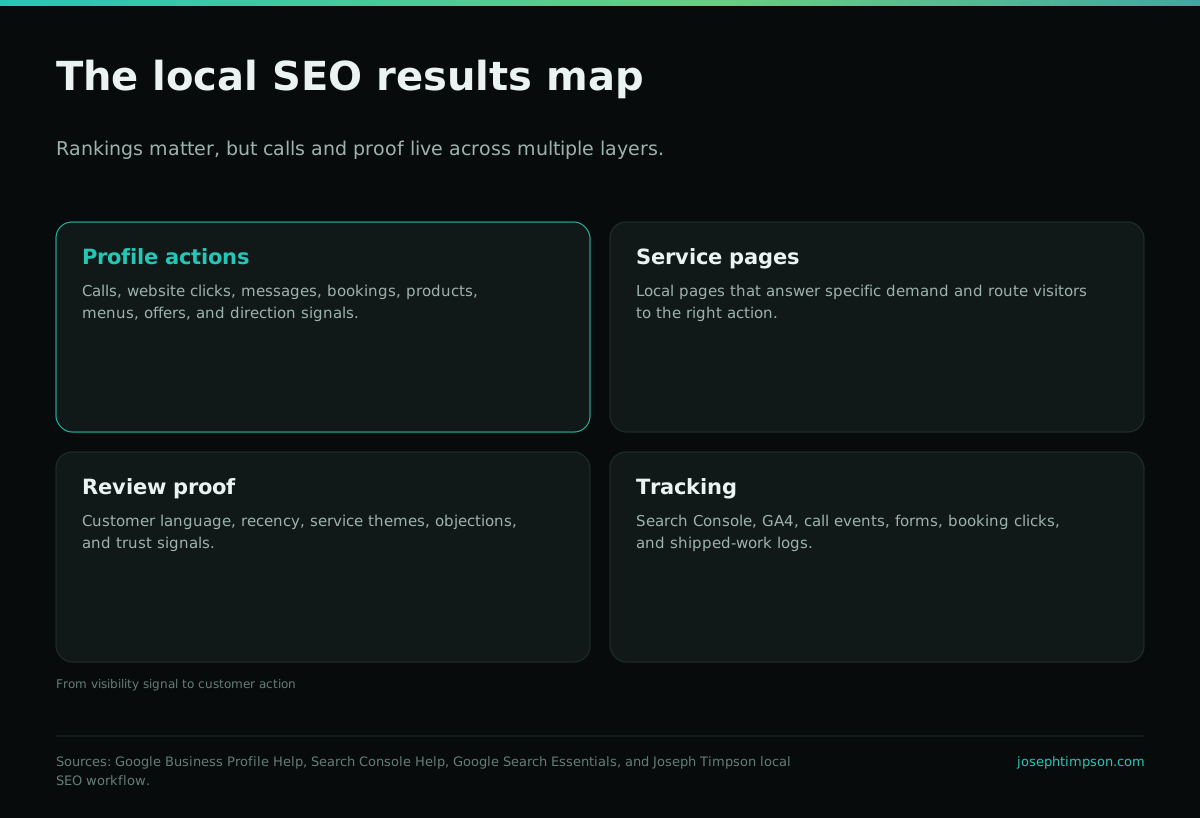
Local SEO results should be read as a map: Business Profile actions, service-page visibility, call quality, review velocity, local content coverage, and conversion tracking. A map pack ranking is useful, but it is not the whole result.
Local SEO gets distorted when every conversation collapses into "where do we rank on Maps?" Ranking matters, but a local business does not deposit rankings. It deposits calls, booked jobs, directions, form fills, and repeat customers. The job is to connect map visibility, page visibility, profile actions, and tracked outcomes without pretending any one report is the whole truth.
The guardrails are not a private theory. Google's AI optimization guide says generative AI visibility still starts with ordinary SEO, while AI features and your website says there are no extra requirements for AI Overviews or AI Mode. The SEO starter guide, technical requirements, helpful content guide, Core Web Vitals guidance, Search Console metric definitions, and Business Profile performance docs give us the measurement spine.
No one can guarantee a #1 ranking on Google.
Indexing and serving aren't guaranteed.
SEO is still relevant for generative AI search.
The profile action layer
The first local layer is the Business Profile because that is where many customers act before they visit the website. Google's Business Profile performance docs define actions such as calls, website clicks, messages, bookings, products, menus, and offers. Those are not vanity metrics. They are closer to the customer than a ranking grid.
The limitation is that profile actions still need interpretation. A call click is not a completed sale. A website click is not a form fill. Direction requests matter more for a storefront than for a service-area business. This is why local SEO results need context by business model. A ranch, a lawyer, an HVAC company, and a storage facility should not read the same report the same way.
The service-page layer
The second layer is the website's local service architecture. Search Console shows which queries and pages are earning impressions and clicks, but the page has to match the intent. A "near me" visitor often needs service area proof, availability, phone access, trust markers, and a reason to choose the business now. A generic blog post is usually the wrong landing page for that job.
The SEO starter guide starts with making the site easy for users and search engines to understand. For local SEO, that means service pages, location context, reviews, photos, schema, internal links, and CTAs all tell the same story. If the page says the business serves a city but gives no local proof, it is asking the visitor to do the trust work.
The technical local layer
Local pages fail quietly when basic access is broken. A page can look fine to the owner and still be excluded from useful search discovery because it is blocked, non-indexable, thin, duplicated, slow, or not connected internally. Before we argue about content angles, we check the floor.
Google's technical requirements make the first audit simple: can Googlebot access it, does it return a success status, and does it have indexable content? The Core Web Vitals guidance adds user experience signals around loading, interactivity, and visual stability. A local lead page that loads badly on a phone is not a small issue. It is a sales leak.
The review and proof layer
Reviews are not just stars. They are language about the business written by customers. They mention services, cities, staff, urgency, quality, price, and trust. That language helps humans decide, and it gives the business a source of first-hand proof that no generic service page can manufacture.
The mistake is treating reviews as decoration. A local SEO operating system should mine reviews for service themes, objections, proof phrases, and testimonial snippets. Then it should connect those themes to service pages and profile updates. This is not fake "mention building." Google's AI optimization guidance warns against inauthentic mentions. The answer is to earn real reviews and use them honestly.
- Business Profile calls, website clicks, messages, bookings, products, menus, and offers
- Search Console clicks and impressions by service page and query group
- GA4 sessions, key events, forms, booking clicks, and call events where tracking exists
- Review count, review quality, review recency, and service language
- Local service pages returning 200 with indexable content
- Internal links from homepage, service pages, city pages, and proof pages
- Named proof assets, photos, project examples, and staff credentials
The content coverage layer
Local content should not be a city-name swap. The strongest local pages answer what is different about the service in that place: response time, local conditions, laws, neighborhoods, equipment, seasonal patterns, common failures, pickup rules, delivery areas, or proof from nearby work. If there is no local detail, the page is only pretending to be local.
This is where Search Console content roadmaps and local SEO meet. Query families show what people ask. Business Profile actions show how they act. Reviews show how they describe the service after buying. The content plan should sit at the intersection of those three inputs.
The reporting layer
A local report should lead with counted facts before interpreted ones. Count the profile actions, calls, forms, pages shipped, reviews earned, crawl fixes, and URLs indexed. Then interpret ranking movement and query movement. This order prevents the report from overreacting to a map grid or a single keyword.
That does not make rankings irrelevant. It puts rankings in their proper place. A rank change is useful when it explains or predicts a business action. It is weak when it floats alone. This is the same discipline behind GEO client reporting: the instrument decides how much confidence the claim deserves.
If your local report is a ranking screenshot with no call path, bring it. We will rebuild the proof map.
Map my local SEO results→The client-facing promise
The clean promise is not "we will make you number one everywhere." Google's own hiring guidance says nobody can guarantee that. The promise is better: we can help you make every local surface clearer, stronger, more measurable, and more likely to produce real customer actions. We can show the work layer by layer.
For the personal site, that distinction matters. The proof wall should not imply one universal ranking trick. It should show repeatable local operating systems: profile actions, pages, speed, reviews, tracking, and reporting. Those are the results a prospect can understand and the results we can help them pursue.
The agency handoff
This is where the personal site has to be clearer than a normal blog. A reader should not finish the page thinking Joseph only writes about local seo results. The page should make the operating path obvious: if the problem is general SEO or GEO, Timpson Marketing owns the execution. If the problem is legal visibility, The SEO For Law Firms owns the vertical. If the problem is farm, ranch, or local agriculture marketing, Agriculture Marketing Agency owns the vertical. The personal site is the proof and routing layer above those teams.
That structure also protects the reader. It means a local farm is not forced into the same SEO package as a personal injury firm, and an agency owner looking for white-label GEO help is not routed through a farm-marketing offer. The concept has a commercial job: qualify the problem and route the prospect to the team most likely to create the result.
What we can help with
The practical help usually falls into one of four buckets. First, we can audit the site and show the largest constraint. Second, we can build or repair the measurement system so the owner can see what changed. Third, we can ship the pages, schema, internal links, speed fixes, local profile work, and proof assets that the constraint requires. Fourth, we can report the result without inflating weak numbers.
That is a stronger promise than "we can help with SEO" because it says how. It also avoids the guarantee trap. We do not control Google's final placement, an AI engine's citation choice, or a customer's buying mood. We do control the quality of the work, the clarity of the evidence, the speed of implementation, and the honesty of the report.
The next action
If this page describes the problem on your site, the next step is not a proposal. The next step is a working session. Bring the URL, the existing reports, and the result you want. We will look for the constraint, name the work that would remove it, and tell you whether the opportunity is real enough to pursue.
That is the point of this month-end SEO concepts cluster. It gives prospects the language to understand the work behind the proof wall. It lets Joseph say, plainly and defensibly, that we can help build the same kind of measured evidence for the right business.
Frequently asked questions
What are good local SEO results?
Good local SEO results include more qualified calls, website clicks, forms, bookings, direction requests, service-page clicks, and review-driven trust. Rankings matter, but they should be tied to customer actions rather than reported alone.
Which Google Business Profile metrics matter most?
The most useful metrics depend on the business model, but calls, website clicks, messages, bookings, products, menus, offers, and direction requests can all matter. Interpret them alongside website data and actual lead quality.
Is a map-pack ranking enough to prove local SEO worked?
No. A map-pack ranking is useful, but it does not prove calls, bookings, or revenue by itself. Strong proof connects ranking or visibility movement to profile actions, service-page traffic, calls, forms, and tracked business outcomes.
What should a local service page include?
A local service page should include the service, area served, proof of local work, trust markers, reviews or testimonials, photos where possible, clear CTAs, internal links, and content that reflects real local conditions or customer needs.
How do reviews support local SEO?
Reviews provide customer language, proof, recency, and trust. They help prospects decide and can inform service-page copy, FAQ, objections, and proof sections. Reviews should be earned honestly and used visibly.
How often should local SEO be reported?
Report local SEO monthly, but separate counted facts from interpreted movement. Calls, website clicks, reviews, pages shipped, and forms can be counted. Ranking movement should be interpreted with context and not treated as the only result.
Sources
- Google Search Central. Optimizing your website for generative AI features on Google Search (Accessed 2026-08-27)
- Google Search Central. AI features and your website (Accessed 2026-08-27)
- Google Search Central. Search Engine Optimization Starter Guide (Accessed 2026-08-27)
- Google Search Central. Google Search technical requirements (Last updated 2025-12-18)
- Google Search Central. Creating helpful, reliable, people-first content (Accessed 2026-08-27)
- Google Search Central. Understanding Core Web Vitals and Google search results (Accessed 2026-08-27)
- Google Search Central. Do you need an SEO? (Accessed 2026-08-27)
- Google Search Console Help. What are impressions, position, and clicks? (Accessed 2026-08-27)
- Google Business Profile Help. Understand your Business Profile performance and insights (Accessed 2026-08-27)
- Google Search Central. Introduction to structured data markup in Google Search (Accessed 2026-08-27)
- Ahrefs. Update: 38% of AI Overview Citations Pull From The Top 10 (2026-03-02)
- Semrush. Semrush releases expanded 2026 AI Visibility Index (2026-06-26)
Joseph Timpson has worked in search since 2010 and runs Timpson Marketing out of St. George, Utah. He built The Cited Method, a five stage framework for earning and proving real citations in AI answers, and publishes what does not work alongside what does.
Want me to run this on your site and show you the before and after?
One call, no pitch deck. We look at what is actually blocking you and tell you the truth about whether we can help.
Book a free consultation →