Turn Search Console Queries Into a Content Roadmap
The export is not a content calendar. It is a map of what Google is already testing you for, if you group it by problem instead of chasing the biggest number.

- Split branded from non-branded demand before choosing topics.
- Group queries by problem, not by exact keyword string.
- Prioritize partial authority where the site already earns impressions but does not satisfy the intent.
- Choose the page type before writing the brief.
Search Console is a map, not a trophy case
A Search Console content roadmap starts by grouping queries by intent, not by sorting them by impressions. The best next post is usually the query family where the site already earns impressions, answers the topic incompletely, and has a clear business path after the click.
Search Console is easy to misuse because the export looks like a scoreboard. The highest impression query feels important. The highest average position feels promising. The lowest CTR feels broken. Sometimes those reads are right. Often they are not. A roadmap needs a different question: what is Google already testing us for, and what page would satisfy that demand better than what we currently have?
The guardrails are not a private theory. Google's AI optimization guide says generative AI visibility still starts with ordinary SEO, while AI features and your website says there are no extra requirements for AI Overviews or AI Mode. The SEO starter guide, technical requirements, helpful content guide, Core Web Vitals guidance, Search Console metric definitions, and Business Profile performance docs give us the measurement spine.
SEO is still relevant for generative AI search.
Indexing and serving aren't guaranteed.
No one can guarantee a #1 ranking on Google.
Step one: split branded from non-branded demand
Start by splitting branded queries from non-branded queries. Branded queries prove awareness. Non-branded queries expose market demand. Both matter, but they do different jobs. If branded queries are growing, the brand is being remembered or recommended. If non-branded queries are growing, the site is being considered for category-level answers.
This distinction matters even more in AI search. Semrush's 2026 AI Visibility Index release says its expanded study looked at 126 million U.S. prompts and found a measurement challenge for marketers. The exact commercial lesson is simple: do not treat every mention, citation, click, or query as the same kind of visibility. Build the roadmap from intent families, then measure each family with the right instrument.
Step two: group by problem
Once branded demand is separated, group the remaining queries by problem. A local service site may have emergency, cost, location, comparison, and how-to groups. A law firm may have statute, timeline, settlement, liability, and injury groups. A GEO or SEO site may have concept, proof, measurement, tool, and implementation groups.
The goal is not to create one post for every phrase. Google's AI optimization guide specifically warns against overdoing separate content for every possible variation. A strong roadmap creates one complete page for the problem, then uses headings, examples, tables, FAQ, and internal links to cover the variations naturally.
Step three: identify partial authority
Partial authority is the best place to start. These are query groups where the site earns impressions but does not yet win enough clicks, or where the page ranking is not the best page for the intent. The site is already in the conversation, but the answer is incomplete.
In Search Console terms, that can look like many impressions with low CTR, mid-pack average position, or multiple pages showing for related queries. The Search Console metric guide matters here because position is not a rank tracker screenshot. It is an average across impressions. Treat it as a directional signal, not a courtroom exhibit.
Step four: choose the page type
The same query family can need different page types. A "cost" group usually needs a pricing explainer with ranges, variables, and a decision table. A "what is" group needs a definitional guide with examples and boundaries. A "near me" group may need a location or service-area page. A "best" group may need a comparison page. A "how to choose" group may need a checklist.
This is the part most content calendars skip. They write another blog post because the calendar cell says "blog." A roadmap chooses the asset type that matches the searcher's decision. For JosephTimpson.com, "SEO concepts" belongs as a concept explainer. "SEO results" belongs as proof methodology. "Search Console content roadmap" belongs as an operator guide. Each page has a different job.
Demand
Does the query group already show impressions or clear market language?
Fit
Does the topic connect to a service, proof asset, or methodology we actually want to sell?
Gap
Is our current page thin, mismatched, outdated, or absent?
Proof
Can we add a table, screenshot, checklist, source analysis, or original framework?
Link path
Can the page link to a pillar, sibling posts, and a conversion page without forcing it?
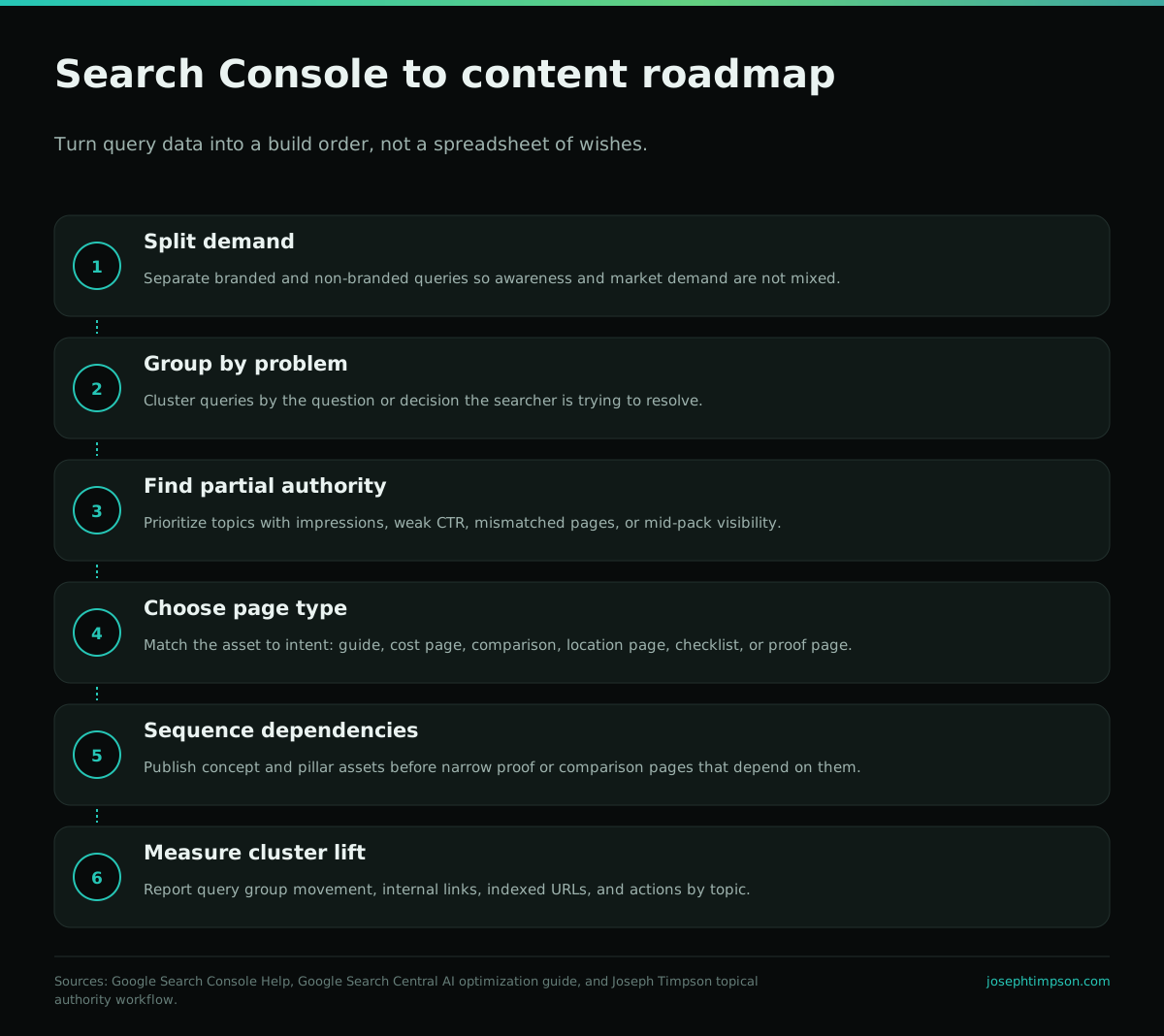
Step five: sequence by dependency
A roadmap is not a list of good ideas. It is an order of operations. The pillar or concept page should publish before the narrower proof page. The proof page should publish before the comparison page that cites it. The local results page should publish before the local case study page. The prioritization framework should publish before the sprint log.
That is why this August push starts with broad SEO concepts, then proof, then Search Console planning, then local results, then prioritization. The sequence teaches the reader how we think before asking them to believe a specific claim. It also gives the internal link graph a clean shape.
Step six: write the brief before the draft
The brief should name the target query family, intent, page type, parent concept, internal links, external sources, original proof element, CTA, and success metric. If those fields are empty, the draft is not ready. This is where we prevent content from becoming a loose essay.
The helpful content guide becomes practical here. A brief asks whether the page is made for the audience, whether it adds original value, and whether it leaves the reader satisfied. Those questions are better than asking whether the draft repeated the keyword enough times.
Bring the Search Console export and the offer. We will turn query noise into a build order.
Build my content roadmap→Step seven: measure by cluster
The final mistake is measuring each post alone. A single post can win, but topical authority compounds by cluster. Measure the topic group: impressions, clicks, indexed pages, internal links, conversions, and the specific business actions each group supports. The GEO reporting rule applies to standard SEO too. Report what the instrument can defend.
That is how five posts this month become more than five posts. They become one new cluster: SEO Concepts and Client Proof. The cluster gives the personal site a clearer bridge from "I publish evidence-first thinking" to "we can help you achieve results like this."
The agency handoff
This is where the personal site has to be clearer than a normal blog. A reader should not finish the page thinking Joseph only writes about search console content roadmap. The page should make the operating path obvious: if the problem is general SEO or GEO, Timpson Marketing owns the execution. If the problem is legal visibility, The SEO For Law Firms owns the vertical. If the problem is farm, ranch, or local agriculture marketing, Agriculture Marketing Agency owns the vertical. The personal site is the proof and routing layer above those teams.
That structure also protects the reader. It means a local farm is not forced into the same SEO package as a personal injury firm, and an agency owner looking for white-label GEO help is not routed through a farm-marketing offer. The concept has a commercial job: qualify the problem and route the prospect to the team most likely to create the result.
What we can help with
The practical help usually falls into one of four buckets. First, we can audit the site and show the largest constraint. Second, we can build or repair the measurement system so the owner can see what changed. Third, we can ship the pages, schema, internal links, speed fixes, local profile work, and proof assets that the constraint requires. Fourth, we can report the result without inflating weak numbers.
That is a stronger promise than "we can help with SEO" because it says how. It also avoids the guarantee trap. We do not control Google's final placement, an AI engine's citation choice, or a customer's buying mood. We do control the quality of the work, the clarity of the evidence, the speed of implementation, and the honesty of the report.
The next action
If this page describes the problem on your site, the next step is not a proposal. The next step is a working session. Bring the URL, the existing reports, and the result you want. We will look for the constraint, name the work that would remove it, and tell you whether the opportunity is real enough to pursue.
That is the point of this month-end SEO concepts cluster. It gives prospects the language to understand the work behind the proof wall. It lets Joseph say, plainly and defensibly, that we can help build the same kind of measured evidence for the right business.
Frequently asked questions
How do I use Search Console for a content roadmap?
Export queries and pages, split branded from non-branded demand, group queries by problem, identify partial authority, choose the right page type, and sequence content by dependency. Do not simply sort by impressions and write one post per keyword.
What is partial authority in SEO?
Partial authority is a query family where your site already earns impressions or weak rankings but does not fully satisfy the search intent. These opportunities are often easier to improve than topics where the site has no visibility at all.
Should I create a page for every Search Console query?
No. Group queries by intent and write the asset that answers the broader problem. Creating separate pages for every wording variation can produce thin, manipulative content and weak internal architecture.
Which Search Console metric matters most for content planning?
No single metric is enough. Impressions show opportunity, clicks show earned demand, CTR points to snippet or intent issues, and average position gives directional visibility. Read them together by query group and page.
How often should a content roadmap be refreshed?
For an active SEO program, review query groups monthly and rebuild priorities quarterly. Fresh Search Console data shows new partial authority, decay, and topic gaps that were not visible when the original roadmap was built.
How does Search Console content planning support AI search?
Search Console shows how Google already associates your site with demand. Since Google's AI features still rely on core Search systems, a roadmap that improves useful, crawlable, well-linked pages also strengthens AI search eligibility.
Sources
- Google Search Central. Optimizing your website for generative AI features on Google Search (Accessed 2026-08-27)
- Google Search Central. AI features and your website (Accessed 2026-08-27)
- Google Search Central. Search Engine Optimization Starter Guide (Accessed 2026-08-27)
- Google Search Central. Google Search technical requirements (Last updated 2025-12-18)
- Google Search Central. Creating helpful, reliable, people-first content (Accessed 2026-08-27)
- Google Search Central. Understanding Core Web Vitals and Google search results (Accessed 2026-08-27)
- Google Search Central. Do you need an SEO? (Accessed 2026-08-27)
- Google Search Console Help. What are impressions, position, and clicks? (Accessed 2026-08-27)
- Google Business Profile Help. Understand your Business Profile performance and insights (Accessed 2026-08-27)
- Google Search Central. Introduction to structured data markup in Google Search (Accessed 2026-08-27)
- Ahrefs. Update: 38% of AI Overview Citations Pull From The Top 10 (2026-03-02)
- Semrush. Semrush releases expanded 2026 AI Visibility Index (2026-06-26)
Joseph Timpson has worked in search since 2010 and runs Timpson Marketing out of St. George, Utah. He built The Cited Method, a five stage framework for earning and proving real citations in AI answers, and publishes what does not work alongside what does.
Want me to run this on your site and show you the before and after?
One call, no pitch deck. We look at what is actually blocking you and tell you the truth about whether we can help.
Book a free consultation →