The Proof Stack Behind Real SEO Results
A screenshot is not proof. It becomes proof only when the baseline, shipped work, crawl evidence, visibility movement, and business action all line up.

- SEO proof needs a sequence, not a single screenshot.
- Baseline and shipped-work logs make later results believable.
- Crawl and index evidence explain whether the work could even produce traffic.
- Business actions matter most, but they need clean tracking and cautious language.
The result is not the screenshot
The proof stack behind SEO results has five layers: baseline, shipped work, crawl and index evidence, visibility movement, and business action. A screenshot by itself is not proof. It becomes proof when it sits inside that sequence and when every layer can be rechecked.
A traffic screenshot can sell the dream and still fail as evidence. Maybe seasonality changed. Maybe paid traffic slipped into the organic bucket. Maybe one branded query spiked. Maybe the site already had momentum and the agency took credit for gravity. The job is not to hide those objections. The job is to build a proof stack that survives them.
The guardrails are not a private theory. Google's AI optimization guide says generative AI visibility still starts with ordinary SEO, while AI features and your website says there are no extra requirements for AI Overviews or AI Mode. The SEO starter guide, technical requirements, helpful content guide, Core Web Vitals guidance, Search Console metric definitions, and Business Profile performance docs give us the measurement spine.
No one can guarantee a #1 ranking on Google.
Indexing and serving aren't guaranteed.
A lot has changed since then.
Layer one: the baseline
Baseline proof records where the site stood before the work started. For a local business, that can include organic clicks, impressions, Business Profile calls, direction requests, website clicks, page speed, indexed pages, review count, and conversion events. For a national or niche authority site, the baseline may lean more heavily on Search Console query groups, indexed URLs, referring pages, crawl health, and assisted conversions.
The baseline is also where we refuse fake precision. Search Console uses impressions, clicks, CTR, and position in specific ways. Google Business Profile performance tracks actions such as calls and website clicks inside the profile surface. GA4 acquisition reports answer a different question again. A proof stack keeps those instruments separate.
Layer two: the shipped work
Shipped work is the layer most agencies under-report because it sounds less exciting than growth. That is a mistake. If the result is real, the work trail makes it believable. A clean log names the pages created or rewritten, schema added, internal links changed, speed fixes shipped, Business Profile updates made, citations corrected, and third-party mentions earned.
This is where the sales bridge becomes honest. When we say "we can help you achieve those results," we are not saying every client gets the same graph. We are saying the system that created the graph is repeatable: diagnose, prioritize, ship, verify, measure, and report. The exact slope changes by market, competition, domain age, budget, and offer quality.
Layer three: crawl and index evidence
A page cannot produce organic results if it never enters the indexable system. That sounds obvious, but it is one of the most common hidden failures. The page exists in WordPress, the owner approved it, the sitemap lists it, and nobody checks whether the crawler can fetch it with a success response and indexable text.
Google's technical requirements make the proof simple: the crawler is not blocked, the page returns a success status, and the page has indexable content. That is why crawler access audits are not just a GEO trick. They are the first layer of any serious SEO proof stack.
Layer four: visibility movement
Visibility proof is where most reports become too confident. A higher line is not automatically a result. A lower line is not automatically a failure. You have to ask what changed, how the metric is collected, whether the query mix changed, whether seasonality matters, and whether the movement is large enough to matter.
The AI Overview citation study from Ahrefs is a useful warning. Ahrefs reported that 37.9 percent of AI Overview cited URLs appeared in the first 10 result blocks in its 2026 analysis, far below its earlier top-ten relationship. That does not mean rankings stopped mattering. It means the proof stack has to track more than one visibility surface.
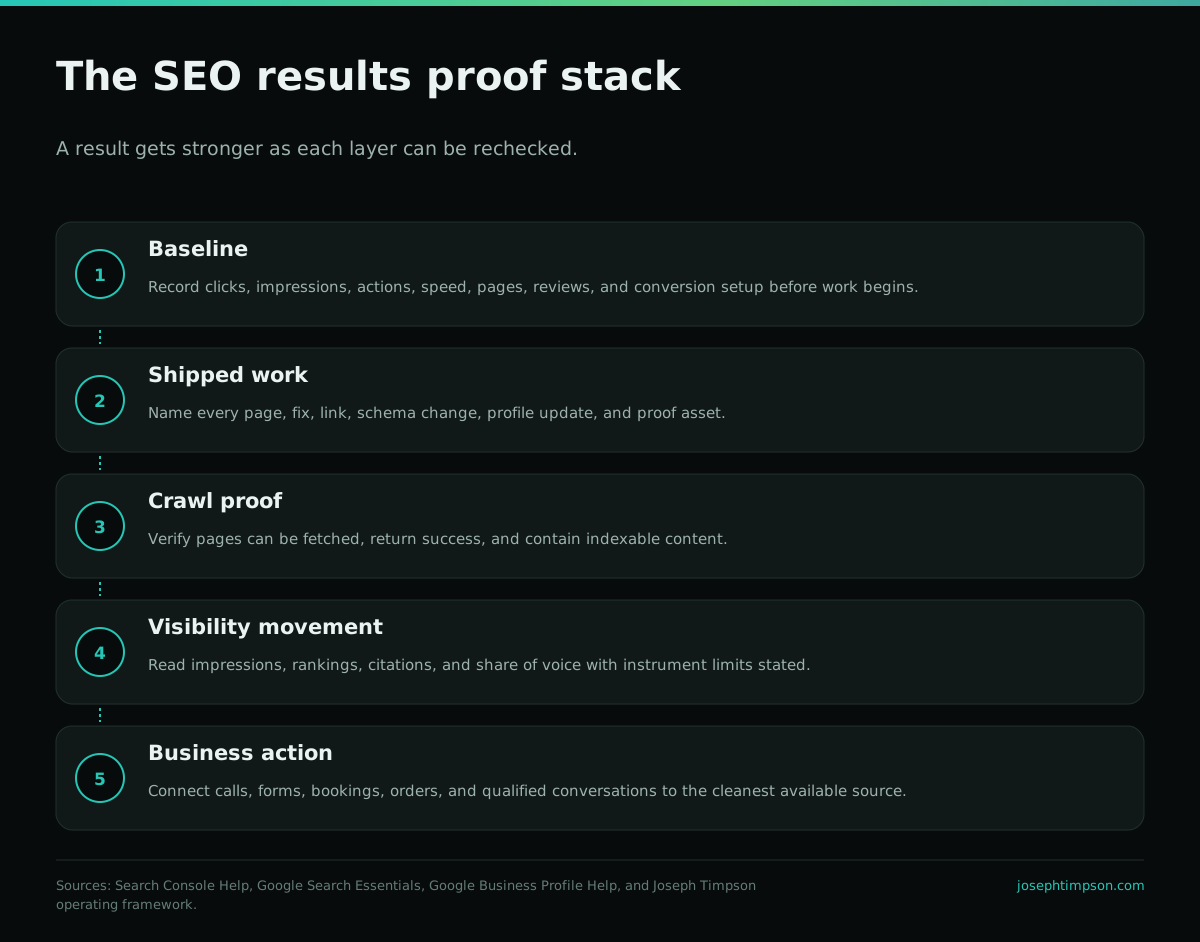
Layer five: business action
Business action is the layer clients feel. Calls, form fills, booked consultations, orders, direction requests, and qualified conversations matter more than raw rankings. But this layer is also the easiest to overclaim if tracking is dirty. A phone call from a Business Profile is not the same as an organic website form. A Calendly booking is not the same as a closed deal. A direct visit after an AI answer may never expose its source.
The proof stack has to label action honestly. If we know a lead came from organic search, say that. If we only know visibility rose and leads rose in the same period, say correlation. If we fixed Business Profile calls and calls rose, show the before and after. The commercial value comes from restraint, not theatrical certainty.
The proof wall test
Every result you show publicly should pass four questions. What was the starting point? What work shipped? What instrument recorded the change? What alternative explanation could explain it? If the proof cannot answer those questions, it belongs in an internal motivation folder, not on a sales page.
This is why anonymous proof can still be useful. A screenshot with a named client is stronger, but an anonymized screenshot with dates, instrument labels, and a clear explanation can still teach. For JosephTimpson.com, the next level is getting permission for named proof assets. Until then, the site should keep making the mechanism explicit.
If your site has results but you cannot explain why they happened, we can help turn the evidence into a system.
Bring me your proof stack→How this changes the sales conversation
A weak sales conversation asks the prospect to trust the agency. A strong one asks the prospect to inspect the operating system. Here is the baseline. Here is the shipped work. Here is the crawl proof. Here is the visibility movement. Here are the business actions. Here is what we know, what we suspect, and what we refuse to claim.
That is the message the personal site should carry across its next wave of posts. We are not selling a secret trick. We are selling disciplined execution with receipts. The proof stack makes the promise believable without pretending every market, timeline, or budget behaves the same way.
The agency handoff
This is where the personal site has to be clearer than a normal blog. A reader should not finish the page thinking Joseph only writes about seo results. The page should make the operating path obvious: if the problem is general SEO or GEO, Timpson Marketing owns the execution. If the problem is legal visibility, The SEO For Law Firms owns the vertical. If the problem is farm, ranch, or local agriculture marketing, Agriculture Marketing Agency owns the vertical. The personal site is the proof and routing layer above those teams.
That structure also protects the reader. It means a local farm is not forced into the same SEO package as a personal injury firm, and an agency owner looking for white-label GEO help is not routed through a farm-marketing offer. The concept has a commercial job: qualify the problem and route the prospect to the team most likely to create the result.
What we can help with
The practical help usually falls into one of four buckets. First, we can audit the site and show the largest constraint. Second, we can build or repair the measurement system so the owner can see what changed. Third, we can ship the pages, schema, internal links, speed fixes, local profile work, and proof assets that the constraint requires. Fourth, we can report the result without inflating weak numbers.
That is a stronger promise than "we can help with SEO" because it says how. It also avoids the guarantee trap. We do not control Google's final placement, an AI engine's citation choice, or a customer's buying mood. We do control the quality of the work, the clarity of the evidence, the speed of implementation, and the honesty of the report.
The next action
If this page describes the problem on your site, the next step is not a proposal. The next step is a working session. Bring the URL, the existing reports, and the result you want. We will look for the constraint, name the work that would remove it, and tell you whether the opportunity is real enough to pursue.
That is the point of this month-end SEO concepts cluster. It gives prospects the language to understand the work behind the proof wall. It lets Joseph say, plainly and defensibly, that we can help build the same kind of measured evidence for the right business.
Frequently asked questions
What counts as proof of SEO results?
Strong SEO proof includes the baseline, a log of shipped work, evidence that pages were crawlable and indexable, visibility movement from a defined instrument, and business actions such as calls, forms, bookings, or sales. One screenshot alone is not enough.
Can anonymous SEO results still be useful?
Yes, if they include dates, instrument labels, baseline context, and a clear explanation of what changed. Named case studies are stronger, but anonymized proof can still teach when it is specific and not exaggerated.
Why include shipped work in an SEO report?
Shipped work connects the result to the system that produced it. It names the pages, fixes, links, schema, profile updates, and proof assets created. Without that log, a result can look impressive but remain impossible to evaluate.
What is the difference between visibility and business action?
Visibility measures discovery, such as impressions, rankings, or citations. Business action measures what people did, such as calls, forms, bookings, or purchases. Both matter, but they should not be blended into one vague success claim.
How do you avoid overclaiming SEO results?
Label the instrument, name alternative explanations, separate correlation from causation, and avoid guarantee language. The safest report says what changed, what shipped, what the data proves, and what remains uncertain.
Why does crawl proof belong in an SEO case study?
Crawl proof shows that search engines could access and process the pages involved. If the pages were blocked, broken, or not indexable, the rest of the case study has a serious missing link.
Sources
- Google Search Central. Optimizing your website for generative AI features on Google Search (Accessed 2026-08-27)
- Google Search Central. AI features and your website (Accessed 2026-08-27)
- Google Search Central. Search Engine Optimization Starter Guide (Accessed 2026-08-27)
- Google Search Central. Google Search technical requirements (Last updated 2025-12-18)
- Google Search Central. Creating helpful, reliable, people-first content (Accessed 2026-08-27)
- Google Search Central. Understanding Core Web Vitals and Google search results (Accessed 2026-08-27)
- Google Search Central. Do you need an SEO? (Accessed 2026-08-27)
- Google Search Console Help. What are impressions, position, and clicks? (Accessed 2026-08-27)
- Google Business Profile Help. Understand your Business Profile performance and insights (Accessed 2026-08-27)
- Google Search Central. Introduction to structured data markup in Google Search (Accessed 2026-08-27)
- Ahrefs. Update: 38% of AI Overview Citations Pull From The Top 10 (2026-03-02)
- Semrush. Semrush releases expanded 2026 AI Visibility Index (2026-06-26)
Joseph Timpson has worked in search since 2010 and runs Timpson Marketing out of St. George, Utah. He built The Cited Method, a five stage framework for earning and proving real citations in AI answers, and publishes what does not work alongside what does.
Want me to run this on your site and show you the before and after?
One call, no pitch deck. We look at what is actually blocking you and tell you the truth about whether we can help.
Book a free consultation →