Six SEO Concepts That Create Client Results
The useful SEO concepts are not jargon. They are the sequence that turns a site from invisible, unclear, and unmeasured into something people and search systems can trust.

- SEO concepts only matter when they explain a repeatable sequence of work.
- The six-part stack is access, meaning, usefulness, entity proof, conversion, and measurement.
- AI search does not replace the stack. It makes the proof burden higher.
- A good sales page explains the operating system behind the results, not just the results.
The concept stack has to start before keywords
SEO concepts only matter when they describe a sequence of work that produces an observable change. For a client, that sequence is simple: make the page discoverable, make the offer understandable, make the proof believable, make the action trackable, then keep publishing until the topic has depth. Anything outside that sequence is usually vocabulary, not strategy.
Most SEO conversations start too late. They start with a phrase, a ranking target, a plugin score, or a competitor screenshot. That is how teams end up buying disconnected tasks. The better frame is a stack of six concepts that have to sit in order: access, meaning, usefulness, entity proof, conversion, and measurement. When a prospect sees that stack, the claim changes from "we do SEO" to "we can help you build the system that made these results possible."
The guardrails are not a private theory. Google's AI optimization guide says generative AI visibility still starts with ordinary SEO, while AI features and your website says there are no extra requirements for AI Overviews or AI Mode. The SEO starter guide, technical requirements, helpful content guide, Core Web Vitals guidance, Search Console metric definitions, and Business Profile performance docs give us the measurement spine.
SEO is still relevant for generative AI search.
No one can guarantee a #1 ranking on Google.
Indexing and serving aren't guaranteed.
Concept one: access
Access means search engines and AI retrieval systems can reach the work. It is not glamorous, but it is the first gate. A page that returns a blocked response, hides its useful text behind broken rendering, or ships with no indexable content does not enter the race. This is why our first SEO concept is not "content." It is "can the machine fetch and understand the page at all?"
Google's technical requirements reduce the minimum to three plain checks: Googlebot is not blocked, the page works with a success status, and the page has indexable content. Those checks are not a growth plan. They are the floor under every growth plan. For JosephTimpson.com, this is why the full-stack push verified live 200 responses, sitemap availability, bot access, and clean build output before treating the content library as an asset.
Concept two: meaning
Meaning is the second layer. Search engines have to understand what the page is about, which entity wrote it, which organization publishes it, and what problem it answers. This is where titles, headings, internal links, structured data, and the visible on-page claim all have to agree. If the page says one thing, the schema says another thing, and the internal links imply a third, the site is asking a retrieval system to resolve a contradiction.
The structured data introduction is useful because it does not pretend schema is magic. It says structured data gives explicit clues. That is the right phrase. Schema is not a win button. It is a disambiguation layer. It helps a crawler connect the visible page to the person, organization, service, image, article, and breadcrumb already present on the page.
Concept three: usefulness
Usefulness is where most SEO content fails. A page can be crawlable and semantically tidy and still be useless. It may say what every competitor says, cite nothing, show no first-hand evidence, and leave the reader no closer to a decision. Useful content answers the question, names the limit of the answer, and gives the next action.
Google's helpful content guidance is not an anti-AI essay. It is a test of audience intent. The practical question is whether a visitor leaves satisfied, not whether a page used a certain tool during drafting. That matters for our own site because the audience is not beginners looking for "what is SEO." It is owners and operators asking whether someone can produce results without inventing proof.
Concept four: entity proof
Entity proof is how a site stops being a pile of pages and starts being a source. The reader needs to know who Joseph is, what Timpson Marketing does, what The SEO For Law Firms does, what Agriculture Marketing Agency does, and how those pieces connect. Search systems also need the same connective tissue. A personal site with no entity graph is a biography. A personal site with proof, sameAs links, agency routing, and topical depth is an authority layer.
The reason this concept matters for sales is simple. People do not buy a methodology because the acronym is clever. They buy when the person and the operating brands look real, specific, and verifiable. That is why the site now bridges to the agencies and says we can help prospects build the same kind of evidence. The concept is not "personal branding." The concept is reducing uncertainty.
Concept five: conversion
Conversion is not the button at the bottom. It is the fit check that begins at the top of the page. A reader should know whether they are in the right place before they ever reach a form. For this site, the audience is not every business owner. It is the owner, marketer, agency partner, or professional service team that wants evidence-first SEO, AI visibility, local proof, or a clean path from visibility work to booked conversations.
That is why every concept post needs a commercial bridge. The page can teach openly and still say the quiet part clearly: if you want this done on your site, book a free consultation. The goal is not to trap the reader. The goal is to make the next step obvious for the person who recognizes the problem.
If your site has pieces of this stack but no operating system, bring the URL. We will tell you what is missing and whether we can help.
Book a free consultation→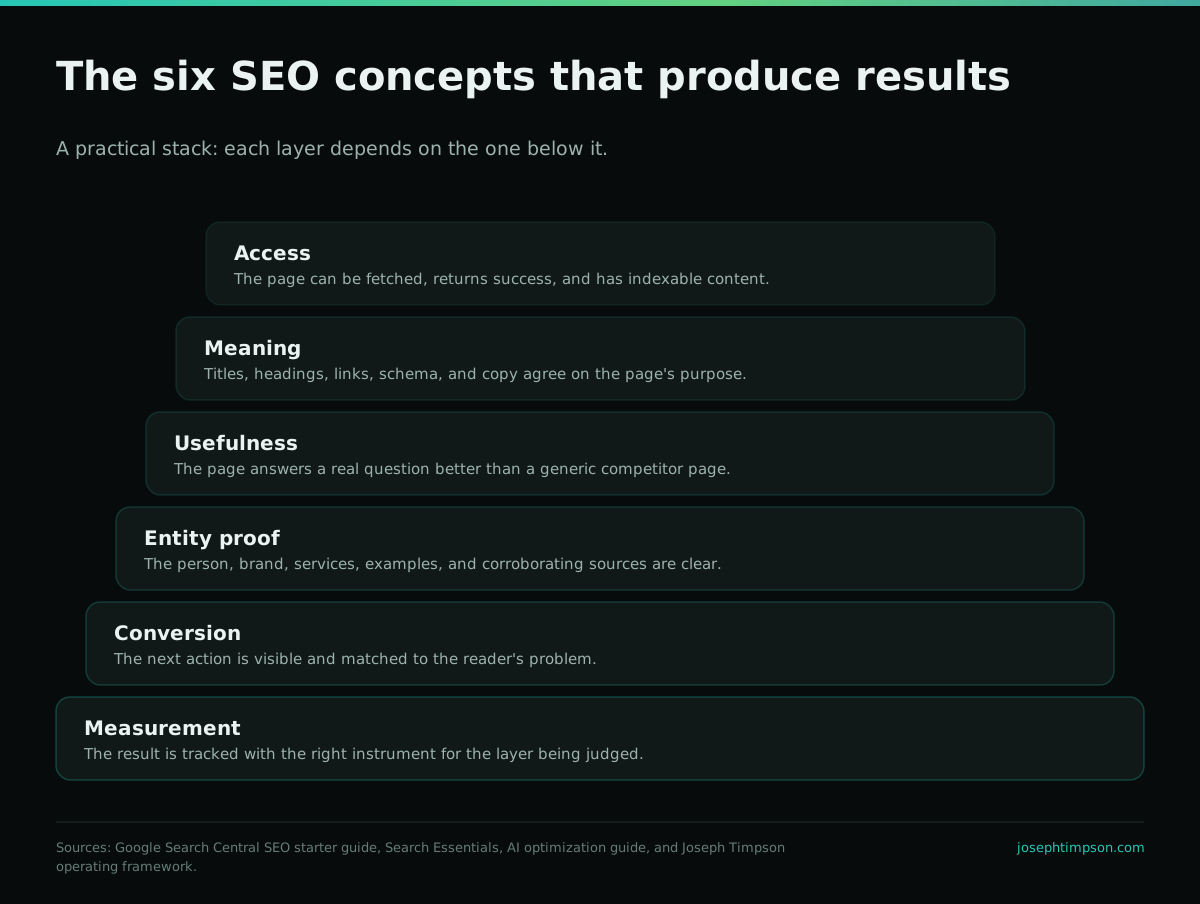
Concept six: measurement
Measurement keeps the previous five concepts honest. If we cannot show what changed, we should not narrate it as a result. That does not mean every result is revenue-attributed on day one. It means each layer has a proper instrument: crawl checks for access, indexed URLs for discoverability, Search Console for queries and clicks, Business Profile metrics for local interactions, GA4 for sessions and key events, and screenshots or exports for proof.
The Search Console definitions matter because impressions, clicks, and position are not interchangeable. The Business Profile performance docs matter because calls and website clicks are not the same as ranking. The measurement concept is not "make a dashboard." It is choosing the right proof for the layer of work being judged.
Where AI search fits in the stack
AI search does not replace the stack. It makes the stack less optional. Google's generative AI guidance says AI features are rooted in core Search ranking and quality systems, and Ahrefs found that AI Overview citations no longer map cleanly to ordinary top ten rankings. Both statements can be true. The page still needs SEO fundamentals, and citation eligibility now depends on being the best retrieved answer across related fan-out queries, not only the best page for one exact phrase.
That is why The Cited Method starts with access and measurement instead of hype. AI visibility work is still SEO, but the proof burden is higher. You need pages engines can fetch, claims engines can corroborate, and reporting that separates counted facts from sampled visibility estimates.
The client-facing version
Here is the clean way to say it to a prospect: we help make your site discoverable, understandable, useful, provable, and measurable. Then we keep building until your topic has enough depth that search engines and AI engines have a reason to trust you. That sentence is better than a menu of tactics because it names the result the tactics are supposed to produce.
The five August posts that follow this one expand the stack into proofs, roadmaps, local outcomes, and prioritization. The point is not to publish more words. The point is to make the personal site explain the work so clearly that a qualified visitor can look at the proof wall, read the method, and say: that is what we need.
The agency handoff
This is where the personal site has to be clearer than a normal blog. A reader should not finish the page thinking Joseph only writes about seo concepts. The page should make the operating path obvious: if the problem is general SEO or GEO, Timpson Marketing owns the execution. If the problem is legal visibility, The SEO For Law Firms owns the vertical. If the problem is farm, ranch, or local agriculture marketing, Agriculture Marketing Agency owns the vertical. The personal site is the proof and routing layer above those teams.
That structure also protects the reader. It means a local farm is not forced into the same SEO package as a personal injury firm, and an agency owner looking for white-label GEO help is not routed through a farm-marketing offer. The concept has a commercial job: qualify the problem and route the prospect to the team most likely to create the result.
What we can help with
The practical help usually falls into one of four buckets. First, we can audit the site and show the largest constraint. Second, we can build or repair the measurement system so the owner can see what changed. Third, we can ship the pages, schema, internal links, speed fixes, local profile work, and proof assets that the constraint requires. Fourth, we can report the result without inflating weak numbers.
That is a stronger promise than "we can help with SEO" because it says how. It also avoids the guarantee trap. We do not control Google's final placement, an AI engine's citation choice, or a customer's buying mood. We do control the quality of the work, the clarity of the evidence, the speed of implementation, and the honesty of the report.
The next action
If this page describes the problem on your site, the next step is not a proposal. The next step is a working session. Bring the URL, the existing reports, and the result you want. We will look for the constraint, name the work that would remove it, and tell you whether the opportunity is real enough to pursue.
That is the point of this month-end SEO concepts cluster. It gives prospects the language to understand the work behind the proof wall. It lets Joseph say, plainly and defensibly, that we can help build the same kind of measured evidence for the right business.
Frequently asked questions
What are the most important SEO concepts?
The most useful SEO concepts are access, meaning, usefulness, entity proof, conversion, and measurement. Access gets the page into the system. Meaning clarifies what it is. Usefulness satisfies the reader. Proof builds trust. Conversion turns attention into action. Measurement keeps the whole system honest.
Are SEO concepts different for AI search?
The foundations are the same, but the proof burden is higher. Google's guidance says AI features rely on foundational SEO practices. AI search adds retrieval, citation, and fan-out behavior, so a site needs clearer entities, stronger topical depth, and more careful measurement.
Why start SEO with access instead of content?
A page that cannot be crawled, returns the wrong status, or lacks indexable content cannot produce reliable search results. Content still matters, but technical eligibility comes first. Access is the floor under every content and authority decision.
How does entity proof help SEO?
Entity proof helps readers and search systems understand who is speaking, what organization stands behind the page, what services are offered, and what external sources corroborate the claim. It reduces ambiguity and makes the site easier to trust.
What makes an SEO concept useful for clients?
A useful SEO concept helps the client understand what work will be done, why it matters, how it connects to revenue, and how the result will be measured. If a concept cannot guide a decision or explain a result, it is probably just vocabulary.
Where should a business start if it wants better SEO results?
Start by checking whether your important pages are accessible, indexable, useful, internally linked, connected to proof, and tracked. The first fix should remove the largest bottleneck, not the task that sounds most fashionable.
Sources
- Google Search Central. Optimizing your website for generative AI features on Google Search (Accessed 2026-08-27)
- Google Search Central. AI features and your website (Accessed 2026-08-27)
- Google Search Central. Search Engine Optimization Starter Guide (Accessed 2026-08-27)
- Google Search Central. Google Search technical requirements (Last updated 2025-12-18)
- Google Search Central. Creating helpful, reliable, people-first content (Accessed 2026-08-27)
- Google Search Central. Understanding Core Web Vitals and Google search results (Accessed 2026-08-27)
- Google Search Central. Do you need an SEO? (Accessed 2026-08-27)
- Google Search Console Help. What are impressions, position, and clicks? (Accessed 2026-08-27)
- Google Business Profile Help. Understand your Business Profile performance and insights (Accessed 2026-08-27)
- Google Search Central. Introduction to structured data markup in Google Search (Accessed 2026-08-27)
- Ahrefs. Update: 38% of AI Overview Citations Pull From The Top 10 (2026-03-02)
- Semrush. Semrush releases expanded 2026 AI Visibility Index (2026-06-26)
Joseph Timpson has worked in search since 2010 and runs Timpson Marketing out of St. George, Utah. He built The Cited Method, a five stage framework for earning and proving real citations in AI answers, and publishes what does not work alongside what does.
Want me to run this on your site and show you the before and after?
One call, no pitch deck. We look at what is actually blocking you and tell you the truth about whether we can help.
Book a free consultation →