What to Fix First When SEO Is Not Moving
Most SEO waste comes from doing true things in the wrong order. This framework finds the bottleneck before anyone writes another page.

- Prioritize by bottleneck, not by the task that sounds most impressive.
- Fix access before content polish and fix intent before authority work.
- Visible proof should exist before schema describes it.
- Measurement can be the first fix if nobody can prove what changed.
The first fix is the one that removes the bottleneck
The best SEO prioritization framework starts with bottlenecks, not ideas. Fix blocked pages before rewriting copy, fix mismatched intent before adding links, fix weak proof before buying mentions, and fix measurement before declaring success.
SEO teams usually have too many ideas and too little sequencing. Rewrite the homepage. Add schema. Build service pages. Speed up the site. Get reviews. Publish blogs. Add citations. Fix titles. Run digital PR. All of those can be useful, but the wrong order wastes months. Prioritization is the discipline of finding the constraint.
The guardrails are not a private theory. Google's AI optimization guide says generative AI visibility still starts with ordinary SEO, while AI features and your website says there are no extra requirements for AI Overviews or AI Mode. The SEO starter guide, technical requirements, helpful content guide, Core Web Vitals guidance, Search Console metric definitions, and Business Profile performance docs give us the measurement spine.
Indexing and serving aren't guaranteed.
No one can guarantee a #1 ranking on Google.
SEO is still relevant for generative AI search.
Gate one: can the page qualify?
The first gate is qualification. If the page cannot be crawled, returns the wrong status, lacks indexable text, or violates basic technical requirements, everything else waits. Do not polish a page that cannot enter the system. Do not write ten more pages under a template that blocks the useful text. Do not build links to a URL that canonicalizes somewhere else by accident.
Google's technical requirements are the simplest prioritization tool in the stack. A page needs access, a success response, and indexable content. If one of those is broken, it is a P0. That is true for ordinary SEO and for generative AI features, because Google's AI features guidance points back to the same foundational SEO practices.
Gate two: does the page satisfy the intent?
If the page qualifies technically, ask whether it satisfies the searcher's intent. This is where many sites with "good SEO" stall. They have service pages, but the service pages answer the wrong question. They have blog posts, but the posts attract people who will never buy. They have location pages, but no local proof. They have schema, but the visible page is thin.
The helpful content guide is useful as a prioritization document because it asks whether content is made for people and whether it leaves them satisfied. A page that fails that test needs a content fix before it needs more backlinks.
Gate three: does the site prove the claim?
Once the page is technically eligible and useful, proof becomes the constraint. A competitor may outrank you because they show staff, case results, project photos, review language, original data, comparison tables, pricing clarity, or named credentials. If your page has claims and theirs has evidence, the next fix is not another generic paragraph.
This is the core idea behind the SEO results proof stack. Proof reduces uncertainty. It also gives search systems more specific entities, relationships, images, and corroborating language to process. Structured data can help organize that proof, but Google's structured data documentation is clear that markup should describe content on the page. The proof has to be visible first.
| Do first | Do later | |
|---|---|---|
| Googlebot cannot fetch the page | Access, status, indexable content | Copy polish and design detail |
| Page ranks for the wrong intent | Rebuild the page around the query family | More internal links to the wrong page |
| Page makes unsupported claims | Add proof, sources, examples, reviews, photos | Schema that describes proof not yet visible |
| Leads are not tracked | Fix GA4, forms, calls, booking events | Storytelling about ROI |
| Topic is shallow sitewide | Build cluster depth and internal links | One-off blog posts with no pillar |
Gate four: does the topic have depth?
If the page is eligible, useful, and believable, the next constraint may be topical depth. One strong page can rank, but a site that covers a topic from multiple angles has more ways to be retrieved, cited, and trusted. This is why topic clusters still matter. They are not content volume. They are evidence that the site has a center of expertise.
Google's AI optimization guide describes query fan-out and warns against creating separate pages for every variation just to manipulate rankings. The practical middle is a cluster with real intent boundaries: a concept page, proof page, roadmap page, local page, and prioritization page. That is exactly what this August push adds.
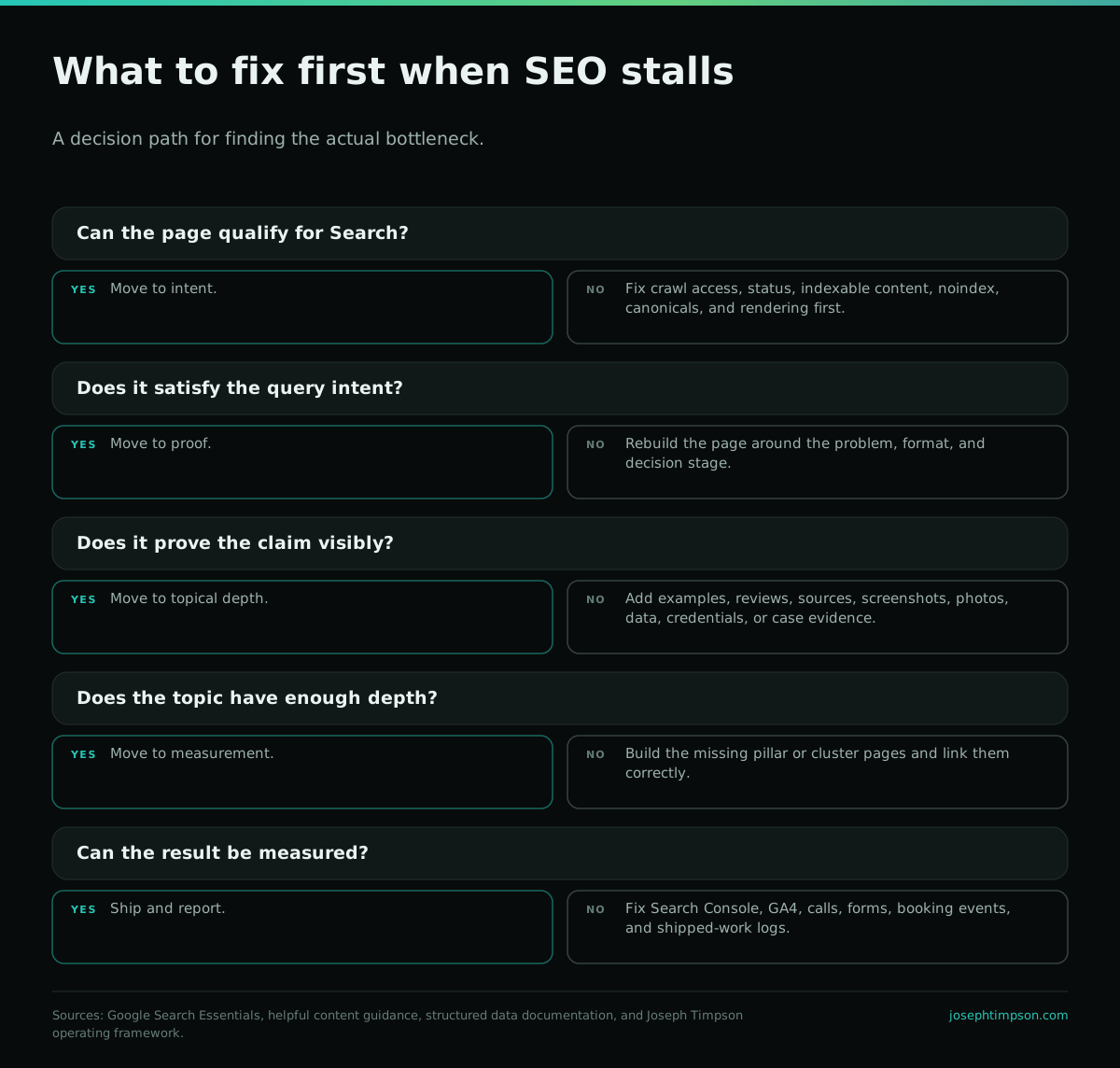
Gate five: can you measure the result?
Measurement can be the bottleneck too. If the site has no Search Console, no GA4 events, no call tracking, no Business Profile history, and no shipped-work log, then the next fix is instrumentation. Otherwise, every report turns into opinion.
The Search Console metric definitions, Business Profile performance docs, and Core Web Vitals guidance each measure a different layer. A prioritization framework chooses the instrument before promising the outcome.
Bring the backlog, the site, and the reports. We will find the constraint before anyone writes another page.
Prioritize my SEO backlog→A practical scoring model
Score each candidate task on four questions: does it remove a hard blocker, does it affect a money page or topic cluster, does it create visible proof, and can the result be measured within the next reporting cycle? A task that scores high on all four goes first. A task that scores low on all four goes into the parking lot, even if it sounds impressive.
This model is intentionally plain. It beats complexity because most SEO waste comes from doing true things in the wrong order. Core Web Vitals matter, but not before the page exists. Schema matters, but not before the proof is visible. Content matters, but not before the query intent is understood. Links matter, but not before the target deserves to win.
How we use this on JosephTimpson.com
The personal site needed the same discipline. The first push fixed the conversion bridge, exposed the 30-post insight library, submitted the sitemap, verified Search Console, installed GA4, and checked crawler access. The next constraint is concept clarity: making the SEO offer understandable to people who want the results shown in the proof wall.
That is why the next five posts are not random. They make the offer legible: SEO concepts, proof stack, Search Console roadmap, local results map, and prioritization framework. The site now has a clearer path from "here are results" to "we can help you build the system behind them."
The agency handoff
This is where the personal site has to be clearer than a normal blog. A reader should not finish the page thinking Joseph only writes about seo prioritization framework. The page should make the operating path obvious: if the problem is general SEO or GEO, Timpson Marketing owns the execution. If the problem is legal visibility, The SEO For Law Firms owns the vertical. If the problem is farm, ranch, or local agriculture marketing, Agriculture Marketing Agency owns the vertical. The personal site is the proof and routing layer above those teams.
That structure also protects the reader. It means a local farm is not forced into the same SEO package as a personal injury firm, and an agency owner looking for white-label GEO help is not routed through a farm-marketing offer. The concept has a commercial job: qualify the problem and route the prospect to the team most likely to create the result.
What we can help with
The practical help usually falls into one of four buckets. First, we can audit the site and show the largest constraint. Second, we can build or repair the measurement system so the owner can see what changed. Third, we can ship the pages, schema, internal links, speed fixes, local profile work, and proof assets that the constraint requires. Fourth, we can report the result without inflating weak numbers.
That is a stronger promise than "we can help with SEO" because it says how. It also avoids the guarantee trap. We do not control Google's final placement, an AI engine's citation choice, or a customer's buying mood. We do control the quality of the work, the clarity of the evidence, the speed of implementation, and the honesty of the report.
The next action
If this page describes the problem on your site, the next step is not a proposal. The next step is a working session. Bring the URL, the existing reports, and the result you want. We will look for the constraint, name the work that would remove it, and tell you whether the opportunity is real enough to pursue.
That is the point of this month-end SEO concepts cluster. It gives prospects the language to understand the work behind the proof wall. It lets Joseph say, plainly and defensibly, that we can help build the same kind of measured evidence for the right business.
Frequently asked questions
What SEO work should I prioritize first?
Prioritize the bottleneck. If pages are blocked or not indexable, fix access first. If pages qualify but miss intent, fix content. If content is useful but not trusted, add proof. If work cannot be measured, fix tracking.
How do I prioritize an SEO backlog?
Score each task by whether it removes a blocker, affects a money page or topic cluster, creates visible proof, and can be measured soon. Tasks that score high across those questions should move ahead of cosmetic or speculative work.
Should technical SEO always come before content?
Technical SEO comes first when it blocks crawling, indexing, rendering, or user experience. If the technical floor is sound, content and proof may be the larger constraint. The framework chooses the constraint, not a universal department order.
When should schema be prioritized?
Prioritize schema after the visible page already contains the entity, proof, service, article, product, FAQ, or breadcrumb information being marked up. Structured data should clarify visible content, not replace it.
How does this framework apply to AI search?
AI search still depends on accessible, useful, well-structured, trustworthy content. The framework applies directly: qualify the page, satisfy the intent, prove the claim, build topic depth, and measure visibility with honest instruments.
What is the biggest SEO prioritization mistake?
The biggest mistake is doing true tasks in the wrong order. Publishing more content will not fix blocked pages. Adding schema will not fix weak proof. Building links will not fix a page that answers the wrong intent.
Sources
- Google Search Central. Optimizing your website for generative AI features on Google Search (Accessed 2026-08-27)
- Google Search Central. AI features and your website (Accessed 2026-08-27)
- Google Search Central. Search Engine Optimization Starter Guide (Accessed 2026-08-27)
- Google Search Central. Google Search technical requirements (Last updated 2025-12-18)
- Google Search Central. Creating helpful, reliable, people-first content (Accessed 2026-08-27)
- Google Search Central. Understanding Core Web Vitals and Google search results (Accessed 2026-08-27)
- Google Search Central. Do you need an SEO? (Accessed 2026-08-27)
- Google Search Console Help. What are impressions, position, and clicks? (Accessed 2026-08-27)
- Google Business Profile Help. Understand your Business Profile performance and insights (Accessed 2026-08-27)
- Google Search Central. Introduction to structured data markup in Google Search (Accessed 2026-08-27)
- Ahrefs. Update: 38% of AI Overview Citations Pull From The Top 10 (2026-03-02)
- Semrush. Semrush releases expanded 2026 AI Visibility Index (2026-06-26)
Joseph Timpson has worked in search since 2010 and runs Timpson Marketing out of St. George, Utah. He built The Cited Method, a five stage framework for earning and proving real citations in AI answers, and publishes what does not work alongside what does.
Want me to run this on your site and show you the before and after?
One call, no pitch deck. We look at what is actually blocking you and tell you the truth about whether we can help.
Book a free consultation →