Ranking First Is Not the Strongest Citation Predictor
Nine published analyses put the overlap between AI citations and top ranking pages anywhere from 12% to 90%. All nine are real. The advice built on them is built on the wrong number.

- Published overlap figures between AI Overview citations and Google's top 10 currently range from 12% (Ahrefs, for ChatGPT, Gemini and Copilot) to 90% (seoClarity, per AI Overview). Both were competently measured.
- The range exists because three different quantities are being reported under one label: per AI Overview overlap, per citation origin, and per URL conversion rate.
- Only the third answers the question a site owner is actually asking. Ahrefs measured it at about 50% for a number one ranking, seoClarity at 43% in AI Overviews and 25% in AI Mode.
- Ahrefs' own Spearman correlation between top 10 ranking and AI Overview citation is 0.347. Surfer measured fan out coverage at 0.77 and Ahrefs measured branded web mentions at 0.664. Two things out correlate rank.
- Ranking well is table stakes, not the lever. Crawler access, subquery coverage and off site mentions are where the marginal citation is won.
Nine published figures, one question, no agreement
Rank number one in Google and you appear in the top three AI Overview citations about half the time. That is Ahrefs' own measurement, from the same 1 million AI Overview dataset whose headline number gets quoted to prove that ranking is the whole job.
Half. At the single best position on the internet.
AI Overviews do cite top ranking pages, but ranking is a weak predictor of being cited. Published overlap figures range from 12% to 90% because they measure three different things. The one that matters to a site owner, whether a ranking page actually gets cited, is measured at roughly 25% to 50% at position one and drops fast from there.
Here is every published overlap figure I could fetch and verify, side by side. To my knowledge nobody has put them in one table, which is exactly why the bad advice survives.
| Analysis | Published | Population | Figure | What it counts |
|---|---|---|---|---|
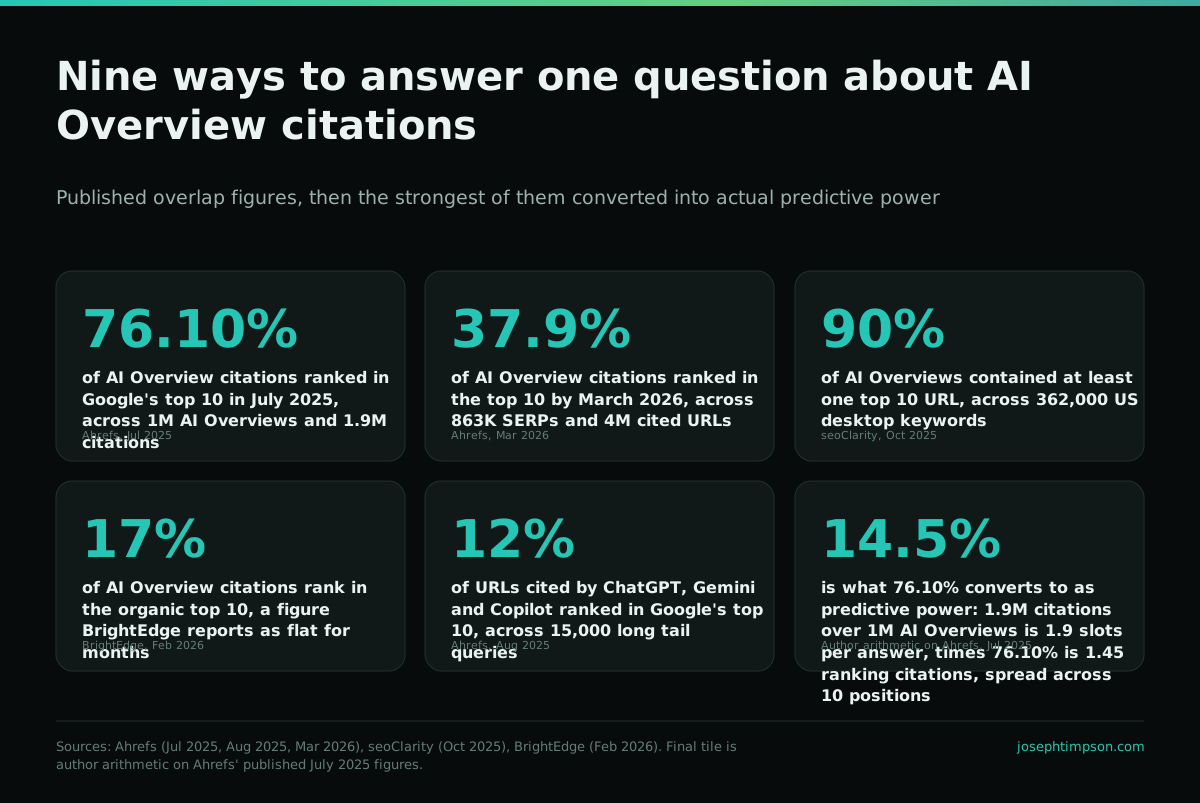
| Ahrefs | Jul 2025 | 1M AI Overviews, 1.9M citations | 76.10% | citations that ranked top 10 |
| Ahrefs | Mar 2026 | 863K SERPs, 4M cited URLs | 37.9% | citations that ranked top 10 |
| Ahrefs | Aug 2025 | 15,000 long tail queries, 4 assistants | 12% | ChatGPT, Gemini and Copilot citations in Google's top 10 (Perplexity 28.6%) |
| seoClarity | Oct 2025 | 362,000 US desktop keywords | 90% | AI Overviews containing a top 10 URL |
| seoClarity | Oct 2025 | 1,000 US transactional queries | 19% | AI Mode citations from the top 20 |
| Surfer | Dec 2025 | 10,000 keywords, 173,902 URLs | 32.18% | citations ranking top 10 for the query or a fan out |
| Semrush | Jul 2025 | 5,000 keywords, 150K citations | 67% | URL overlap, AI Overviews against top 10 |
| BrightEdge | Feb 2026 | tracked set, 9 industries | ~17% | citations ranking in the organic top 10 |
| Originality.AI | Nov 2025 | citations that rank in the top 100 | 52.5% | ranking citations that sit in the top 10 |
One note on the Surfer row. Surfer publishes the inverse, 67.82%, so the 32.18% is my subtraction, not theirs.
A seven fold spread across nine competent studies is not a measurement problem. It is a definition problem. It belongs on the same shelf as the other GEO claims that fall apart on inspection, except this one is worse, because the underlying research is good and only the interpretation is broken.
Three different questions wearing the same number
Strip the labels off and the studies split into three groups.
Per AI Overview overlap. Does this AI Overview contain at least one URL that also ranks? seoClarity found 90% for the top 10 and 94% for the top 20 across 362,000 keywords. This is the highest number in the domain and the least useful, because you do not own the AI Overview. You own one URL.
Per citation origin. Of all the citation slots handed out, what share went to a ranking page? This is where Ahrefs' 76.10% and 37.9% live, along with BrightEdge's 17% and Semrush's 67%. Better, but still backwards. It describes the population of winners, not your odds of joining it.
Per URL conversion. If my page ranks, does it get cited? This is the only one that answers the operator's question, and it is the least reported.
There is a fourth confusion sitting underneath all three, which is that a citation is not a mention and neither is a recommendation. A page can be used as a source without the brand ever appearing in the answer text. Keep citations and recommendations separated or the overlap debate gets even muddier than it already is.
Watch what happens inside a single study when you move from the first question to the third. seoClarity's AI Overviews work reports 90% overlap in the headline and a 43% appearance rate for position one URLs in the body, falling to 7% by position 20. Same author, same dataset, same week. The number the industry repeats is more than double the number a site owner can act on.
The AI Mode companion study is starker still.
Simply ranking for the primary query itself is no longer sufficient to guarantee inclusion in AI Mode.
Gandhi's 1,000 query AI Mode analysis found 81% of queries had at least one AI Mode citation from the top 20, which sounds like a strong endorsement of ranking. In the same study, only 19% of total AI Mode citations came from the top 20, and a number one ranking converted to an AI Mode citation 25% of the time. One study, three numbers, and the pitch deck only ever uses the first.
The arithmetic that turns overlap into predictive power
Take the strongest overlap figure ever published, Ahrefs' 76.10%, and convert it.
Ahrefs studied 1.9 million citations across 1 million AI Overviews, capped at the top three citations per response. That is 1.9 studied citation slots per AI Overview. If 76.10% of those slots went to top 10 pages, then 1.45 slots per AI Overview landed on a ranking page. Spread across the ten positions in the top 10, the average top 10 page took one of those slots about 14.5% of the time.
That is my arithmetic on Ahrefs' published figures, not a number Ahrefs states, and it assumes an even spread across the ten positions. The spread is not even, which is the point. Ahrefs measured the top of that curve directly.
Even pages ranking #1 only appear in the top three cited links in AI Overviews about 50% of the time.
So the curve runs from about 50% at position one down to a 14.5% average across the ten. Run the same conversion on the 2026 data and you get a similar shape: 4 million cited URLs across 863,000 SERPs is 4.6 citations per AI Overview, of which 37.9% ranked top 10, which is 1.76 ranking citations spread across ten positions, or 17.6% each. One caveat on my own arithmetic: the 2025 set was capped at the top three citations per answer and the 2026 set was not, so 14.5% is the odds of taking a top three slot and 17.6% is the odds of taking any slot. Different quantities, same order of magnitude, two datasets eight months apart both landing in the mid teens.
And seoClarity's directly measured curve, 43% at position one falling to 7% at position 20, brackets that average from an entirely separate sample of 362,000 keywords. Three methods, one answer. A top 10 ranking buys you a coin flip at best and something closer to a one in six shot on average.
A fourth analysis lands in the same place from the opposite direction. Originality.AI restricted its sample to citations that rank in the top 100 at all, which is the most generous framing available, and still found the single best position carries very little of the load.
The top-ranked document alone accounts for 8 percent of all citations.
Eight percent. That is the share of the entire citation pool held by every number one ranking page in the study combined. Any strategy whose whole thesis is "get to number one" is competing for the smallest slice on the board, at the highest cost per unit of movement.
| The overlap question | The prediction question | |
|---|---|---|
| What it asks | Given a citation, did that page rank? | Given a ranking, did that page get cited? |
| Ahrefs, Jul 2025 | 76.10% of citations ranked top 10 | about 50% at position one |
| seoClarity AI Overviews, Oct 2025 | 90% of AI Overviews held a ranking URL | 43% at position one |
| seoClarity AI Mode, Oct 2025 | 81% of queries held a top 20 citation | 25% at rank one |
| Who it serves | Headlines and vendor decks | Anyone who owns exactly one URL |
Rank is a moderate correlate, and two things out correlate it
Ahrefs put a number on the relationship rather than leaving it qualitative. The Spearman correlation between ranking in the top 10 and being cited in the top three AI Overview slots is 0.347. Moderate. Real, but moderate.
Now put that next to the other measured correlates in the same domain.
That is the ranking of predictors, and organic rank finishes third. Branded web mentions correlate at 0.664 against backlinks at 0.218 across 75,000 brands, and Surfer found pages ranking for both the head query and its fan outs were 161% more likely to be cited than pages ranking for the head query alone.
All three are correlations and none of them prove causation. Ahrefs says so on the page. I am not claiming fan out coverage causes citations. I am claiming that if you are going to build strategy on correlation strength, and the industry plainly is, then you should at least build it on the strongest correlation available rather than the third strongest. That is why subtopic coverage and fan out mapping sits ahead of head keyword rank in my order of operations, and why earned brand mentions sit ahead of both.
If your AI visibility plan currently reads "rank top three and citations follow," the numbers above are the reason it has not worked. I will walk your actual citation data with you.
Book a working session→The citations that came from nowhere
The overlap conversation quietly assumes every cited page ranks somewhere. A large share do not rank at all.
Ahrefs' March 2026 breakdown splits into near thirds: 37.9% top 10, 31.2% at positions 11 to 100, and 31.0% beyond position 100. In July 2025 that last bucket, citations from pages not ranking in the top 100 at all, was 14.40%. It roughly doubled in eight months. Restrict the 2026 count to organic blue links and it is 36.70%.
Surfer went further and checked the fan outs too.
67.82% of AIO citations in our sample didn't rank in the top 10 at all
Hardwick's qualifier is the important part: not for the main query, and not for any of the 33,000 fan out queries his team extracted. Two thirds of citations came from pages that were not in the top 10 for anything the AI Overview was plausibly retrieving against.
Where do they come from? YouTube alone accounts for 18.2% of non ranking AI Overview citations and 5.6% of all AI Overview citations, up 34% in six months. A domain with no organic ranking in your SERP is taking a citation slot you were told belonged to the top 10.
Widen the lens past Google's own product and the floor drops through. Ahrefs ran 15,000 long tail queries through four assistants and found only 12% of links cited by ChatGPT, Gemini and Copilot appeared in Google's top 10 for the same prompt, and roughly 10% in Bing's. Perplexity is the exception in that same study at 28.6%, which is itself the lesson: the overlap you get is a property of the engine you asked, not a law of AI search. If your entire AI strategy is a ranking strategy, you have optimized for the one surface where the assumption is least wrong, and abandoned the rest. Sorting out which engine actually cites you and from where is a different exercise from a rank report.
Why the number moved, and why one vendor says it never did
The mechanism is not mysterious. Google published it in its own AI Mode announcement, in plain language, more than a year before the vendor studies started disagreeing about the consequences.
AI Mode uses our query fan-out technique, breaking down your question into subtopics and issuing a multitude of queries simultaneously on your behalf.
If the retrieval substrate is a fan of subquery SERPs rather than the head query SERP, then measuring citations against the head query SERP will show declining overlap even with no change in Google's preferences. Ahrefs reads it the same way, noting the system is now selecting far fewer pages straight from the original SERP. Search Engine Journal's Matt G. Southern put the operator consequence plainly: optimizing for a single keyword and ranking well for it may not be enough.
Here is the part I have not seen anyone say out loud. BrightEdge, tracking its own keyword set across nine industries, reports about 17% top 10 overlap and states the figure has been flat for months. Ahrefs reports the same quantity falling from 76% to 38% over roughly the same window. Those two trend lines cannot both describe the same underlying thing.
BrightEdge's own September 2025 analysis reported overlap rising from 32.3% to 54.5% over sixteen months, which is a third BrightEdge number in a third direction. The reconciliation is almost certainly definitional: 54.5% counts citations that rank organically anywhere, 17% counts citations that rank in the top 10. One vendor, two thresholds, a three fold gap, and no shared vocabulary to flag it.
What I do with this instead
Rank is table stakes. Google's documentation is unambiguous that a page must be indexed and eligible to appear with a snippet before any AI feature can use it. That is a floor, not a lever, and treating a floor as a lever is how agencies end up selling rank reports as AI strategy.
Confirm access
If OAI-SearchBot or Claude-SearchBot is being challenged or blocked, nothing downstream is measurable. This is mechanical, cheap, and skipped constantly.
Freeze a baseline
Sample a defensible prompt set repeatedly before changing anything, because single run screenshots are noise.
Map the citation set
Pull who is actually cited for your prompts and where those URLs rank. Most operators have never looked.
Cover the subqueries
Fan out coverage carries the strongest published correlation. Build breadth of subtopic, not length of page.
Earn the mentions
Branded web mentions out correlate backlinks by roughly three to one. Earn them, never buy them.
Notice what is not on that list. Not schema, which Ahrefs tested on 1,885 pages against 4,000 controls and found no meaningful uplift on any platform. Not llms.txt, which the largest published study could not connect to citation at all. Not a rank push from position 6 to position 3 sold as an AI citation play.
If your ranking already sits in the top 10 and you are not being cited, more of the same ranking work is the least likely fix. Even at position one, the two studies that measured conversion directly put non conversion at 50% and 57%, and the average across the full top 10 is far worse than that. You are in the majority, and the reason is upstream in crawler access or sideways in coverage and mentions. That is the whole argument for running the ACCESS and MAP stages before touching content.
One last thing worth saying, because it changes the economics of this whole debate. Winning the citation and winning the click are now separate outcomes, and what AI Overviews do to click through rate means a cited page is not automatically a visited page. Chasing citations as if they were rankings repeats the same category error one level up.
Ranking first is necessary in the same way a passport is necessary for a flight. Nobody boards on the strength of the passport alone. If you want the rest of the working, every evidence audit in this series takes one industry claim and tries to break it, and you can put your own data in front of me if you would rather skip to the part where it applies to you.
Frequently asked questions
Do AI Overviews cite top ranking pages?
Yes, but less than the industry assumes. Ahrefs measured 37.9% of AI Overview citations coming from top 10 pages in March 2026, down from 76.10% in July 2025. BrightEdge measures the same quantity at roughly 17% and reports it flat.
If I rank number one, will I get cited in the AI Overview?
Roughly half the time at best. Ahrefs found number one ranking pages appear in the top three AI Overview citations about 50% of the time. seoClarity measured 43% appearance for position one URLs, and 25% for rank one in AI Mode.
Why do published overlap figures disagree so badly?
Because they measure three different things. Per AI Overview overlap asks whether any ranking URL appears. Per citation origin asks what share of slots went to ranking pages. Per URL conversion asks whether your ranking page got cited. Only the third is actionable.
Is organic rank the strongest predictor of AI citation?
No. Ahrefs measured a Spearman correlation of 0.347 between top 10 ranking and AI Overview citation. Surfer measured fan out query coverage at 0.77 and Ahrefs measured branded web mentions at 0.664 across 75,000 brands. Two measured factors out correlate organic rank, though all three are correlations rather than proven causes.
What share of AI Overview citations do not rank at all?
Ahrefs found 31.0% of AI Overview citations came from pages beyond position 100, rising to 36.70% when the count is restricted to organic blue links. In July 2025 that same bucket was 14.40%, so it roughly doubled in eight months. YouTube alone supplies 18.2% of non ranking citations.
Does this mean rankings no longer matter?
No. Google requires a page to be indexed and snippet eligible before any AI feature can use it, so ranking work remains the floor. The error is treating that floor as the lever. Rank qualifies you, coverage and mentions select you.
Do the same overlap numbers apply to ChatGPT and Perplexity?
No, and the gap is large. Ahrefs found only 12% of URLs cited by ChatGPT, Gemini and Copilot ranked in Google's top 10 across 15,000 long tail queries. Semrush separately measured Perplexity above 91% domain overlap with the same top 10. Treat each engine as a separate surface with its own answer.
How should I measure whether ranking is working for AI visibility?
Sample a fixed prompt set repeatedly rather than screenshotting a single run, then join every cited URL to its organic position for the same query. Report the conversion rate from ranking to citation, not the overlap share, because overlap describes the winners and conversion describes your odds.
Sources
- Ahrefs. 76% of AI Overview Citations Pull From the Top 10 (2025-07)
- Ahrefs. Does Ranking Higher on Google Mean You'll Get Cited in AI Overviews? (2025-07)
- Ahrefs. Update: 38% of AI Overview Citations Pull From The Top 10 (2026-03)
- Ahrefs. Only 12% of AI Cited URLs Rank in Google's Top 10 for the Original Prompt (2025-08)
- seoClarity. The Overlap Between AI Overviews and Organic Rankings (2025-10)
- seoClarity. Do Better Google Rankings Translate to AI Mode Visibility? (2025-10)
- Surfer. The Impact of Query Fan-Out on AI Overview Citations (2025-12)
- Semrush. How Google's AI Mode Compares to Traditional Search and Other LLMs (2025-07)
- BrightEdge. AI Overviews at the One-Year Mark: Presence, Size, and What They're Citing (2026-02)
- BrightEdge. Rank Overlap After 16 Months of AI Overviews (2025-09)
- Originality.AI. Google Ranking and AI Citations Study (2025-11)
- Search Engine Journal. Google AI Overview Citations From Top-Ranking Pages Drop Sharply (2026-03)
- Google Search Central. AI Features and Your Website (2025-12)
- Ahrefs. Ahrefs Study: Branded Web Mentions Correlate With AI Overview Visibility (2025-05)
- Ahrefs. Does Schema Markup Help AI Citations? We Analyzed 1,885 Pages (2026-05)
- Google. AI Mode in Search: Google I/O 2025 Update (2025-05)
Joseph Timpson has worked in search since 2010 and runs Timpson Marketing out of St. George, Utah. He built The Cited Method, a five stage framework for earning and proving real citations in AI answers, and publishes what does not work alongside what does.
Want me to run this on your site and show you the before and after?
One call, no pitch deck. We look at what is actually blocking you and tell you the truth about whether we can help.
Book a free consultation →