At What Price Does a GEO Retainer Make Money?
Every pricing guide in this category surveys what other agencies charge. None of them work the arithmetic from hours to loaded cost to the price where the account stops losing money.

- The $75 to $125 an hour that GEO pricing guides call labor cost is a billing rate, not a cost. Nobody in the category derives it from a salary.
- BLS puts benefits at 30.1% of private industry employer compensation cost, so a $85,000 strategist at 70% utilization costs $83.52 per billable hour before overhead.
- A 26 hour monthly GEO scope costs about $2,567 to deliver at loaded cost. The market's entry tier of $1,000 to $2,500 sits at or below that line.
- Run Parakeeto's fee formula at a 65% project delivery margin and that same scope prices at roughly $7,334 a month, not $2,500.
- Twelve hours of monthly scope creep on one account costs $1,125 a month and $13,500 a year. That is the number to price, and almost nobody does.
The $75 an hour that is not a cost
Every GEO pricing guide currently ranking for this term makes the same arithmetic error, and it is not a small one.
DemandLocal's packaging guide prices a GEO strategist at $75 to $125 an hour and a content specialist at $50 to $85, then calls the result labor cost. Capston's agency model assumes 40 hours at $100 an hour blended for a setup engagement and never says where $100 came from. Those are billing rates wearing a cost label. If your cost per hour equals what you charge per hour, your gross margin is zero, which is presumably not the plan.
A GEO retainer makes money at the price where revenue exceeds fully loaded delivery cost by enough to carry the account's share of overhead. Work it in three steps: loaded cost per billable hour, hours the scope actually consumes, then the fee formula. For a 26 hour monthly scope run by a mid and senior pair, that price is roughly $7,300 a month. The category's entry tier of $1,000 to $2,500 does not cover delivery.
I checked nine pages ranking for GEO and AEO pricing before writing this. Every one of them is a survey of what other people charge. The Digital Elevator's guide contains zero labor cost, overhead, or break-even content. Digital Agency Network's version lists seven price bands and no hours. That is a market price, and a market price tells you what your competitors are willing to charge. It tells you nothing about whether you can afford to.
This post is the other calculation. I costed the scope in the GEO scope of work post at 26 hours a month for a real program: prompt set maintenance and multi-engine sampling, citation source analysis, page level retrieval work, off-site earned mention outreach, access monitoring, and reporting. Take that as the input. Everything below is what it costs.
Step one: what one hour of your delivery actually costs
Start with the only part of this that has a government dataset behind it.
The BLS Employer Costs for Employee Compensation release for March 2026 puts total employer compensation for private industry workers at $46.60 per hour worked, of which wages and salaries are $32.60 (69.9%) and benefits are $14.01 (30.1%). That ratio is the multiplier. Divide a salary by 0.699 and you get what the person costs the company before a single square foot of rent.
Then divide by billable hours, not paid hours. This is where most agency math quietly breaks. A full year is 2,080 paid hours. Nobody delivers 2,080 hours of client work. Define utilization as billable hours divided by the 2,080 you pay for, which folds holidays, PTO, sick days, internal meetings and sales support into one honest number.
| Salary | Loaded annual cost | Cost per hour at 60% | at 70% | at 80% |
|---|---|---|---|---|
| $65,000 | $92,990 | $74.51 | $63.87 | $55.88 |
| $85,000 | $121,602 | $97.44 | $83.52 | $73.08 |
| $110,000 | $157,368 | $126.10 | $108.08 | $94.57 |
| $140,000 | $200,286 | $160.49 | $137.56 | $120.36 |
Read the $85,000 row against the category's $75 an hour strategist. At 70% utilization that person costs $83.52 an hour. At 60%, which is closer to what most small agencies actually run, $97.44. The number the pricing guides use as a cost floor is below true cost for a competent mid level strategist, and it is being presented as the cost of the person doing the most senior thinking in the engagement.
Two honest caveats before you use this table. First, the BLS 30.1% is the private industry average and includes paid leave, insurance, retirement and legally required benefits. A two person shop with no health plan and no retirement match carries closer to 10 to 15%, so this multiplier runs high for a lean operation and I would rather you pull the real payroll expense line off your own P&L. Second, because paid leave sits inside the BLS benefit load and I am also dividing by paid hours, the model double counts leave slightly. It is conservative by a few percent. I would rather be conservative on the cost side than discover the error in December.
Step two: the two costs GEO adds that classic SEO did not
Here is where a GEO retainer stops being an SEO retainer with a new label, and it is not the part sellers talk about.
Per client platform cost is real and it does not amortize the way you expect. The published prices are not hidden. Ahrefs lists Brand Radar AI from $199 a month with custom prompt packages at $50, $100 and $250. Semrush includes AI search tracking from the $199 Starter plan upward. Alex Birkett, who runs Omniscient Digital, compiled published pricing across the category and lists Scrunch Agency Core at $500 a month and Peec AI at 89, 199 and 499 euros. Superlines cites an industry average GEO tool price of $337 a month, sourced to Rankability rather than to a survey, so treat it as a shape rather than a benchmark.
Pricing that looks reasonable for one brand becomes untenable at ten, let alone one hundred.
When you're running a 35-person agency with 50+ clients, that difference is thousands to tens of thousands of dollars per month.
That is the trap in one line. A $500 a month agency platform across twelve clients is $42 per client. Across three clients it is $167. Most agencies adding GEO have three clients on it, price as if they have twelve, and never revisit. I use $150 per client per month in the model below, which assumes a mid tier platform spread across a modest book. Substitute your own.
Measurement is non-billable labor unless you build it in. AI answers are not stable, so a single run proves nothing. SparkToro and Gumshoe ran 2,961 prompts across ChatGPT, Claude and Google AI and found less than a 1 in 100 chance that two runs of the same prompt return an identical brand list. Repeated sampling across a fixed prompt set is the minimum defensible bar, which is why sample size discipline is a cost line and not a nice to have. Every additional engine, prompt and repetition is either platform spend or human hours, and if you did not price it you are absorbing it. The same applies to the prompt set itself, which needs maintenance rather than a one time build.
The practical consequence is that GEO carries a higher fixed cost per account than SEO at the same hour count. That is the actual reason the arithmetic lands where it does.
Step three: run the fee formula, not the market survey
The formula already exists and it is better than anything the GEO category has produced. Marcel Petitpas of Parakeeto publishes it plainly:
Agency Fee = (Delivery Cost / (1 - Margin Target)) + Pass-Through Costs
Generally speaking, your agency fee should leave you with a 60-70% Delivery Margin relative to your Delivery Costs.
Note why the project target is higher than the agency wide one. Parakeeto's benchmark for the P&L is a delivery margin of 50% or higher, with project level targets 10 to 20 points above that, because the gap absorbs utilization shortfalls, time off, turnover and training. Price every project at the agency wide target and you will hit the agency wide target only if utilization is perfect, which it never is. Parakeeto also puts shared delivery expenses at 4 to 8% of adjusted gross income, which is roughly where per client GEO tooling lands if you are disciplined about it.
Now build the delivery cost. Take the 26 hour scope split as 10 senior hours and 16 mid hours, using the 70% utilization column above.
| Line | Calculation | Monthly cost |
|---|---|---|
| Senior strategist, 10 hours | 10 x $108.08 | $1,080.80 |
| Mid level specialist, 16 hours | 16 x $83.52 | $1,336.32 |
| Per client platform allocation | fixed | $150.00 |
| Total delivery cost | $2,567.12 |
Run the formula. At a 60% target the fee is $6,418. At 65%, $7,334. At 70%, $8,557. Blended cost across the scope works out to $92.97 an hour.
That is the whole calculation. It took four numbers and none of them were an industry benchmark.
The uncomfortable finding
Compare $7,334 to what the market actually charges and the problem is obvious.
Ahrefs polled 439 SEO providers and found the single most common monthly retainer band was $501 to $1,000 at 20.4% of respondents, with agencies averaging $3,209 and an average agency hourly rate of $98.90. That page is dated August 2024 and is a practitioner poll rather than a market sample, so treat it as the 2024 shape. Backlinko's survey of 300+ professionals puts typical monthly SEO cost at $1,000 to $2,500. The GEO specific guides put entry level AEO and GEO retainers at $1,000 to $2,500 and mid market at $2,000 to $10,000.
Set that against a $2,567 delivery cost and the entry tier of this category is at or below break-even before overhead. Not thin. Negative.
Invert the formula and it gets worse, because now you can see what a price actually buys. Hold the 65% delivery margin, subtract $150 of platform, and divide by the $92.97 blended cost.
| Monthly price | Delivery budget | Less platform | Labor budget | Hours it buys |
|---|---|---|---|---|
| $1,500 | $525 | $150 | $375 | 4.0 |
| $2,500 | $875 | $150 | $725 | 7.8 |
| $3,500 | $1,225 | $150 | $1,075 | 11.6 |
| $5,000 | $1,750 | $150 | $1,600 | 17.2 |
| $7,500 | $2,625 | $150 | $2,475 | 26.6 |
| $10,000 | $3,500 | $150 | $3,350 | 36.0 |
A $2,500 GEO retainer, priced to a healthy project margin, buys under eight hours a month. Eight hours does not cover a defensible measurement cadence, let alone content work and outreach. Either you deliver eight hours and the client gets a monitoring subscription with a human attached, or you deliver twenty six and eat the difference.
That is the honest read on the whole category. Most GEO retainers currently sold are not underpriced by a little. They are priced at roughly a third of what the advertised scope costs, and the gap is being closed by the agency owner's unbilled evenings. Which is also why so much of what gets sold as GEO reduces to an llms.txt file and a schema audit. Those are cheap because they do nothing, and cheap is what a $2,500 price point can afford.
If your GEO line item is priced off a competitor's rate card rather than your own delivery cost, bring me the hours and I will run this model against your actual numbers.
Book a call→Scope creep, priced
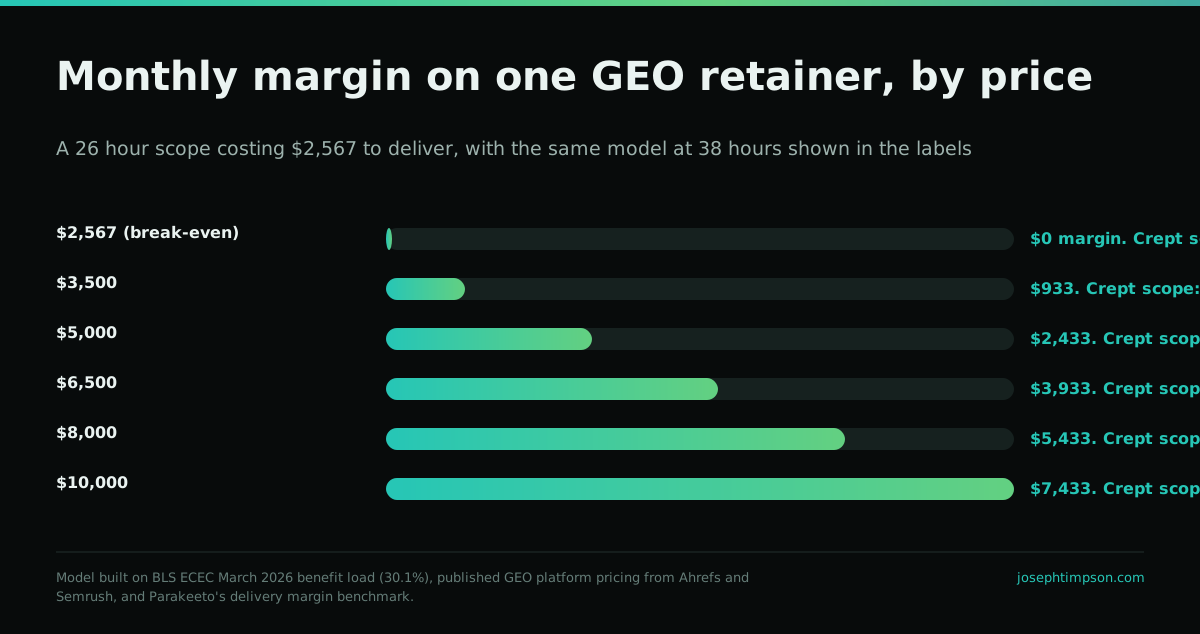
The second series in the chart above is the same model at 38 hours instead of 26, which is roughly where DemandLocal puts a tier two GEO engagement at 38 to 58 hours. Call it five extra senior hours and seven extra mid hours a month. Nothing dramatic. One extra content revision cycle, one unplanned competitor question, one call that runs long.
That costs $1,125 a month. $13,500 a year. Per account.
The gap between the two series is constant across every price point, which is the useful part. Scope creep does not scale with your fee. It is a fixed subtraction, so it hurts a $3,500 account nearly three times as much in percentage terms as it hurts a $10,000 one. At $3,500 the base scope earns $933 a month and the crept scope loses $192.
PMI's Pulse of the Profession found 52% of projects experienced scope creep in its 2018 edition, up from 43% five years prior. That is enterprise project management rather than agency retainers, and I am citing it as directional. The agency specific signal is sharper anyway: AgencyAnalytics surveyed 494 agency professionals between February and April 2026 and found 44% say clients now expect faster turnaround than a year ago, while 66% report increased client demand for AEO and AI search work. Faster expectations plus a service category clients cannot yet evaluate is the exact condition under which scope quietly expands.
Price the creep or govern it. Governing it is cheaper, and it starts with a reporting format that shows what was delivered against what was scoped rather than a dashboard screenshot.
Four exits when the arithmetic says no
If your current price does not clear the model, there are exactly four moves and only one of them is comfortable.
Raise the price
The cleanest and least popular. Promethean Research's survey of 1,452 agency leaders found only 20% of agencies raised rates in 2026, down from 28% in 2025, while average net margin fell to 13%. The two facts are related.
Cut the scope to fit the price
Sell 8 hours as 8 hours. Access verification and a fixed prompt set sampled monthly is a defensible small product. Pretending it is a full program is what generates the churn.
Buy the delivery instead of building it
If a vendor delivers the same scope below your loaded cost, your build decision is already answered. This is the honest case for white label.
Decline the account
An account priced below delivery cost consumes the capacity you would use on a profitable one. The opportunity cost is the real loss, not the margin.
The third exit is where the arithmetic points more often than agency owners expect, because the fixed costs in GEO are unusually high relative to the hours. Platform spend, prompt set maintenance and the sampling discipline required for a defensible number do not get cheaper at one client. They get cheaper at forty. That structural fact is what makes white label GEO delivery a real option rather than a lazy one, and it is the first thing I would model before building the service line internally.
One cost saving move that is genuinely cheap and genuinely works: verify crawler access before anything else. An access audit is an hour or two of work with the highest certainty of any lever in this category, and running it first stops you from billing twenty hours of content work into a site that no engine can fetch.
What the client's side of the ledger has to survive
Your break-even is only half the trade. The other half is whether the account lives long enough to matter.
AgencyAnalytics found 62% of clients stay two or more years and 42% name budget cuts and economic pressure as the top churn reason, which has overtaken performance. That matters for pricing because it says your account dies from the CFO, not from the rankings. The CMO Survey, fielded January 2026 with 308 US marketing leaders, found marketing budgets at 9.0% of revenues and marketing expenses cut 45.4% of the time when profits fall short, more often than any other category. Gartner's 2025 survey found 39% of CMOs planned to cut agency budgets specifically.
CMOs are being asked to deliver growth, efficiency and transformation without meaningful budget expansion.
So the pricing conclusion is not simply charge more. It is charge enough to deliver something whose value survives a budget review, which means the retainer has to produce evidence a finance person recognizes. That is a measurement problem before it is a pricing problem, and it is why AI search attribution belongs in the scope you are pricing rather than in the upsell you never get to.
Where this model is weak
The candid section, because a pricing model presented as certainty is how people end up underwater with confidence.
The 26 hour scope is my estimate, not a benchmark. No published survey measures the hours a GEO retainer actually consumes. I built the figure from my own delivery and cross checked it against DemandLocal's 38 to 58 hour tier two range, which brackets it. If your scope is different, the entire output changes. That is the point of the model rather than a flaw in it, but do not treat 26 hours as a standard.
Utilization is the input with the widest error bar. The benchmark numbers circulating for agency utilization come almost entirely from software vendor blogs with no stated methodology, so I did not cite any of them. I used 60, 70 and 80% as a range because it spans what I have seen, not because a study says so. Your real number is in your time tracking, and if you are not tracking time you do not have a pricing model, you have a hope.
Promethean and AgencyAnalytics measure agencies broadly, not GEO delivery. Promethean's finding that studio agencies under ten people average 19% net margin against 8% for firms above fifty is useful context and says nothing about this service line specifically.
The Ahrefs pricing poll is stale and self selected. August 2024, 439 practitioners who chose to answer. I used it because it is the most detailed public dataset on SEO retainer distribution and because Backlinko's independent survey lands in the same territory. Two vendor polls agreeing is weaker than one good sample.
The test takes twenty minutes. Pull last month's payroll expense from your P&L, divide by the billable hours your team actually logged, multiply your scope hours by the result, add your platform spend, and divide by 0.35. If the number that comes out is above what you are charging, you have one of the four exits to pick and a decision to make this quarter rather than next year. The rest of the method is about making the number defensible once you have set it, and that is the work I do.
Frequently asked questions
What should a GEO retainer cost?
That depends entirely on the hours your scope consumes and your loaded cost per hour. A 26 hour monthly scope run by a mid and senior pair costs about $2,567 to deliver and prices at roughly $7,334 at a 65% project delivery margin. Copying a competitor's rate card skips the only calculation that matters.
How do I calculate my loaded cost per billable hour?
Take the salary, divide by 0.699 to add the BLS private industry benefit load of 30.1%, then divide by the billable hours that person actually delivers out of 2,080 paid hours. Better still, use your real payroll expense line and your real tracked hours.
Is a $2,000 a month GEO retainer profitable?
Only if the scope is genuinely small. At a 65% delivery margin and $150 of platform cost, $2,000 buys about six billable hours a month. That is enough for access verification and a fixed prompt set sampled monthly. It is not enough for content work and outreach.
Why is GEO more expensive to deliver than SEO at the same hour count?
Two fixed costs. Per client platform spend runs $150 to $500 a month depending on engines and prompt volume, and AI answers vary enough between runs that a single sample proves nothing, so repeated measurement is a recurring cost rather than a one time setup.
What delivery margin should I target on a GEO project?
Parakeeto's published benchmark is 60 to 70% at the project level and 50% or higher agency wide. The project target sits higher because the gap absorbs utilization shortfalls, holidays, turnover and training. Pricing projects at the agency wide target guarantees you miss it.
How much does scope creep actually cost on a GEO account?
Twelve extra hours a month, split five senior and seven mid level, costs $1,125 a month and $13,500 a year at the loaded rates in this model. The subtraction is fixed, so it damages a $3,500 retainer far more in percentage terms than a $10,000 one.
Should I build GEO delivery in house or buy it white label?
Model both against your loaded cost. GEO carries unusually high fixed costs relative to hours, and platform spend plus prompt maintenance gets cheaper at forty clients rather than at three. If a vendor delivers your scope below your own delivery cost, the arithmetic has already answered you.
Can I just charge hourly for GEO instead?
You can, but hourly caps your upside at your capacity and transfers all efficiency gains to the client. The larger problem is that hourly billing on a service with high fixed platform costs under recovers those costs unless you build them into the rate explicitly.
Sources
- U.S. Bureau of Labor Statistics, via Primary News Source. Employer Costs for Employee Compensation, March 2026 (BLS news release reproduction) (2026-06)
- Parakeeto (Marcel Petitpas). Agency Fee Calculator: How Much Should You Charge? (2022-11)
- Parakeeto (Marcel Petitpas). 3 Key Profitability Drivers Agencies Need to Prioritize (2023-03)
- Promethean Research. How Profitable are Digital Agencies? (2026)
- Ahrefs. SEO Pricing: How Much Does SEO Cost? (439 provider poll) (2024-08)
- Backlinko. SEO Pricing: How Much Does SEO Cost in 2026? (2025-12)
- AgencyAnalytics. 2026 Marketing Agency Benchmarks Report (494 agency professionals) (2026-04)
- Alex Birkett / Omniscient Digital. The 8 Best GEO Tools for Agencies (published platform pricing) (2026)
- Ahrefs. Ahrefs pricing (Brand Radar AI and prompt packages) (2026-07)
- Semrush. Semrush pricing (AI search tracking by plan) (2026-07)
- DemandLocal. How to Price GEO Services: A Packaging Guide for Agencies (2026)
- Capston. GEO Pricing Models For Agencies In 2026 (2026)
- The Digital Elevator. AEO and GEO Pricing Guide (2026)
- Digital Agency Network. GEO Service Pricing: Structuring Your Agency's AI Search Packages (2026)
- Superlines (Kimmo Ihanus). The State of GEO in Q1 2026 (2026-03)
- SparkToro with Gumshoe.ai. AIs are highly inconsistent when recommending brands or products (2026-01)
- Project Management Institute. Pulse of the Profession 2018: Success in Disruptive Times (2018)
- Duke Fuqua, Deloitte and the American Marketing Association. The CMO Survey, Highlights and Insights Report (35th edition, n=308) (2026-04)
- Demand Gen Report, reporting Gartner. Gartner CMO Spend Survey reveals marketing budgets have flatlined (2025-06)
- Gartner, reproduced by National Law Review. Gartner 2026 CMO Spend Survey (2026-05)
Joseph Timpson has worked in search since 2010 and runs Timpson Marketing out of St. George, Utah. He built The Cited Method, a five stage framework for earning and proving real citations in AI answers, and publishes what does not work alongside what does.
Want me to run this on your site and show you the before and after?
One call, no pitch deck. We look at what is actually blocking you and tell you the truth about whether we can help.
Book a free consultation →