Vetting a White Label GEO Partner Before You Sign
Every page in this category is written by a provider. This one is written for the buyer, by someone who sells the same thing and would rather you interrogated me properly.

- The published wholesale price for a white label GEO package is $429 per month, and the deliverable stack is dominated by schema and one page of content per month.
- The best controlled test of schema as an AI citation lever measured minus 4.6 percent in AI Overviews across 1,885 treated pages against 4,000 matched controls.
- The most diagnostic question you can ask a partner is not what they do. It is what they used to sell and stopped selling, and what changed their mind.
- Any guaranteed citation rate, any share of voice figure presented as a direct engine reading, and any case study number you cannot trace to a source are hard stops, not negotiating points.
- You are the advertiser of record. Your client signed with you, and the claims in the report go out under your brand and your liability.
The going rate is $429 a month, and most of the deliverable is schema
51Blocks publishes its white label GEO package price on the open web. It is $429 per month covering three informational keyword themes, and the monthly deliverable list reads: one new page of content, article and author schema, FAQ schema, structured markup for every piece of content, keyword research, response monitoring, and white labeled reporting.
Three of those seven line items are structured data. One is a single page of content. That is the product you would be reselling.
Vet a white label GEO partner on method, not on price or turnaround. Ask what they do, why they believe it works, and what evidence sits behind each lever. Then ask how they measure: runs per prompt, who owns the prompt set, and whether you can export raw responses. A partner who hedges on any of those is selling you a deliverable list, and you are the one who has to defend it when the client's marketing director starts asking questions.
The best controlled test of that product does not support it. Ahrefs tracked 1,885 pages that added JSON-LD between August 2025 and March 2026 against 4,000 matched control pages, ran a difference in differences analysis with a 30 day pre and post window, and measured minus 4.6 percent in AI Overviews, plus 2.4 percent in AI Mode and plus 2.2 percent in ChatGPT.
Adding schema produced no major uplift in citations on any platform.
The other half of that package is publishing volume, and volume is the weakest measured factor in the largest correlational study available. Across 75,000 brands, Ahrefs found site page count correlated with AI visibility at roughly 0.194, against 0.664 for branded web mentions.
I want to be fair here, because fairness is the point of a vetting document. That same 51Blocks page is more honest about measurement than most of the category. It states plainly that "Success is measured by Google AI recommendation and citation frequency, which is not consistently trackable through standard analytics platforms" and that AI Overview visibility is not guaranteed. That disclosure is better than most provider pages manage.
So the failure is not dishonesty about measurement. It is that the deliverable stack is assembled from the two levers with the weakest published evidence behind them, priced for volume, and sold on turnaround. Price and turnaround are the only two columns most agencies compare, and they are the two columns that tell you nothing about whether the work survives contact with a client who reads.
Four method questions, ranked by how much they actually reveal
I would ask these in this order, and I would stop the call after question two if it goes badly.
1. Which AI crawlers can reach my client's site right now, and how do you check?
This is the highest certainty mechanical lever in the entire discipline and the one most sellers skip, because it is unglamorous and it is billable exactly once. OpenAI's own developer documentation is explicit: OAI-SearchBot is used to surface websites in ChatGPT's search features, and sites that disallow it will not be shown in ChatGPT search answers, though they can still appear as navigational links. The same page tells site owners to permit requests from OpenAI's published IP ranges, which is a firewall and CDN question, not a robots.txt question.
A partner who answers "we check robots.txt" has answered half of it. The half they missed is the one that actually bites, because a bot management rule serving a challenge page to a crawler that is technically allowed in robots.txt produces the same outcome as a block, and it never shows up in an audit tool. Running that check properly takes an hour and it is the only item on this list with near certain causality.
2. Name a tactic you used to sell and stopped selling. What changed your mind?
This is the question. Everything else is a preference. This one tells you whether there is an evidence loop inside the business or just a price list.
The obvious answer in 2026 is llms.txt. Google updated its own guidance to say you do not need to create new machine readable files, AI text files, markup, or Markdown to appear in Google Search, and that Search itself ignores them. Search Engine Land reported the same documentation change with the line that creating those files will neither harm nor help your visibility or rankings. SE Ranking analysed nearly 300,000 domains, found 10.13 percent adoption, and found no measurable relationship to citation. Removing the feature improved their model.
Profound ran the adjacent experiment on serving Markdown to AI crawlers: 381 pages, 189 control and 192 treatment, 21 days, and no statistically significant increase in bot traffic. Three independent negative results, all with published methods, all ignored by most of the category.
If a partner still has llms.txt on the deliverable list, that is survivable, because a lot of clients ask for it and it costs nothing. If they still have it on the list and cannot tell you the evidence is against it, that is not survivable. The tactic is not the tell. The awareness is. My full accounting of which levers survived contact with evidence is the version of this conversation I would want a partner to be able to have with me unprompted.
3. Does the work land on the client's site or off it?
Ask this and watch whether the answer is 100 percent on-site, because on-site is where the margin is for a fulfilment shop and off-site is where the evidence points.
Ahrefs revised its own headline number here, which is worth knowing because half the sales decks in this category still quote the old one. In July 2025 it measured roughly 76 percent of AI Overview citations coming from pages ranking in the top 10. In March 2026, across 863,000 keyword SERPs and 4 million AI Overview URLs, that figure came in at 38 percent. A partner quoting 76 percent in 2026 is quoting a number the publisher has itself halved.
Rank is table stakes, not the mechanism. What correlates harder is presence in places you do not own, which is precisely the work a low price white label package cannot afford to do. The brand mention evidence is the part of this that changes what you should be buying, and the ranking question is the part most partners get wrong in the reassuring direction.
4. What is proprietary about your method, and what part of it is not?
The correct answer includes a lot of "not." Nobody has a back channel.
None of the experts have special access to the internal workings of Google's local search algorithm.
Shaw wrote that as a methodology caveat on a survey of 47 local search experts scoring 187 factors. He is describing his own study's limits, in public, in the document he is asking you to trust. That is what an evidence posture looks like. A partner whose entire method is proprietary has no method you can inspect, and you cannot defend an uninspectable method to a client who asks a hard question at month four.
The measurement interrogation is where most partners actually fail
Delivery quality is hard to assess in a sales call. Measurement quality is not, because measurement has a right answer and it is arithmetic.
SparkToro and Gumshoe.ai put 600 volunteers and 12 prompts through 2,961 runs across ChatGPT, Claude and Google's AI. They found less than a 1 in 100 chance that two runs of the same prompt return the same brand list.
That single finding invalidates most of what gets screenshotted in GEO sales decks.
any tool that gives a 'ranking position in AI' is full of baloney
So ask for six numbers, and write down which ones they cannot give you.
- Runs per prompt. One capture of a probabilistic system is a draw, not a reading. If the answer is one, every month over month delta in their report is noise wearing a suit.
- Prompt set size and ownership. How many prompts, who wrote them, and can you take them with you when the relationship ends. A prompt set you do not own is a switching cost disguised as a deliverable.
- Prompt set stability. Whether they rotate the library between reporting periods, which silently breaks every trend line in the deck.
- Locale. Which country and language each prompt runs in, and whether it can be set per prompt. For a single location client this is the decisive column and it is the one nobody fills in.
- The counting rule. Whether a mention means a brand string in the answer text, a linked URL in the source list, or both. Semrush and Growth Memo logged 3,981 domain appearances across 115 prompts and found 61.7 percent of citations never named the brand in the answer at all. Count citations as mentions and you overstate brand impact by roughly two and a half times.
- Raw response export. Whether you can see the answers behind the score, or only the score. This is the one that separates an instrument from a chart.
Ranked by how much they change the reported number, runs per prompt beats everything else on that list, and engine coverage, the item every provider leads with, does not make the top six at all. How many runs a prompt set actually needs before a delta means anything is arithmetic, not opinion, and most published GEO reporting is running an order of magnitude short. If you want to test a partner cheaply, hand them a frozen prompt set of your own and ask them to report against it. The ones who agree are the ones worth talking to.
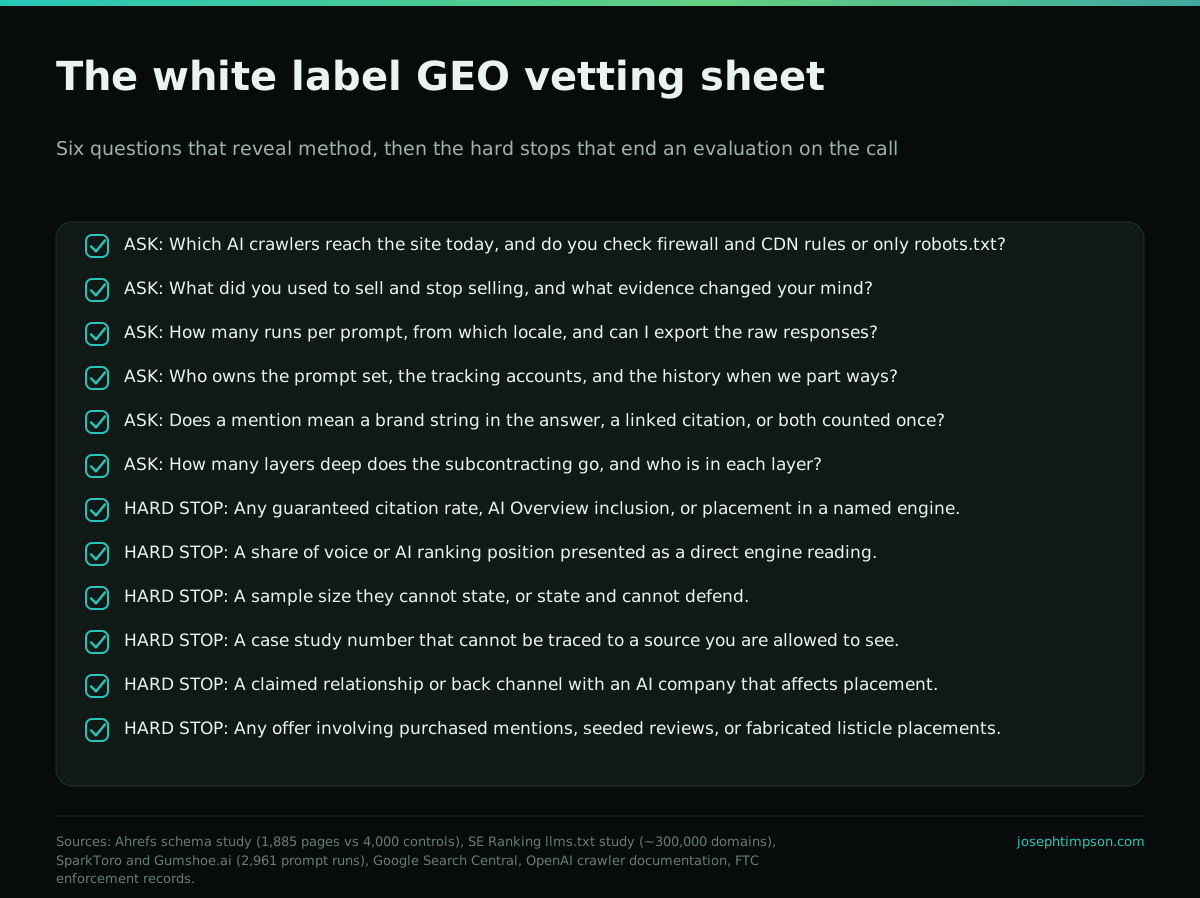
The disqualifier list
These are not negotiating points. Any single occurrence ends the evaluation, and I would end it on the call rather than in a follow up email.
- Any guaranteed citation rate, guaranteed AI Overview inclusion, or guaranteed placement in a named engine.
- A share of voice or AI ranking position figure presented as a direct reading from an engine rather than an estimate from a sample.
- A sample size they cannot state, or state and cannot defend when you ask how many runs per prompt.
- A case study number that cannot be traced to a source you are allowed to see, even anonymised.
- A claimed relationship, partnership, or back channel with OpenAI, Google, Anthropic or Perplexity that affects placement.
- Refusal to disclose whether the work is subcontracted again below them, and to whom.
- A report you cannot reproduce from the underlying data they hold.
- Any offer involving purchased brand mentions, seeded reviews, or fabricated third party listicle placements.
The first one is the most common and the easiest to rationalise, because the client wants to hear it and the partner wants to sell it. Google's own documentation has been unambiguous for years: "No one can guarantee a #1 ranking on Google. Beware of SEOs that claim to guarantee rankings, allege a 'special relationship' with Google, or advertise a 'priority submit' to Google." Nothing about generative engines makes that promise more keepable. It makes it less keepable, because the answer is composed at query time.
If someone promises they can guarantee your brand appears in ChatGPT responses, you should be sceptical. Very sceptical.
Leslie is describing the same market from the client side that you are about to enter from the reseller side, and her sharpest line is about attribution rather than placement: with current technology that level of tracking precision is impossible, and "if someone's promising it, they're guessing at best, fabricating at worst." That is the standard I would hold a partner to, and it is the standard I expect to be held to.
The last item on the list is the one that ends careers rather than contracts, and it is worth knowing that this is enforced. The FTC and the state of Illinois sued a company in May 2026 over thousands of fabricated local business listings with fake five star reviews. If a fulfilment partner offers to manufacture third party presence, the fastest route to an AI citation is also the fastest route to a complaint that names your agency, because your agency is the one on the invoice.
If you have a white label proposal on your desk and want a second read before you sign, I will go through the method and measurement sections with you. No pitch attached.
Bring me a partner's proposal→The commercial terms the sales page will never answer
Method gets you through the first call. These get you through the first bad quarter.
How deep does the subcontracting go? You are buying from a partner who may be buying from someone else. Ask for the layer count and the countries involved, and put a clause in that binds every layer to the same confidentiality and data handling terms. A three layer chain with no named parties is not a supply chain, it is an unmanaged risk sitting under your brand.
Who owns the prompt set, the tracking account, and the historical data? If the account is in their name, your trend line ends the day the relationship does. That is the single most common lock-in mechanism in this category and it is almost never discussed before signature.
What happens when the numbers do not move? Get the escalation path in writing and get the kill switch date. AgencyAnalytics surveyed 494 agency professionals between February and April 2026 and found 44 percent say clients now expect faster turnaround than a year ago, alongside 66 percent fielding AEO requests. Compressed patience plus a discipline that moves slowly is exactly the combination that turns month five into a refund conversation.
What is your actual margin after account management? Wholesale price is not cost. Your cost is wholesale plus the hours you spend reviewing the work, translating the report, and absorbing the client's questions. On a $429 package, two hours of senior time a month eats the margin entirely.
And read the partner's own marketing the way a client will read yours. A white label provider announcing a GEO launch in April 2026 wrote that "early internal testing and campaign rollouts indicate that content optimized for AI-driven environments demonstrates stronger inclusion rates in generated summaries" and published no sample size, no time window, no baseline, and no figure. That sentence is unfalsifiable by construction. It is not a lie. It is worse than a lie for your purposes, because you cannot check it, and you will be the one repeating it. Getting the scope written down in testable terms is how you convert that kind of sentence into something you can hold someone to, and it is the same discipline that makes your own pricing defensible.
You are the advertiser of record, not them
Here is the part that white label marketing pages structurally cannot tell you, because it is the reason their model works.
When the work goes out under your brand, the claims go out under your liability. Your client signed a contract with you. The report has your logo on it. If the report contains a share of voice number that turns out to be a single run screenshot, or a guaranteed citation rate that did not happen, the client's complaint has your name on it, not your partner's. The partner is contractually invisible, which is the product you paid for.
The enforcement history in adjacent search marketing is not theoretical. The FTC's Pointbreak Media case, where telemarketers claimed to represent Google and sold guaranteed top placement, ended with more than $700,000 refunded to 4,467 small business owners, an average of $158.32 each. Small dollars per victim, and a case name that follows the company forever.
The practical consequence is that you should be reviewing every report before it reaches a client, not forwarding it. That is billable time you must price in, and it is also the only mechanism that catches a partner drifting toward claims you would never have made. The reporting standard I would apply to a partner's work is the one I apply to my own: label every estimate as an estimate, print the sample size next to the number, and never assert that a specific piece of work caused a specific citation, because the attribution chain does not support that claim and saying so has never cost me an account.
And know what you are choosing against. Outsourcing buys you speed and a fixed cost. Building the capability yourself buys you the ability to answer a client's hardest question in the room instead of after a two day email round trip. Neither is wrong. Pretending the first one removes your responsibility is.
What a passing answer sounds like
After enough of these calls the pattern gets audible.
| End the evaluation | Keep talking | |
|---|---|---|
| Guarantees | "We guarantee citation in AI Overviews within 90 days" | "We can improve the probability and here is which levers we think move it" |
| Measurement | "Our platform shows your AI ranking position" | "We run N prompts M times per month from this locale, and here is the raw export" |
| Evidence | "Our proprietary framework is the only one that works" | "Here are the studies we rely on, including the ones that went against us" |
| Schema | "Structured data is how you get cited" | "Schema is classic search hygiene and the controlled data on AI citation is null" |
| Subcontracting | "We handle everything in house" (unverified) | "Two layers, here is who, and here is the DPA that binds them" |
| Data ownership | Accounts and prompt sets in the partner's name | Accounts in your name, prompt set exportable, history yours on exit |
Credit where it is earned. At least one provider in this category answers the guarantee question correctly on its own public page, writing that no legitimate AEO or GEO provider can guarantee placement. That single sentence tells you more about a partner than any case study, because it is a promise they have voluntarily removed from their own sales arsenal.
The uncomfortable synthesis is that the vetting standard in this article is one very few sellers can currently pass, including some good ones who simply have not thought about measurement yet. That does not mean you should not outsource. It means the shortlist is shorter than the search results suggest, and price should be the last column you look at rather than the first.
The standard is public on purpose. If you want the method I hold myself to before you hold a partner to it, it is written out in full, and the rest of my working notes live in the insights archive. If you would rather talk it through with a proposal in front of you, that is a conversation worth having.
Frequently asked questions
What should I ask a white label GEO partner before signing?
Ask which AI crawlers currently reach your client's site and how they check, what tactic they stopped selling and why, how many runs per prompt sit behind their reporting, who owns the prompt set and tracking accounts, and whether you can export raw responses. Method and measurement, before price.
How much do white label GEO services cost?
Published wholesale pricing exists at the low end. 51Blocks lists a white label GEO package at $429 per month covering three keyword themes. Full service GEO retainers sit far higher. Your real cost is wholesale plus the senior hours you spend reviewing work and translating reports.
Can a GEO provider guarantee AI citations?
No. Google's own documentation says no one can guarantee a number one ranking and warns against anyone claiming a special relationship. AI answers are composed at query time, and SparkToro measured under a 1 in 100 chance that two runs of the same prompt return the same brand list.
Is schema markup a legitimate white label GEO deliverable?
As classic search hygiene, yes. As an AI citation lever, the controlled evidence is against it. Ahrefs ran 1,885 treated pages against 4,000 matched controls and measured minus 4.6 percent in AI Overviews. A package built mostly from schema is selling hygiene as a citation mechanism.
Who is liable if a white label partner's reporting is wrong?
You are, in practice. The client contracted with your agency, the report carries your brand, and the partner is contractually invisible by design. Review every report before it reaches a client rather than forwarding it, and price that review time into your margin.
Should I outsource GEO or build it in house?
Outsourcing buys speed and a fixed cost. Building buys the ability to answer a client's hardest question in the room. The deciding factor is usually how technical your client base is. Sophisticated clients ask follow up questions that a two day email round trip cannot survive.
What is a red flag in a white label GEO sales call?
A guaranteed citation rate, an AI ranking position presented as a direct engine reading, a sample size they cannot defend, a case study you cannot trace, a claimed back channel to an AI company, or refusal to say whether the work is subcontracted again below them.
Who should own the prompt set and tracking accounts?
You, or your client. If the tracking account sits in the partner's name, your historical trend line ends the day the relationship does. That is the most common lock in mechanism in this category, and it is almost never discussed before the contract is signed.
Sources
- 51Blocks. White Label GEO Package (2026)
- Ahrefs (Louise Linehan and Xibeijia Guan). Does Schema Markup Help With AI Citations? We Studied 1,885 Pages (2026-05)
- Ahrefs. AI Brand Visibility Correlations Study (2025-12)
- Ahrefs (Louise Linehan). Only 38% of AI Overview Citations Come From Top 10 Pages (2026-03)
- SE Ranking (Yulia Deda). LLMs.txt Study: Adoption Across ~300,000 Domains (2025-11)
- Google Search Central. Optimizing your website for generative AI features on Google Search (2026)
- Google Search Central. Do I need an SEO? (2026-06)
- Search Engine Land. Google says llms.txt files won't harm or help your search rankings (2026-06)
- OpenAI developer documentation. OpenAI crawlers and user agents (2026)
- SparkToro with Gumshoe.ai. New research: AIs are highly inconsistent when recommending brands or products (2026-01)
- Semrush with Growth Memo. The Ghost Citations Study (2026-06)
- Profound (Brandon Punturo). Does Markdown Increase AI Bot Traffic? A Controlled Experiment (2026-02)
- Whitespark (Darren Shaw). Local Search Ranking Factors 2025 (2025-11)
- Bottle (Jem Leslie). AI red flags and what to trust (2026-02)
- AgencyAnalytics. 2026 Marketing Agency Benchmarks Report (2026-04)
- SEO.co press release via Barchart. White Label SEO Agency Launches Generative Engine Optimization (GEO) Services for AI Search Era (2026-04)
- Brandify. White-Label AEO Services and GEO Fulfillment For Agencies (2026)
- U.S. Federal Trade Commission. FTC and Illinois take action to stop deceptive conduct by company that created thousands of business listings with fake reviews (2026-05)
- U.S. Federal Trade Commission. FTC sends refund checks totaling more than $700,000 to small business owners defrauded by deceptive robocalls (2020-08)
Joseph Timpson has worked in search since 2010 and runs Timpson Marketing out of St. George, Utah. He built The Cited Method, a five stage framework for earning and proving real citations in AI answers, and publishes what does not work alongside what does.
Want me to run this on your site and show you the before and after?
One call, no pitch deck. We look at what is actually blocking you and tell you the truth about whether we can help.
Book a free consultation →