Who Actually Does This Work, and How You Staff It
Two thirds of agencies have the demand. The job description for the person who delivers it barely exists. Here is the actual skill profile, a ramp plan with the assumption stated out loud, and the point where buying beats building.

- Semrush found AI search terms in just 6.3% of 3,900 senior SEO job listings, while 66% of agencies report client demand for the service. You are hiring against a job description nobody has written.
- Three skills decide this hire: server log work, sampling discipline, and a willingness to report a null result. Almost no SEO resume shows any of them.
- Realistic ramp is 90 days to supervised delivery and about two quarters to unsupervised, assuming five protected non-billable hours a week. No published ramp study exists, so that number is derived, not measured.
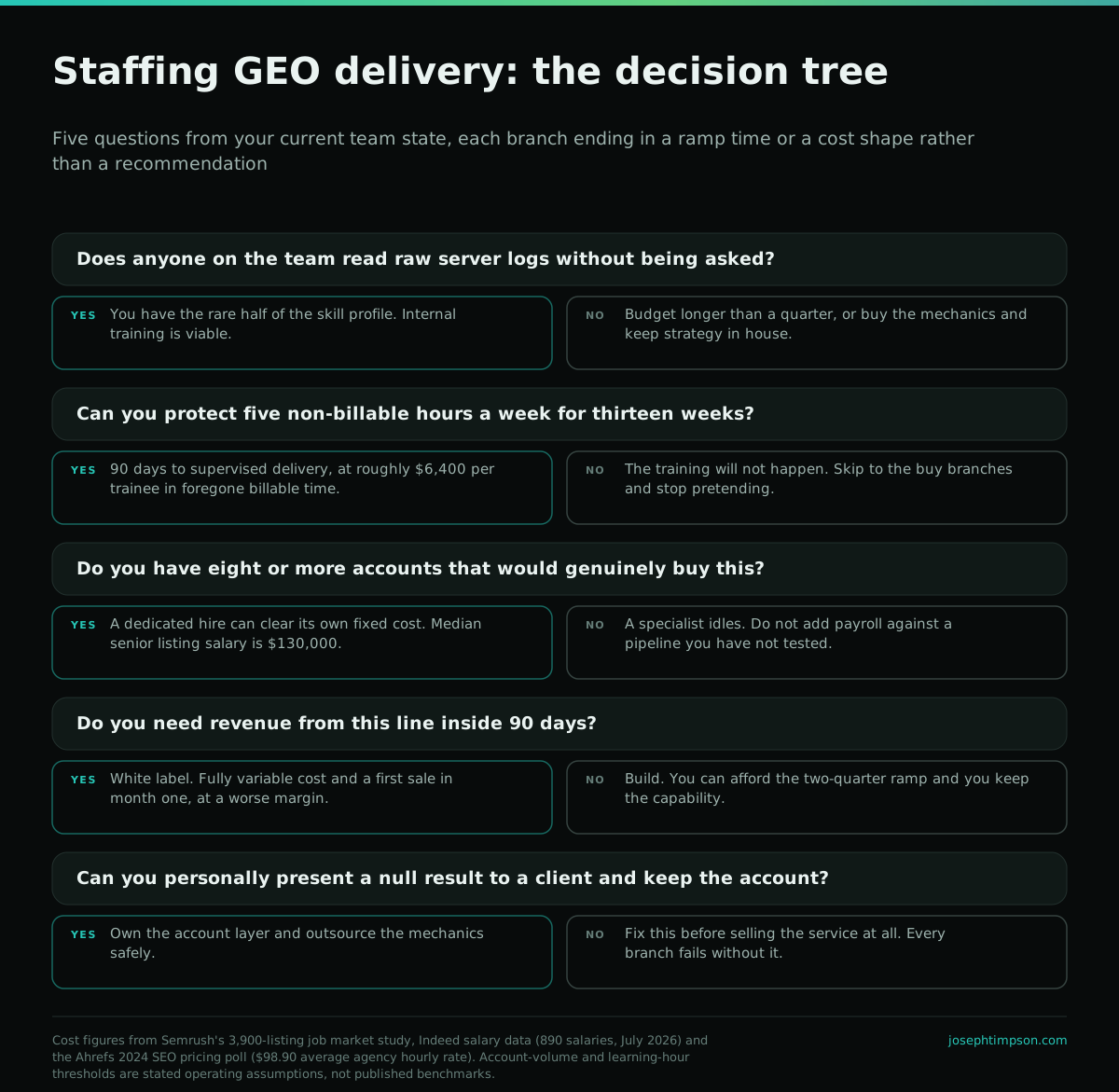
- Below roughly eight accounts that would genuinely buy, a dedicated hire idles and the fixed cost eats the margin. That is the buy branch.
- The most expensive hiring mistake is someone who cannot deliver bad news. They will sell schema and llms.txt, both of which have published null results.
Two thirds of agencies have the demand. Almost nobody has posted the job.
Semrush pulled 3,900 US SEO job listings off Indeed on November 25, 2025. Across that entire set, SGE, AEO and AI search appeared in 6.3% of senior listings and 3.7% of everything else. Technical SEO appeared in 5.8% of senior listings. Project management appeared in 31%.
Now set that against demand. AgencyAnalytics surveyed 494 agency professionals between February and April 2026 and found 66% reporting increased client demand for AEO and SEO for AI-driven search, the number one new service category of the year. Roughly half of those agencies have ten or fewer full time employees.
So two thirds of the market is being asked for the service, and the job description for the person who delivers it does not exist. Every owner writes one from scratch, and the ones I have read are wish lists: enterprise SEO, LLM architecture, schema, digital PR, prompt monitoring and attribution, in one body, for one salary.
Do not hire a GEO specialist. Hire or train a search practitioner who can read a server log, design a sampling plan, and tell a client to their face that a tactic produced nothing. Those three abilities are rare, unglamorous, and they are most of the actual job. Almost everything else on a typical GEO job post is either ordinary SEO or vendor marketing.
The field knows it has a gap. Lumar interviewed more than two dozen SEO professionals for its 2026 skills report and 81% named GEO, AEO or AI search as the skill to learn next, ahead of data analysis at 50%. That is a self-selected qualitative sample of about twenty five people, so read it as a mood, not a measurement. The mood is unambiguous.
Staffing matters more than the two decisions that precede it. Scope and pricing are decided once. Staffing decides whether that scope gets delivered honestly every month for two years.
The delivery skill profile, in the order that matters
This is the profile I would hire against, ranked by how often the missing piece is what kills the engagement rather than by how impressive it sounds in an interview.
| Requirement | What it looks like in practice | How common in SEO hires |
|---|---|---|
| Server log and crawler access work | Pulls raw logs, identifies bot user agents, proves whether an AI crawler got a 200 or a challenge page | Rare |
| Sampling and variance literacy | Knows one prompt run is not a measurement, fixes a repeat count before looking at results | Very rare |
| Willingness to publish a null | Reports "we tested it and nothing moved" without softening it into a win | Very rare |
| Citation forensics | Traces which third-party page an engine actually cited, not just whether the brand appeared | Uncommon |
| Ordinary technical SEO | Indexation, rendering, canonicals, site architecture | Common |
| Editorial judgment | Commissions and edits content a domain expert would not be embarrassed by | Common |
| Client-facing composure | Can hold a meeting where the honest answer is "we do not know yet" | Uncommon |
The bottom three are the ones agencies screen for, because they are the ones a portfolio review can assess. The top three decide whether the work is real.
Notice what is absent. No LLM engineering. No prompt engineering as a discipline. No schema specialism, for reasons that follow. If a candidate opens with model architecture, they are describing a research job, and you are hiring for a delivery job.
The three requirements almost no SEO hire meets
Reading logs unprompted. Crawler access is the highest certainty mechanical lever in this field and it is invisible from every dashboard. Cloudflare's network measurement for 2025 put crawl-to-refer ratios as high as 500,000 to 1 for Anthropic and 3,700 to 1 for GPTBot, against 3:1 to 30:1 for Google. Those are completely different traffic economics, and the only way to know which bots reach a specific client site is to open the log file. Most SEOs have never asked a client for one.
Sampling discipline. SparkToro and Gumshoe.ai ran 12 prompts 2,961 times across ChatGPT, Claude and Google AI with 600 volunteers.
There's a <1 in 100 chance that ChatGPT or Google's AI, if asked 100X, will give you the same list of brands in any two responses.
Someone who has not internalised that will screenshot a good answer and send it to the client as proof. Next month they will get a bad one and have nothing to say. The requirement is that they fix the prompt set and the repeat count before they look at a single result. That is a research habit, not an SEO habit, and you cannot bolt it on later.
Reporting a null. Three of the most heavily sold tactics in this category have published null results. Ahrefs ran a matched difference-in-differences test on 1,885 pages that added JSON-LD against 4,000 control pages.
Adding schema produced no major uplift in citations on any platform.
SE Ranking analysed nearly 300,000 domains and found llms.txt had no measurable relationship to citation, and that removing it from their model improved prediction accuracy. Profound ran a genuinely controlled experiment, 189 control pages against 192 treatment pages over 21 days.
We tested the claim that serving Markdown to AI crawlers drives more bot traffic. The data doesn't support it, at least not at a scale that would justify treating it as a priority.
A delivery person who cannot say that sentence will sell the client schema and llms.txt instead, because both are easy to invoice and impossible to disprove inside a monthly report. That is the most expensive hiring mistake available in this category, and it is invisible for about nine months.
What ramp actually takes, and why "30 days" is a marketing claim
The guides currently ranking for this query are confident about training time. One states that teams with strong SEO and content skills can transition to GEO delivery with a structured 30-day training program. No source. No cohort. No definition of competent.
I went looking for real ramp evidence and there is none. No published study of time to productivity exists for this role, because the role is roughly eighteen months old. The generic onboarding numbers that circulate, the eight months to full productivity and the rest, trace back to vendor blogs citing each other. I am not going to launder those into a figure and put my name on it.
So here is a derivation instead, with the assumption on the table.
The unit of learning here is the measurement cycle, not the training module. Because answers are as volatile as SparkToro measured, one month of data teaches a new practitioner almost nothing about whether their intervention worked. They need enough cycles to separate their own effect from the noise floor. Three cycles is the minimum at which a month-over-month change starts to mean something. That threshold is my judgment, not a finding, and if you disagree with it the whole timeline moves with you.
Weeks 1 to 4
Access and mechanics. Crawler access audit on three live accounts, log pulls, robots and WAF review. Deliverable is a written access finding per account, reviewed by you.
Weeks 5 to 8
Measurement design. Build a prompt set and a repeat schedule for one account. They justify the repeat count in writing before running anything.
Weeks 9 to 12
First supervised cycle. Run it, report it, present it with you in the room. If the honest answer is no movement, they say so out loud.
Months 4 to 6
Two more cycles unsupervised, with you reviewing before send. This is where the null-result muscle either forms or does not.
Month 7 onward
Unsupervised delivery on a capped account load. Not before.
Ninety days to supervised delivery. About two quarters to unsupervised. If that reads slow, compare it with the alternative, which is a confident person reporting noise as progress for six months while the client quietly loses faith.
The cost is not tuition, it is protected non-billable time. Five hours a week for thirteen weeks is sixty five hours. At the $98.90 average agency hourly rate Ahrefs got from a poll of 439 SEO professionals, that is roughly $6,400 of foregone billable capacity per trainee per quarter. That poll is dated August 2024, so treat it as the 2024 benchmark rather than today's rate.
Most agencies will not protect that time, and the client-side data says why. The CMO Survey found marketing training budgets have fallen to 3.8% of marketing spending, down from a pre-pandemic 5.8%, and that the most commonly named capability gap was not a skill at all but capability not being resourced with employees, time and money, at 22.3%. The failure mode is not ignorance. It is unfunded intent.
If you are staring at three imperfect options and a client asking about AI search next week, thirty minutes on a call will get you to the right branch faster than another article will.
Talk through your staffing option→The build versus buy break point
Three cost shapes, three different risks. This is the comparison nobody publishes because two of the three answers do not sell anything.
Train internally. First quarter cost is roughly $6,400 in foregone billable time per trainee, plus tooling. No new payroll, and the capability stays in the building. The risk is that the time never gets protected and you arrive at month eight with a half-trained person and a client who has now asked twice.
Hire a specialist. Semrush's listing data puts the median advertised salary at $130,000 for senior SEO roles and $71,630 for everything else. Indeed's own aggregate, drawn from 890 salaries and updated July 17, 2026, puts the average SEO specialist base at $79,063. Call it $18,000 to $33,000 per quarter in base pay before load. That is fixed cost from day one against revenue that does not exist yet.
White label. Fully variable cost, fastest to a first sale, and the only branch that produces revenue in month one. The risk is that you have outsourced the one part of the service you cannot inspect from the outside. Choosing and vetting that partner is its own problem and it is the one buyers get wrong most often.
| Train internally | Hire a specialist | |
|---|---|---|
| Time to first supervised delivery | 90 days | 30 to 60 days after start date |
| First quarter cash cost | About $6,400 in lost billable time | $18,000 to $33,000 in base pay |
| What breaks it | Unprotected learning time | Account volume under eight |
| What you own at the end | Capability inside the team | A person who can resign |
The break point between hiring and renting is account volume, not enthusiasm. Below roughly eight accounts that would genuinely buy the service, a dedicated hire idles and the fixed cost eats whatever margin the line was supposed to create. That threshold is my own operating number rather than a published benchmark, so run it against your own delivery hours before trusting it.
CMOs are being asked to deliver growth, efficiency and transformation without meaningful budget expansion.
That is your buyer. They are not funding a discovery project. Which argues for the branch that produces a defensible deliverable soonest, even at a worse margin, rather than the branch that produces the best long-run economics on a timeline your pipeline cannot survive.
There is a fourth option nobody names: sell one pilot at cost, deliver it yourself, and decide afterwards. It is slow and it does not scale, and it is the only way to learn what the work costs before you commit payroll to it.
Five interview questions that separate the real ones from the fluent ones
Fluency here is cheap. Everyone has read the same twenty posts. These five are hard to fake.
- Walk me through the last time you read a raw server log. What tool, what did you filter on, what did you find?
- How many times would you run a prompt before reporting the result, and how did you arrive at that number?
- Tell me about a tactic you recommended that turned out to do nothing. What exactly did you tell the client?
- A client's brand appears in the answer text but their site is not cited anywhere. What is happening, and does it matter?
- How do you set expectations on AI visibility in a first meeting, given that nobody can guarantee placement?
Question three is the one that matters. If a candidate cannot produce a real example, either they have never tested anything or they have never admitted it, and both disqualify them from this particular role.
Question four separates people who have looked at the data from people who have read about it. Semrush and Growth Memo logged 3,981 domain appearances across 115 prompts in 14 countries and found 61.7% were ghost citations, where a page was used as a source but the brand name never appeared in the answer text. The gap between being cited and being recommended is the whole reporting problem, and a candidate who conflates the two will build you a dashboard that overstates results by roughly two and a half times.
Question five has a documented right answer. Google's own guidance tells businesses that no one can guarantee a number one ranking and to walk away from anyone who promises it. The same discipline transfers directly to AI placement. A candidate who promises citations in a first meeting will promise them to your clients too.
Three starting states, three honest answers
You already have a technical SEO who reads logs. Train them. Ninety days to supervised delivery, about two quarters to unsupervised, and the binding constraint is whether you can defend five non-billable hours a week against the P&L. Cheapest path, and the one most agencies claim to be on while quietly not protecting the time.
You have content and account people, no technical bench, and fewer than eight accounts that would buy. Rent it. A dedicated hire at $18,000 to $33,000 a quarter against three interested accounts is a bet on a pipeline you do not have yet. Keep strategy and the client relationship in house, rent the mechanics, and accept the margin hit for two quarters while you find out whether the demand is real or polite.
You have volume and no capability. Hire, but hire the profile rather than the title. Your best candidate probably does not have GEO anywhere on their resume. They will have a technical search background, a habit of testing things, and at least one story about being wrong in public.
Whatever branch you land on, the deliverable standard is identical, and it is the part clients can actually judge. Get the reporting and the attribution story right and a staffing mistake stays recoverable. Get them wrong and it does not matter who is doing the work.
Jono Alderson framed the underlying point better than I can:
SEO, GEO, relevance engineering and advertising each influence part of that process. They are instruments, not the organising principle.
Which is the argument against hiring a GEO person at all. Hire someone who can run the method end to end and hand them the instruments. The rest of the operator economics series lives here, and if you want a second opinion on which branch you are genuinely on, book a call and bring your account count.
Frequently asked questions
Should I hire a GEO specialist or train an existing SEO?
Train, if that person already reads server logs without being asked. That single habit predicts success better than any credential on a resume. If nobody on the team has it, a dedicated hire costs $18,000 to $33,000 per quarter in base pay before you have revenue, so rent the capability first.
How long does it take to train an SEO into GEO delivery?
About 90 days to supervised delivery and roughly two quarters to unsupervised, assuming five protected non-billable hours a week. No published ramp study exists for this role. That timeline is derived from needing three full measurement cycles before a month-over-month change means anything at all.
What does the first quarter actually cost?
Internal training costs roughly $6,400 per trainee in foregone billable time at 2024 agency hourly rates, plus tooling. A dedicated hire costs $18,000 to $33,000 in base pay before load. White label costs a per-account fee that stays fully variable and produces revenue in month one.
What should I screen for that is not on typical GEO job posts?
Three things. Server log and crawler access work. Sampling literacy, meaning they fix a repeat count before looking at any result. And a demonstrated willingness to report that a tactic did nothing. All three are rare, and all three decide whether the delivery stays honest.
Do I need someone who understands LLM architecture?
No. Model internals are not actionable at the agency level and no published evidence connects that knowledge to client outcomes. If a candidate opens with transformer architecture rather than crawler access and measurement design, they are describing a research job. You are staffing a delivery job.
How many accounts justify a dedicated GEO hire?
Roughly eight accounts that would genuinely buy the service, based on fixed salary cost against realistic delivery hours. Below that a specialist idles and the fixed cost eats the margin. That threshold is my own operating number, not a published benchmark, so test it against your delivery hours.
Is the AI search hiring market competitive yet?
Barely. Semrush found AI search terms in only 6.3% of 3,900 senior SEO listings collected in November 2025, against 66% of agencies reporting client demand in early 2026. Demand for the service is running far ahead of demand for the people who deliver it.
What is the single most expensive hiring mistake here?
Hiring someone who cannot deliver bad news. They will sell schema and llms.txt because both are easy to invoice and hard to disprove in a monthly report, and both have published null results. The client eventually finds out, and the account leaves with the trust.
Sources
- Semrush. What 3,900 SEO Job Listings Reveal for 2026: Experiments, AI, and Six-Figure Salaries (2026-03)
- AgencyAnalytics. 2026 Marketing Agency Benchmarks Report (2026-04)
- Lumar. SEO Skills You'll Need in 2026 (Survey Results) (2026)
- Indeed. SEO Specialist salary in United States (2026-07)
- Ahrefs. SEO Pricing: How Much Does SEO Cost? (2024-08)
- Ahrefs. Does Adding Schema Increase AI Citations? We Studied 1,885 Pages (2026-05)
- Profound. Does Markdown Increase AI Bot Traffic? (2026-02)
- SE Ranking. LLMs.txt: Adoption and Impact Across 300,000 Domains (2025-11)
- SparkToro. New Research: AIs Are Highly Inconsistent When Recommending Brands or Products (2026-01)
- Semrush with Growth Memo. The Ghost Citations Study (2026-06)
- Cloudflare. Cloudflare Radar 2025 Year in Review (2025-12)
- Duke Fuqua, Deloitte and the AMA. The CMO Survey, Highlights and Insights Report (2026-04)
- Google Search Central. Do I need an SEO? (2026-06)
- Gartner, via National Law Review. Gartner 2026 CMO Spend Survey (2026-05)
- Jono Alderson. SEO vs GEO is the wrong question (2026-07)
- Demand Local. How to Add GEO Services in 2026: A 6-Step Guide for Agencies (2026)
Joseph Timpson has worked in search since 2010 and runs Timpson Marketing out of St. George, Utah. He built The Cited Method, a five stage framework for earning and proving real citations in AI answers, and publishes what does not work alongside what does.
Want me to run this on your site and show you the before and after?
One call, no pitch deck. We look at what is actually blocking you and tell you the truth about whether we can help.
Book a free consultation →