What GEO Denotes, and What Is Genuinely New
The term has a primary source, a coining paper, and a definition that almost nobody uses. Here is that definition disassembled into its component claims, with an evidence grade on each one.

- The term was coined in a November 2023 academic paper that defined GEO as a black-box optimization framework for probing closed systems, not as a service line.
- Graded component by component, most of the working definition is renamed classic search work: indexing, snippet eligibility, structured data and content quality are all pre-existing mechanisms.
- Four components are genuinely new: retrieval happens at the subquery level, competition happens at the passage level, most citation weight sits off your domain, and the output is non-deterministic.
- Several components have been tested at scale and failed. llms.txt showed no citation relationship across nearly 300,000 domains, and serving Markdown to crawlers produced no significant lift across 381 pages.
- As of early 2026 no consensus definition separates GEO from AEO, LLMO or AIO in the academic literature. Choosing between the acronyms is a positioning decision, not a technical one.
The term has a birthday, a paper, and a definition almost nobody uses
Generative engine optimization is the practice of shaping content and off-site presence so that AI systems retrieve it, synthesize it, and cite it inside a generated answer. That definition has a real primary source. The contested part is the claim sitting underneath it, that this constitutes a separate discipline. Graded component by component, a large share of the definition turns out to be classic search work with a new invoice line on it.
The term was coined in a November 2023 paper by Pranjal Aggarwal, Vishvak Murahari, Tanmay Rajpurohit, Ashwin Kalyan, Karthik Narasimhan and Ameet Deshpande, later accepted to KDD 2024. The paper names the systems generative engines "because they not only search for information, but also generate multi-modal responses by synthesizing multiple sources," and describes GEO itself as "a black-box optimization framework for optimizing the visibility of web content."
Read that framing twice. It is a research method for probing systems you cannot see inside. It is not a service description, and it was tested against engines that no longer exist in the form the authors measured.
The definition that actually circulates arrived eighteen months later and from a completely different kind of institution. In May 2025 the a16z partners Zach Cohen and Seema Amble published a newsletter thesis arguing that GEO means optimizing for what the model chooses to reference rather than where you appear in a ranked list. That is the version that reached agency pitch decks, and it is the version most readers are actually asking about.
Wikipedia's entry on the term is blunter than any vendor page on the subject: as of early 2026, no consensus definition separating GEO from answer engine optimization, large language model optimization or AI optimization existed in the academic literature.
A category whose working definition comes from a venture newsletter rather than from the paper that named it deserves an audit before it gets a budget. What follows is that audit. I have written elsewhere about the claims that circulate as fact; this piece takes apart the definition itself.
How I graded each component
Every component of the definition gets one of three grades, and the grade is about published evidence rather than about my instinct.
Renamed. The mechanism is real and it predates generative answers entirely. Doing it well is work you were already doing, or work you already should have been doing.
Genuinely new. The mechanism exists only because a retrieval and synthesis layer now sits between the index and the reader, and somebody has published measurement of it.
Unproven. The claim appears in the category's sales material and no published study, controlled or correlational, supports it.
Unproven is not a synonym for false. Some of the tier three items may turn out to work. They are graded on the evidence that exists today, and today there is none I can link you to.
My tiebreaker throughout is vendor documentation. Where an engine states something plainly about its own systems, that outranks a tool study, and it comfortably outranks a listicle. Google's generative AI optimization guide puts it in one sentence: "From Google Search's perspective, optimizing for generative AI search is optimizing for the search experience, and thus still SEO." The largest engine in the category is on record describing the category as a subset of something older.
Tier one: the components that are renamed
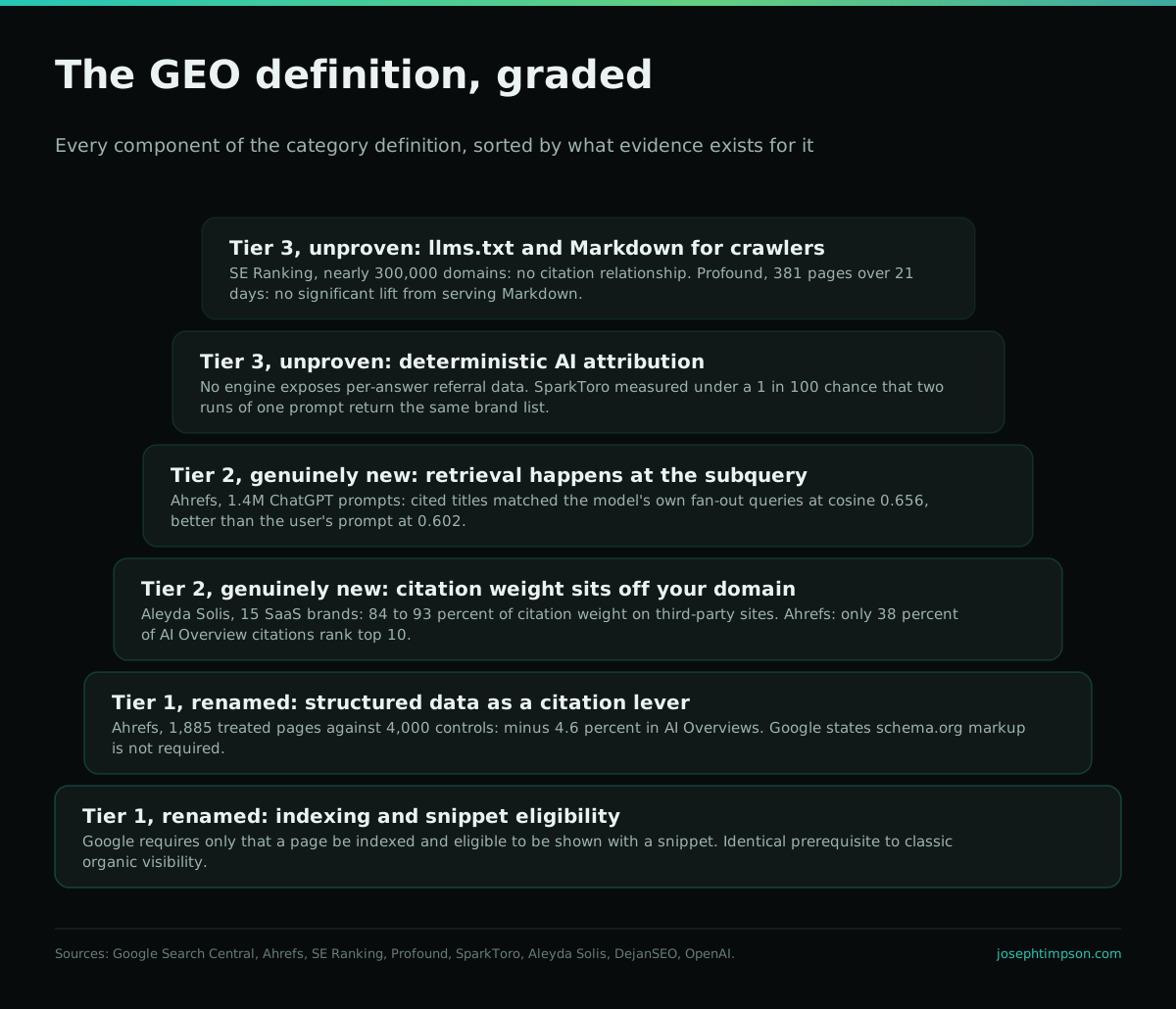
Being indexed and snippet eligible. Google's AI features documentation states the entry condition without hedging: a page must be indexed and eligible to be shown in Google Search with a snippet. That is the crawl, index and serve prerequisite that has governed organic visibility for a quarter century. A stray nosnippet directive zeroes out AI eligibility. Nothing about the mechanism changed. Grade: renamed.
Structured data as a citation lever. This is the most expensive rename in the category. Ahrefs tracked 1,885 pages that added JSON-LD against 4,000 matched control pages and measured minus 4.6 percent in AI Overviews, with the AI Mode and ChatGPT effects statistically indistinguishable from zero. Google's own guide says structured data is not required and there is no special schema.org markup to add.
Adding schema produced no major uplift in citations on any platform.
Schema still earns its keep for rich results and entity disambiguation. It does not earn the line item it is currently sold as. The study's real limits, including the one that should stop you overclaiming the null result, are in the schema question. Grade: renamed, and mis-sold.
Keyword research becoming prompt research. The unit of analysis changed. The activity did not. You are still assembling a defensible set of queries you intend to be present for, still segmenting by intent, still deciding what you will not chase. Grade: renamed. The sampling design underneath it genuinely is new, and that part lands in tier two.
Content quality. Every tier one list eventually collapses into this one, and the coining paper is the best evidence for it. In Table 1, keyword stuffing scored 17.7 on Position-Adjusted Word Count against a 19.3 unoptimized baseline, meaning it scored below doing nothing at all.
While this technique has been widely used for Search Engine Optimization, we find such methods have little to no performance improvement on Generative Engine's responses.
The interesting thing about that finding is what it does to the category's own origin story. The paper everyone cites to prove GEO is new is also the paper that proves the oldest bad habit in search still does not work. I go deeper on what the research does and does not establish in the research audit.
Tier two: the components that are genuinely new
This is the shortest list in any honest version of this post, and it is the part worth paying for.
Retrieval happens at the subquery, not at your keyword. Google's guide defines query fan-out in its own words as "a set of concurrent, related queries generated by the model." Ahrefs analyzed 1.4 million ChatGPT prompts and found that cited URL titles matched the model's internally generated fan-out queries more closely (cosine 0.656) than they matched the user's actual prompt (0.602), while retrieved-but-not-cited URLs sat at 0.484. Surfer's 10,000-keyword study found 51.2 percent of organically ranking AI Overview citations rank for the main query and at least one fan-out, against 19.6 percent ranking for the main query alone. Grade: genuinely new. The mechanics are in the fan-out breakdown.
The unit of competition is a passage, not a page. DejanSEO tokenized 2,275 pages across 7,060 queries and found a fixed grounding budget of roughly 2,000 words per query across all sources combined, with each source's contribution plateauing near 540 words and coverage falling from 61 percent for sub-1,000-word pages to 13 percent for pages over 3,000 words. Grade: genuinely new, and it inverts a decade of long-form orthodoxy. How chunking works has the operational version.
Most of your citation weight is not on your domain. Aleyda Solis measured 84 to 93 percent of citation weight sitting on third-party properties across 15 SaaS brands. Ahrefs' March 2026 update found only 38 percent of AI Overview citations come from pages ranking in the top 10, down from roughly 76 percent in Ahrefs' own July 2025 measurement, which means anyone still quoting the 76 percent figure is quoting a number its own publisher has since replaced. Grade: genuinely new, and the most budget-relevant item on the whole map. See what the ranking overlap studies actually say and why mentions outrun links.
Access became a per-vendor decision. OpenAI documents four separate bots with different jobs and states plainly that sites opted out of OAI-SearchBot will not be shown in ChatGPT search answers. Anthropic documents three. Blocking "AI bots" is not one decision, it is roughly a dozen, and most sites made it by accident. Grade: genuinely new, cheapest lever available, and the one nobody audits. Start at the crawler access audit.
The output is non-deterministic, which makes measurement its own discipline.
There's a <1 in 100 chance that ChatGPT or Google's AI, if asked 100X, will give you the same list of brands in any two responses.
That came from 600 volunteers running 12 prompts 2,961 times. Grade: genuinely new. Nothing in classic search ever required you to design a sampling protocol before you were allowed to report a number, and the fact that this is now a prerequisite is the single biggest practical difference in the job. Sample size for AI visibility is where that gets specific.
Tier three: the components nobody has evidence for
llms.txt. SE Ranking analyzed nearly 300,000 domains and found 10.13 percent adoption with no measurable relationship to citation, and their model actually improved when the feature was removed. Ahrefs found 97 percent of published llms.txt files received zero requests in May 2026. Google's guide states you do not need to create AI text files at all. This one has moved past unproven and into disconfirmed. The full teardown is here.
Markdown served to AI crawlers. Profound ran 381 pages, 189 control against 192 treatment, over 21 days and found no statistically significant increase in AI bot traffic. Grade: unproven, tested, failed.
Deterministic AI attribution. No engine exposes per-answer referral data, and the volatility above means a single observation is not evidence of anything. Anyone selling you a number that says an AI answer caused a sale is modeling, not measuring. What is honestly possible is covered in AI search attribution.
Guaranteed citation or a guaranteed share of voice. There is no first-party share-of-voice metric inside any engine. Every number you have seen is sampled, and the sample design is usually undisclosed. The gap between being cited and being recommended is itself measurable and rarely measured: Semrush and Growth Memo found 61.7 percent of AI citations never name the brand in the answer text at all, which is the subject of citations versus recommendations.
Here is how a tier three claim survives in the wild. The category's most quoted statistic is that AI prompts average 23 words against roughly 4 for a Google search. The a16z thesis attributes it to Semrush. Semrush's own page attributes the 23-word figure to its internal ChatGPT research and the 3.4-word Google figure to a Growth Memo post. So the headline contrast in the category's most influential document is a chained citation across two publishers, comparing a conversational chat interface against a search box. The number may well be right. It is not primary evidence, and it is carrying far more weight than its sourcing can hold.
## The acronym question is a pricing question AEO, GEO, LLMO, AIO, relevance engineering. The industry has produced five labels for one job in under three years, and the proliferation is a marketing artifact rather than a technical taxonomy.
See the method→Whether you label it AEO, GEO, or just next-gen SEO, the mission is the same, and we've been on this mission since day one.
That is from a vendor whose product sits squarely in the category, arguing the category's own naming does not matter. Take the concession seriously. My own position: I use GEO because it is the only one of the five with a citable primary source attached to it, not because it names a separate profession.
The sharpest version of the skeptical case belongs to Pedro Dias, who spent nearly six years on Google's Search Quality team and now writes at The Inference.
GEO isn't a second discipline standing alongside SEO. It's old retrieval visibility in a trench coat pretending to be two disciplines.
I think Dias is right about the mechanism and slightly understates the consequence. Retrieval is retrieval, and grounding is a search task. But tier two is not nothing. Subquery-level retrieval, passage-level competition, off-domain citation weight and a non-deterministic output are four changes to what a practitioner actually does on a Monday morning, and pretending otherwise is its own kind of denial. Jono Alderson lands closest to where I have ended up.
Visibility earns inclusion. Legibility determines what the market makes of you.
Four questions before you fund it
If you are the person who has to approve the budget, the definition matters less than the scope. Run the scope through the map.
- Which tier is the work in? If most line items are tier one, you are paying a second time for something already in your retainer.
- Can the engines fetch you at all? Access is tier two, costs almost nothing, and is skipped more often than any other item.
- What is the measurement design? Ask for the prompt count, the run count and the refresh cadence before you accept any percentage in a report.
- What is being promised: a citation, a brand mention, or revenue? Those are three different outcomes and only one of them pays.
- Who owns the off-domain work? If nobody is named, the 84 to 93 percent of citation weight sitting on third-party sites has no owner.
The scope document is where this becomes real or does not. I have written the operator version of that in the retainer scope of work.
What survives
The honest answer to "what is generative engine optimization" is that it denotes a real problem and oversells itself as a real profession. The problem is genuine: a synthesis layer now stands between your content and your reader, it retrieves at the subquery level, it grounds in passages, it draws most of its material from properties you do not own, and it returns a different answer every time you ask.
The oversell is also genuine. Roughly half the definition describes work that predates the layer entirely, and a meaningful slice of it describes artifacts that have been tested at scale and produced nothing.
My working rule: fund tier two, keep doing tier one because you were doing it anyway, and refuse to pay for tier three until somebody publishes a study. If you want the version of that arranged as a sequence rather than a taxonomy, it is the Cited Method. The rest of the evidence audits live in the insights index.
Frequently asked questions
What is generative engine optimization in one sentence?
Generative engine optimization is the practice of shaping content and off-site presence so AI systems retrieve, synthesize and cite it inside a generated answer. The term was coined in a 2023 academic paper that framed it as a black-box optimization framework rather than as a service category.
Is GEO real, or is it just a rebrand?
Both, in measurable proportions. Four components of the definition are genuinely new: subquery-level retrieval, passage-level grounding, off-domain citation weight, and non-deterministic output that forces a sampling protocol. Most of the rest describes indexing, snippet eligibility, structured data and content quality, all of which predate generative answers entirely.
What is the difference between AEO and GEO?
There is no agreed technical difference. Wikipedia's entry notes that as of early 2026 no consensus definition separating GEO, AEO, LLMO and AIO existed in the academic literature. Practitioners use them interchangeably, and vendors pick whichever label positions their product best.
Who invented the term generative engine optimization?
Pranjal Aggarwal, Vishvak Murahari, Tanmay Rajpurohit, Ashwin Kalyan, Karthik Narasimhan and Ameet Deshpande, in a paper first submitted in November 2023 and accepted to KDD 2024. The definition that circulates commercially came later, from an a16z newsletter piece published in May 2025.
Does schema markup help with generative engine optimization?
Not as a citation lever, on the best available evidence. Ahrefs measured 1,885 pages that added JSON-LD against 4,000 controls and found minus 4.6 percent in AI Overviews. Google's documentation separately states structured data is not required for generative AI search.
Does llms.txt do anything for AI visibility?
No published evidence says it does. SE Ranking found no citation relationship across nearly 300,000 domains, Ahrefs found 97 percent of llms.txt files received zero requests in May 2026, and Google's own guide states site owners do not need to create AI text files.
How do you measure generative engine optimization?
With a documented sampling protocol, because the output is unstable. SparkToro measured under a 1 in 100 chance that two runs of the same prompt return the same brand list. Any report without a stated prompt count, run count and refresh cadence is showing you noise.
Should a small business buy GEO as a separate service?
Only after grading the scope. If most line items are tier one work already covered by an existing retainer, you are paying twice. Fund crawler access, off-domain presence and a real measurement design, and refuse to pay for anything with no published evidence behind it.
Sources
- Aggarwal, Murahari, Rajpurohit, Kalyan, Narasimhan, Deshpande (KDD 2024). GEO: Generative Engine Optimization (2024-06)
- Google Search Central. Optimizing your website for generative AI features on Google Search (2026-07)
- Google Search Central. AI Features and Your Website (2025-12)
- Wikipedia. Generative engine optimization (2026-07)
- Andreessen Horowitz (Zach Cohen and Seema Amble). How Generative Engine Optimization (GEO) Rewrites the Rules of Search (2025-05)
- The Inference (Pedro Dias). GEO Was Invented on Sand Hill Road (2026-04)
- Jono Alderson. SEO vs GEO is the wrong question (2026-07)
- Profound (Nick Lafferty). AEO vs. GEO: Why they're the same thing (and why we prefer AEO) (2025-06)
- Ahrefs (Louise Linehan and Xibeijia Guan). Does Schema Markup Help AI Citations? We Studied 1,885 Pages (2026-05)
- SE Ranking (Yulia Deda). LLMs.txt study across nearly 300,000 domains (2025-11)
- Ahrefs (Louise Linehan). 97% of llms.txt files are never read (2026-06)
- Ahrefs (Louise Linehan). Only 38% of AI Overview citations rank in the top 10 (2026-03)
- Ahrefs. Why ChatGPT cites the pages it cites (1.4M prompts) (2026-04)
- Surfer (Joshua Hardwick). The impact of query fan-out on AI Overview citations (2025-12)
- DejanSEO (Dan Petrovic). How big are Google's grounding chunks? (2025-12)
- Aleyda Solis. SaaS AI search optimization: where citation weight sits (2026-07)
- SparkToro (Rand Fishkin with Gumshoe.ai). AIs are highly inconsistent when recommending brands or products (2026-01)
- Profound (Brandon Punturo). Does serving Markdown increase AI bot traffic? (2026-02)
- Semrush with Growth Memo (Kevin Indig). The Ghost Citations Study (2026-06)
- OpenAI. OpenAI bots documentation (2026-07)
- Anthropic. Does Anthropic crawl data from the web, and how can site owners block the crawler? (2026-07)
- Semrush (Carlos Silva). Feeling behind on AI search? How to catch up in 2026 (2025-12)
Joseph Timpson has worked in search since 2010 and runs Timpson Marketing out of St. George, Utah. He built The Cited Method, a five stage framework for earning and proving real citations in AI answers, and publishes what does not work alongside what does.
Want me to run this on your site and show you the before and after?
One call, no pitch deck. We look at what is actually blocking you and tell you the truth about whether we can help.
Book a free consultation →